
How to Grow Hydrangea: Complete Guide
- •Hydrangea is a genus of deciduous shrubs and climbing vines in the family Hydrangeaceae, native to North and South America, eastern Asia, and Malesia.
- •The genus name comes from the Greek hydor (water) and aggeion (vessel), a reference to the cup-shaped seed capsule that gives the plant its botanical identity.
- •Most garden hydrangeas are multi-stemmed rounded shrubs three to ten feet tall, while the climbing species climbs thirty to fifty feet by means of aerial rootlets.
- •Flower heads are made of showy sterile florets mixed with tiny fertile flowers, arranged as round mopheads, flat lacecaps, or conical panicles in white, cream, green, pink, red, blue, or purple.
- •In bigleaf and mountain hydrangeas, blue and pink color is not fixed by the cultivar alone: it depends on how much aluminum the roots can take up from the soil, which in turn is controlled by soil acidity.
- •The most widely planted species are bigleaf hydrangea (Hydrangea macrophylla), oakleaf hydrangea (H. quercifolia), panicle hydrangea (H.
- •paniculata), smooth hydrangea (H. arborescens, including the popular 'Annabelle'), and climbing hydrangea (H. anomala subsp. petiolaris).
- •Reblooming series such as Endless Summer flower on both old and new wood and have made repeat bloom possible in colder gardens.
- •Hydrangeas serve as foundation plants, mixed-border shrubs, informal hedges, woodland understory plants, accent specimens, and container subjects, and their long-lasting heads are equally valued for fresh bouquets and dried arrangements.
- •The single most important care decision is pruning: timing depends on whether the species flowers on the previous year's stems (old wood) or on the current season's growth (new wood), and cutting at the wrong moment can remove a full season of bloom.
- •All parts of the plant contain cyanogenic glycosides and are considered toxic to cats, dogs, and horses by the ASPCA.
- •This hydrangea care guide covers site selection, planting, watering and feeding, pruning by flowering group, and the soil chemistry behind blue and pink flower color.
📋 Quick Facts
- •Light needs differ by species, and matching the shrub to the site is the easiest way to avoid sparse bloom and scorched foliage. Bigleaf hydrangea (H.
- •macrophylla) performs best in dappled sunlight or partial shade, with morning sun and protection from hot afternoon sun; NC State Extension notes that it tolerates dappled shade and deep shade but flowers more generously where it receives four to six hours of gentle morning light.
- •In warm southern climates, an east-facing foundation or a high-canopied woodland edge is ideal; western exposure causes leaf wilt and burn in summer heat.
- •Panicle hydrangea (H.
- •paniculata) is the most sun-tolerant species: NC State Extension describes it as more tolerant of full sun than other hydrangeas, preferring morning sun and afternoon shade but thriving in open sunny borders as long as soil moisture stays consistent.
- •Smooth hydrangea (H.
- •arborescens, including 'Annabelle') blooms in part shade and tolerates full sun only where roots receive steady moisture; it declines quickly in dry ground.
- •Oakleaf hydrangea (H.
- •quercifolia) grows in full sun to part shade and still needs some direct sun to set flower buds, though it holds up better than bigleaf in woodland shade.
- •Climbing hydrangea (H.
- •anomala subsp.
- •petiolaris) is the shade-tolerant option, flowering on north- and east-facing walls and under tree canopies, although bloom is heaviest with a few hours of light.
- •Across all species, deep dense shade under large trees produces weak stems, open centers, and few flowers; drought stress compounds the problem by causing sudden wilting and leaf scorch in whatever sun the plant receives.
- •Plant so the mature shrub fits the exposure naturally rather than relying on transplanting later to fix a mismatched location.
- •Hydrangeas are shallow-rooted plants that need steady, even moisture through the growing season; the genus name's water reference reflects both the cup-shaped fruit capsule and the plant's fondness for consistent moisture.
- •Water established shrubs with about one inch of water per week (roughly 2.5 centimeters), supplied in deep soakings rather than frequent light sprinkles, and increase that amount during heat waves, dry spells, windy weather, or on sandy soil that drains fast.
- •Direct water onto the root zone at the base of the shrub; avoid overhead sprinklers that wet foliage for long periods, because damp leaves encourage powdery mildew and leaf spot.
- •A two-to-three-inch layer of organic mulch such as shredded bark, pine needles, leaf mold, or compost spread over the root zone keeps the soil cool, cuts evaporation by half, and feeds the soil as it breaks down; keep the mulch two to three inches away from the main stems so bark does not stay damp and rot.
- •Drought-stressed hydrangeas wilt dramatically on hot afternoons, sometimes recovering after sunset, but repeated wilting weakens the plant, scorches leaf edges, and reduces bloom; check the soil two to three inches below the surface before watering, and soak when that depth begins to dry.
- •Equally important, hydrangeas suffer in waterlogged soil: standing water around the crown cuts off root oxygen and invites root rot, so improve heavy clay before planting rather than relying on frequent drainage checks afterward.
- •Newly planted shrubs need regular hand watering for their first full season while roots spread outward; trees and large shrubs nearby compete hard for soil moisture, so a hydrangea under a mature canopy often needs supplemental watering even in an apparently moist woodland.
- •Container hydrangeas dry out within a day or two in summer heat and should be checked daily; pots on pot feet drain freely and never sit in a saucer of standing water.
- •Winter hardiness varies strongly by species, so match the hydrangea to your USDA zone rather than choosing a flower head first.
- •Panicle and smooth hydrangeas are the cold-hardiest, thriving in zones 3 to 8 or 3 to 9; bigleaf hydrangea is generally hardy in zones 5 to 9, oakleaf in zones 5 to 9, and climbing hydrangea in zones 4 to 8.
- •The critical temperature risk for bigleaf, oakleaf, and climbing types is not usually plant death but flower-bud loss: these shrubs bloom on old wood, meaning the buds for this year's flowers were formed on last summer's stems, and a harsh winter or a late spring frost can kill those buds while the stems survive.
- •In colder parts of bigleaf's range, leave the dried flower heads over winter to insulate the buds below them, and mound compost, leaves, or mulch over the crown after the ground freezes; remove the winter cover gradually in spring after frost danger passes.
- •Choose a sheltered position away from cold north walls and frost pockets, where cold air settles around dormant stems.
- •Heat stress matters at the other end of the scale: bigleaf hydrangea struggles in the deepest South unless it receives afternoon shade and enough water to prevent wilt, while panicle types accept warm summer sun more readily.
- •Late spring frost can also nip the new growth of reblooming and new-wood types, but these compensate by flowering later on stems produced after the frost.
- •In all zones, stop applying nitrogen fertilizer by mid to late summer so soft late growth hardens off before cold weather.
- •Hydrangeas thrive in rich, moist but well-drained soil high in organic matter, with a general pH of about 6.0 to 6.5.
- •They tolerate clay and sandy ground better than many shrubs, provided both are improved before planting: heavy clay should be loosened with compost, coarse bark, and aged manure to open drainage, while fast-draining sand needs organic matter to hold water and nutrients.
- •Organic mulch renewed each spring keeps the soil loose and cool and buffers pH swings over time. Color change (blue and pink flowers).
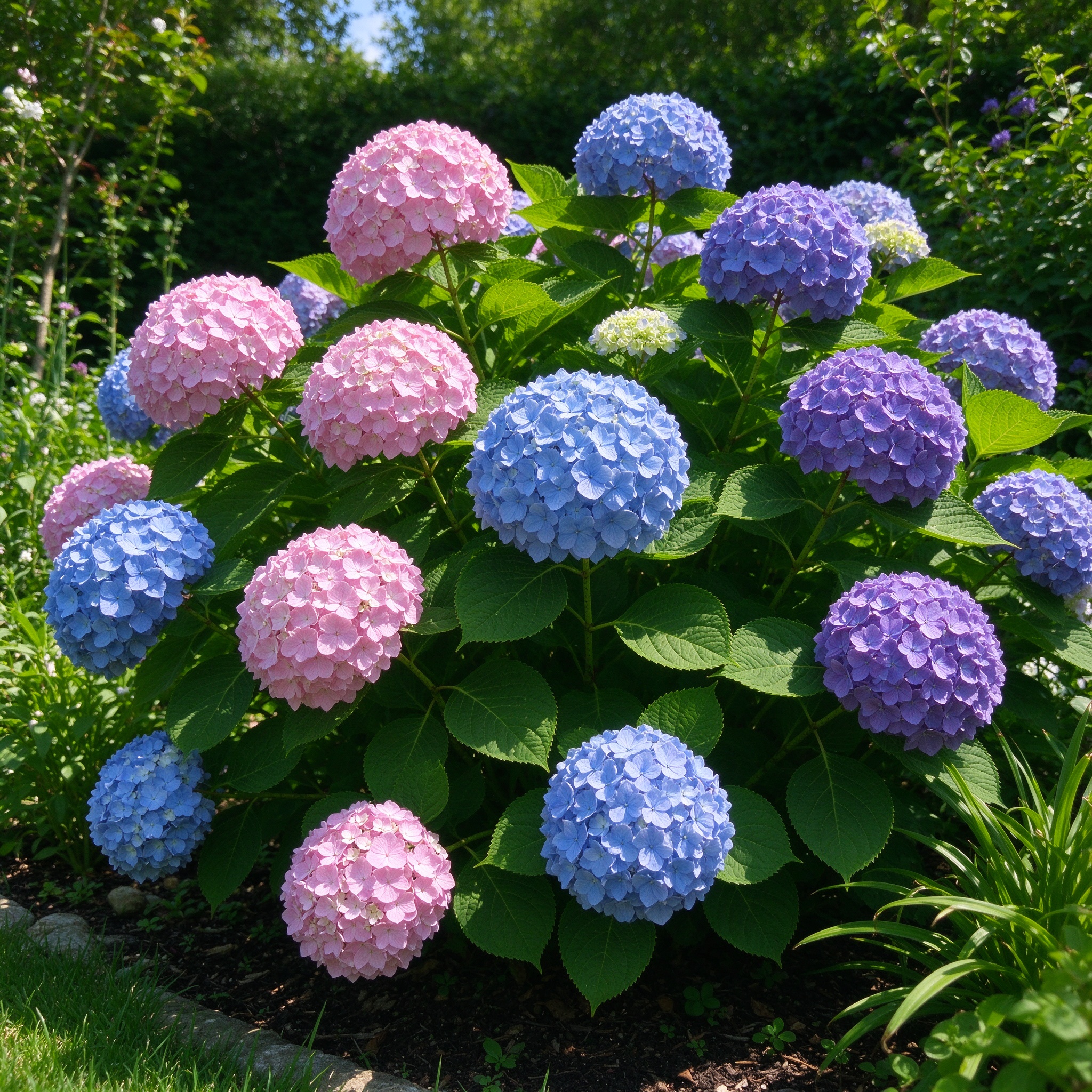
- •On bigleaf and mountain hydrangeas, flower color depends on two factors acting together: soil pH and the availability of soluble aluminum in the root zone.
- •When soil is acidic, roughly below pH 5.5 to 6.0, aluminum in the soil stays soluble and the roots absorb it; aluminum complexes with the blue anthocyanin pigment in the florets and the head opens blue or deep violet.
- •When soil is neutral to alkaline, above pH 6.5 to 7.0, aluminum forms insoluble compounds the plant cannot take up, and the head opens pink or rose.
- •In between, aluminum uptake is partial and flowers turn mauve, lavender, or purple.
- •Aluminum matters more than acidity alone: in a soil that naturally contains no available aluminum, even an acidic bed will not produce blue flowers.
- •Panicle, smooth, oakleaf, and most white-flowered hydrangeas do not shift color with pH, and UF/IFAS notes specifically that soil pH does not affect the color of panicle hydrangeas; white and genetically fixed pink or blue cultivars also keep their own color.
- •Practical blueing: test the soil first and start several months ahead, because UF/IFAS reports it may take two or three blooming cycles before flowers reach the desired color and intensity.
- •Apply aluminum sulfate around the drip line at label strength to acidify the soil and supply aluminum; use elemental sulfur for a gradual pH drop over months rather than a sudden chemical swing.
- •Choose a low-phosphorus, acid-loving shrub fertilizer, because abundant phosphorus ties aluminum up in the soil and prevents blueing.
- •To push flowers pink, raise the pH above 6.5 with garden lime and use a balanced fertilizer; alkaline ground naturally keeps flowers pink.
- •Container plants give the cleanest control because the soilless mix can be adjusted independently of the yard soil.
- •Never over-apply aluminum sulfate: overdoses burn roots and foliage and can stunt the shrub, and chasing an instant blue on an established, deeply rooted plant usually fails.
- •For fresh cut flowers, harvest hydrangea stems early in the morning, before the midday heat lifts moisture from the heads, when most sterile florets have opened fully but the florets are still firm rather than floppy.
- •Choose stems with two or three sets of healthy leaves and a head that shows its mature color; young, tight heads do not open well after cutting.
- •Strip all foliage that would sit below the vase water line, recut the stem at a sharp angle under clean water, and place the stem immediately in lukewarm water.
- •Fresh hydrangea heads last seven to ten days in a cool room away from direct sun and heating vents; change the water daily and recut the stems as needed.
- •Many bigleaf heads wilt quickly in a vase; dipping the cut end in boiling water for ten to thirty seconds and then moving it to cool water can rehydrate a drooping head.
- •For dried flowers, leave the heads on the shrub until late summer or fall, when the florets turn slightly papery and the colors have matured; cut the stem, strip the leaves, and hang the head upside down in a cool, dark, well-ventilated space for two to four weeks until petals and stems feel dry to the touch.
- •Panicle, oakleaf, and bigleaf heads all dry well and keep shades of cream, green, pink, tan, and mauve through winter arrangements.
- •During the growing season, remove faded heads as needed to keep the shrub tidy, but stop cutting flowers and hard deadheading four to six weeks before your average first frost so any late new growth can harden off.
- •Leave mature dried heads on old-wood bloomers through winter: they shield tender next-year buds from frost and add months of outdoor interest.
- •Most common problems trace to four causes: wrong pruning timing on old-wood types (lost bloom), too much shade (few flowers, spindly stems), drought or waterlogging (wilting, root rot), and high nitrogen (leaves at the expense of flowers).
- •Watch for powdery mildew on crowded shaded foliage, Cercospora leaf spot in wet weather, bacterial wilt and bud blight on stressed shrubs, and root rot in poorly drained soil; insect pests include aphids on tender shoots, spider mites in hot dry weather, scale on woody stems, and nematodes in sandy ground.
- •Deer browse young shoots and flower heads readily where pressure is high, and alkaline soil can trigger leaf chlorosis on acid-loving species.
- •Detailed identification and controls appear in the pest and disease sections below.
⚠️ Pet Safety Warning
This plant is toxic to both cats and dogs.
- •Per the ASPCA Animal Poison Control entry for Hydrangea, the plant is toxic to dogs, cats, and horses; the toxic principle is a cyanogenic glycoside found in the buds, flowers, leaves, and stems.
- •Reported clinical signs are vomiting, depression, and diarrhea; true cyanide intoxication is rare and ingestion more often produces a gastrointestinal disturbance than severe cyanide poisoning, but a pet that chews large quantities should be checked by a veterinarian promptly.
- •NC State Extension additionally notes that H.
- •macrophylla in particular is toxic to humans only if large quantities are eaten, causing nausea, stomach pain, vomiting, and sweating.
- •Keep curious cats and dogs from nibbling stems and fallen blooms, and place cut arrangements out of reach.
- •For non-toxic flower and foliage alternatives, see our cat-safe plant list at /cat-safe.
📅 When to Plant
- •Plant bare-root hydrangeas during the dormant season, from late winter to early spring before buds swell and break, when the soil can be worked and danger of hard frost has mostly passed.
- •Container-grown shrubs can be planted in spring after the last average frost date, or in early autumn six weeks before the average first frost in cold zones, so roots establish before winter dormancy.
- •Avoid planting in the heat of summer, in frozen ground, or in a bed that stays soggy after rain; transplanting stress, drought, and waterlogging all slow establishment.
- •Prepare the bed ahead of planting: work the soil to a depth of twelve to eighteen inches over a two- to three-foot-wide area, mixing in aged compost, leaf mold, or well-rotted manure to raise organic matter and improve both drainage and moisture retention.
- •If you are preparing a mixed shrub border or a bed along the house, our guide on starting a vegetable garden at /how-to-start-a-vegetable-garden covers the same bed-size, compost, and drainage basics that apply to any flowering shrub.
- •Set the root ball at exactly the depth it grew in the nursery pot; do not bury the root crown or graft union, and do not plant the shrub higher than it stood before.
- •Space plants according to their mature width, usually three to six feet for bigleaf and smooth types, six to eight feet for oakleaf and large panicle types, and closer for low hedges.
- •Hydrangeas sold indoors as late-winter gift plants should be hardened off outside for a week or two before being planted in the garden, and never moved directly from a warm room into cold outdoor soil.
- •In the Deep South, favor morning sun and afternoon shade sites for bigleaf types; in the North, choose the warmest, most sheltered available position for species that bloom on old wood.
- •After planting, water thoroughly to settle the soil and eliminate air pockets around the roots, and renew a two-to-three-inch organic mulch layer over the root zone without piling it against the stems.
🌱 Growing Stages
- 1
Winter dormancy
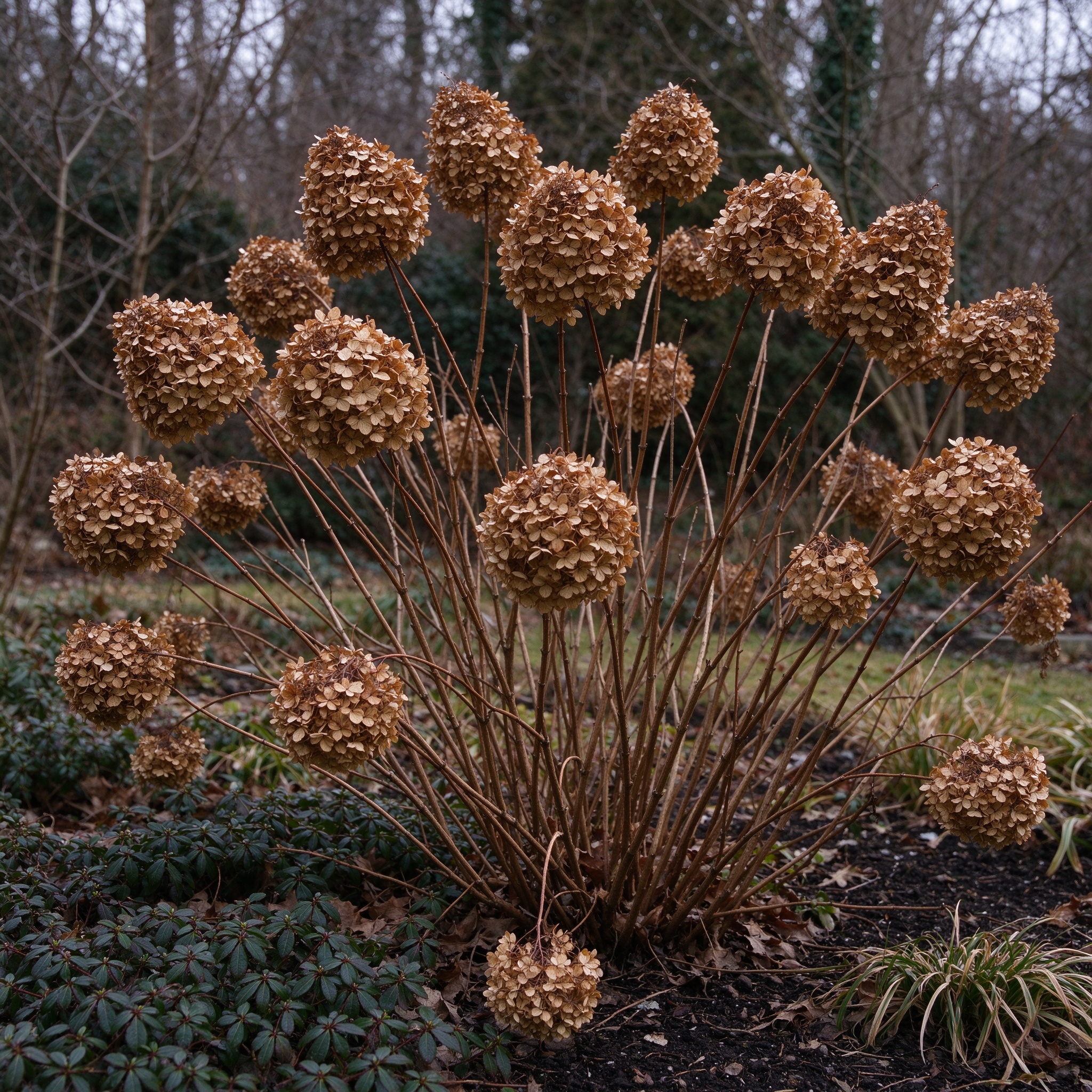
(Late fall through early spring)- •Deciduous hydrangeas drop their leaves and rest as woody stems over a root system storing carbohydrates for spring.
- •Old-wood species carry this year's flower buds on the stems from last summer; protect those buds with retained dried heads and a crown mulch in cold zones.
- •Do not prune old-wood types during winter, and do not apply fertilizer to dormant soil.
 2
Spring bud break and old-wood bloom
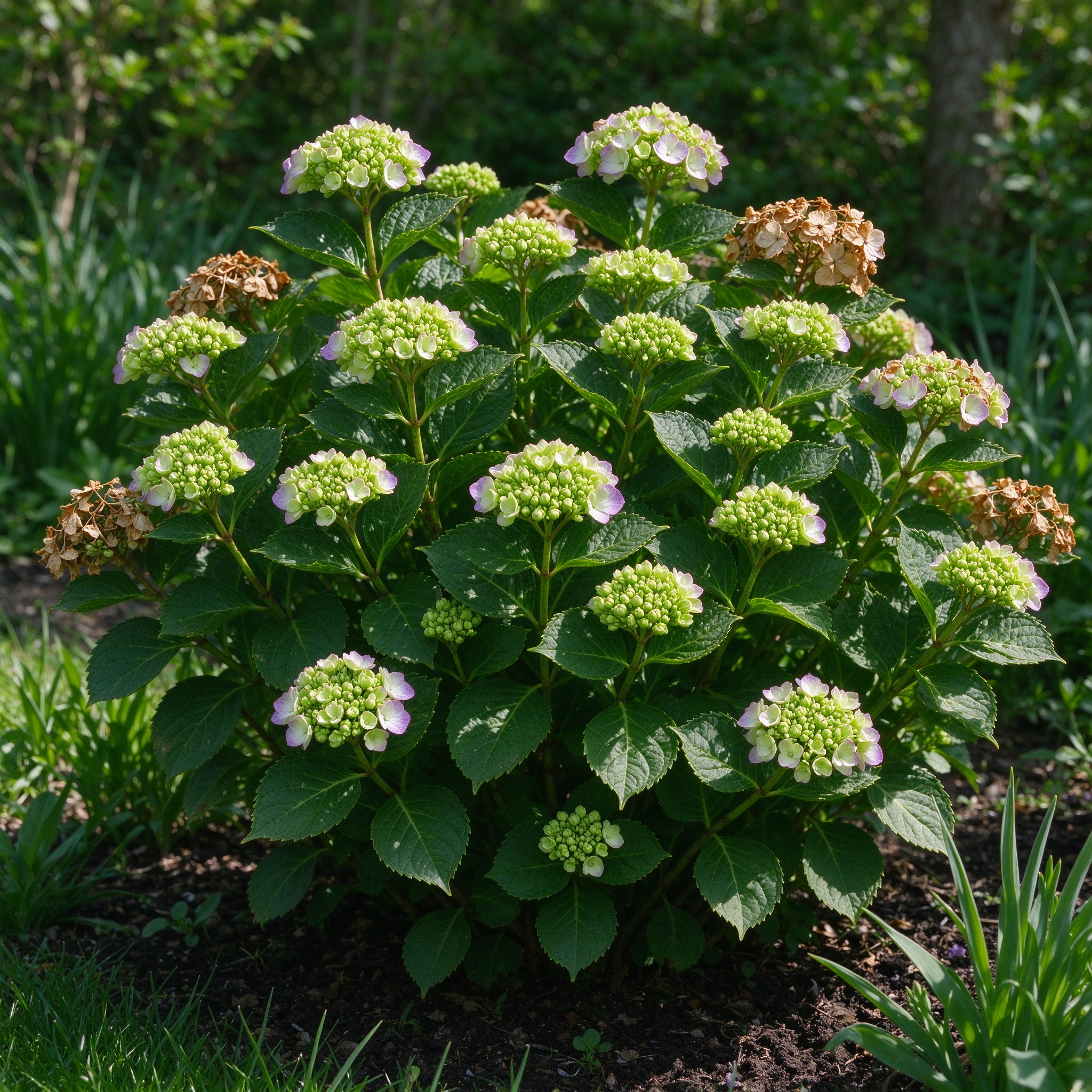
(April to June, depending on zone)- •Buds swell and break as soil warms; foliage expands on both old and new stems.
- •Bigleaf, oakleaf, and climbing hydrangeas open their first flowers on stems formed the previous year, usually late spring into early summer.
- •Watch for late frost: a cold snap after buds expand can blacken tender growth and kill old-wood flower heads.
- •Remove winter-damaged stems after frost danger passes, and water through the first dry spring weeks.
 3
Summer growth and repeat bloom
(June through August)- •The current season's stems lengthen and leaf out in full heat.
- •Panicle and smooth hydrangeas open their summer flower heads on this new growth, and remontant cultivars send a second flush from stems produced after the first bloom.
- •Keep soil evenly moist, renew mulch as needed, and apply the light early-summer feed to established repeat bloomers.
- •Control aphids and mites before populations build on tender shoots.
 4
Fall color and seed maturation
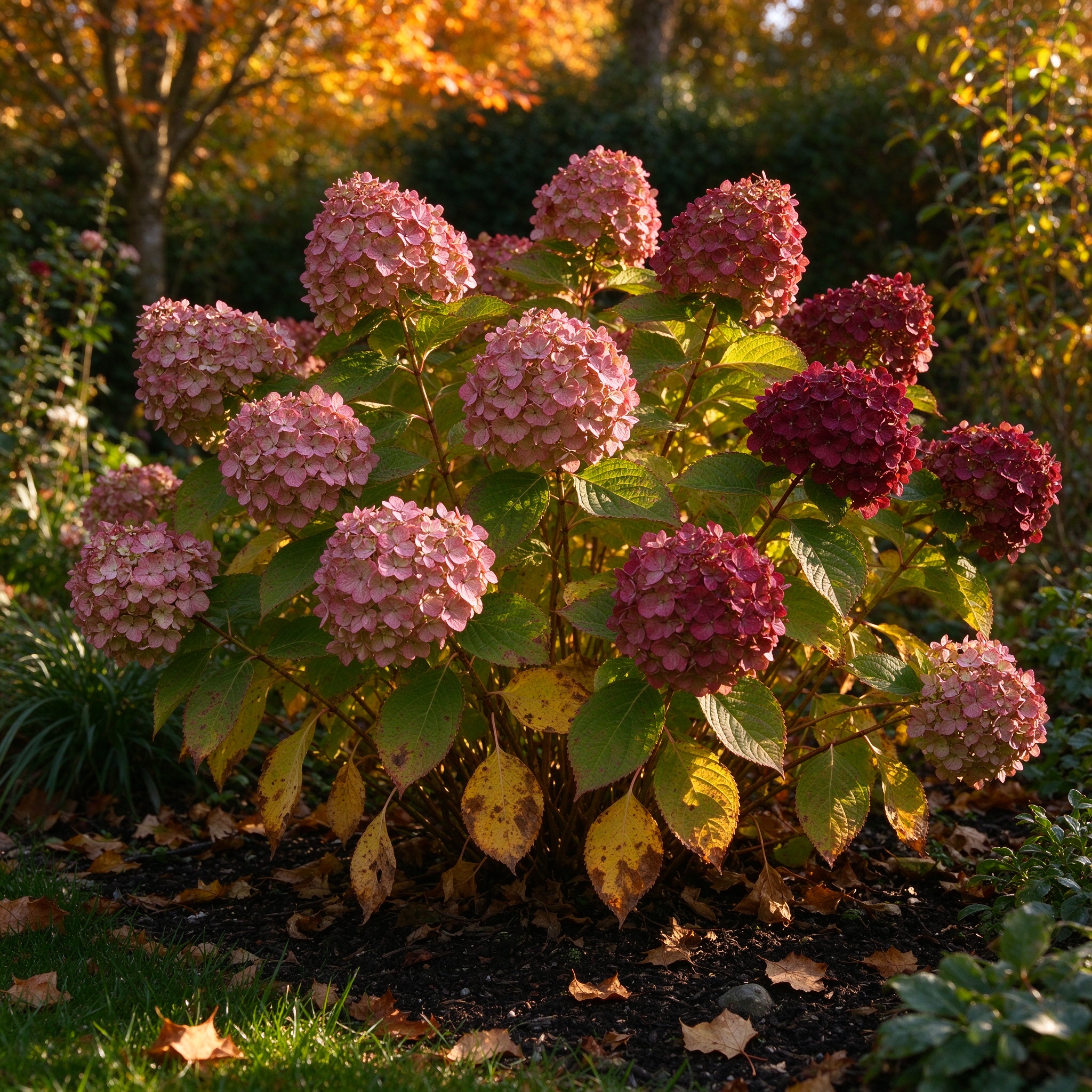
(September to November)- •Panicle and oakleaf heads age through pink, rose, and tan; bigleaf heads fade to green, mauve, or dusty rose before drying on the stems.
- •Oakleaf foliage turns wine red and mahogany, and smooth hydrangea leaves turn yellow.
- •Stop nitrogen feeding by late summer, let stems harden off, and leave mature heads on the shrub for winter interest and bud protection rather than deadheading the whole plant clean.
- 5
Winter preparation and pruning window
(Late fall to late winter)- •Leaves drop and the shrub enters dormancy.
- •New-wood panicle and smooth hydrangeas wait for their pruning window: late winter or early spring before buds swell, when the framework can be cut back safely because flowers will come on new stems.
- •Renew crown mulch after the ground freezes for old-wood species, and keep fallen foliage cleared from the base to reduce overwintering disease spores.
💧 Detailed Care Guide
☀️ Light Requirements
- •Light needs differ by species, and matching the shrub to the site is the easiest way to avoid sparse bloom and scorched foliage. Bigleaf hydrangea (H.
- •macrophylla) performs best in dappled sunlight or partial shade, with morning sun and protection from hot afternoon sun; NC State Extension notes that it tolerates dappled shade and deep shade but flowers more generously where it receives four to six hours of gentle morning light.
- •In warm southern climates, an east-facing foundation or a high-canopied woodland edge is ideal; western exposure causes leaf wilt and burn in summer heat.
- •Panicle hydrangea (H.
- •paniculata) is the most sun-tolerant species: NC State Extension describes it as more tolerant of full sun than other hydrangeas, preferring morning sun and afternoon shade but thriving in open sunny borders as long as soil moisture stays consistent.
- •Smooth hydrangea (H.
- •arborescens, including 'Annabelle') blooms in part shade and tolerates full sun only where roots receive steady moisture; it declines quickly in dry ground.
- •Oakleaf hydrangea (H.
- •quercifolia) grows in full sun to part shade and still needs some direct sun to set flower buds, though it holds up better than bigleaf in woodland shade.
- •Climbing hydrangea (H.
- •anomala subsp.
- •petiolaris) is the shade-tolerant option, flowering on north- and east-facing walls and under tree canopies, although bloom is heaviest with a few hours of light.
- •Across all species, deep dense shade under large trees produces weak stems, open centers, and few flowers; drought stress compounds the problem by causing sudden wilting and leaf scorch in whatever sun the plant receives.
- •Plant so the mature shrub fits the exposure naturally rather than relying on transplanting later to fix a mismatched location.
💧 Watering
- •Hydrangeas are shallow-rooted plants that need steady, even moisture through the growing season; the genus name's water reference reflects both the cup-shaped fruit capsule and the plant's fondness for consistent moisture.
- •Water established shrubs with about one inch of water per week (roughly 2.5 centimeters), supplied in deep soakings rather than frequent light sprinkles, and increase that amount during heat waves, dry spells, windy weather, or on sandy soil that drains fast.
- •Direct water onto the root zone at the base of the shrub; avoid overhead sprinklers that wet foliage for long periods, because damp leaves encourage powdery mildew and leaf spot.
- •A two-to-three-inch layer of organic mulch such as shredded bark, pine needles, leaf mold, or compost spread over the root zone keeps the soil cool, cuts evaporation by half, and feeds the soil as it breaks down; keep the mulch two to three inches away from the main stems so bark does not stay damp and rot.
- •Drought-stressed hydrangeas wilt dramatically on hot afternoons, sometimes recovering after sunset, but repeated wilting weakens the plant, scorches leaf edges, and reduces bloom; check the soil two to three inches below the surface before watering, and soak when that depth begins to dry.
- •Equally important, hydrangeas suffer in waterlogged soil: standing water around the crown cuts off root oxygen and invites root rot, so improve heavy clay before planting rather than relying on frequent drainage checks afterward.
- •Newly planted shrubs need regular hand watering for their first full season while roots spread outward; trees and large shrubs nearby compete hard for soil moisture, so a hydrangea under a mature canopy often needs supplemental watering even in an apparently moist woodland.
- •Container hydrangeas dry out within a day or two in summer heat and should be checked daily; pots on pot feet drain freely and never sit in a saucer of standing water.
🌡️ Temperature
- •Winter hardiness varies strongly by species, so match the hydrangea to your USDA zone rather than choosing a flower head first.
- •Panicle and smooth hydrangeas are the cold-hardiest, thriving in zones 3 to 8 or 3 to 9; bigleaf hydrangea is generally hardy in zones 5 to 9, oakleaf in zones 5 to 9, and climbing hydrangea in zones 4 to 8.
- •The critical temperature risk for bigleaf, oakleaf, and climbing types is not usually plant death but flower-bud loss: these shrubs bloom on old wood, meaning the buds for this year's flowers were formed on last summer's stems, and a harsh winter or a late spring frost can kill those buds while the stems survive.
- •In colder parts of bigleaf's range, leave the dried flower heads over winter to insulate the buds below them, and mound compost, leaves, or mulch over the crown after the ground freezes; remove the winter cover gradually in spring after frost danger passes.
- •Choose a sheltered position away from cold north walls and frost pockets, where cold air settles around dormant stems.
- •Heat stress matters at the other end of the scale: bigleaf hydrangea struggles in the deepest South unless it receives afternoon shade and enough water to prevent wilt, while panicle types accept warm summer sun more readily.
- •Late spring frost can also nip the new growth of reblooming and new-wood types, but these compensate by flowering later on stems produced after the frost.
- •In all zones, stop applying nitrogen fertilizer by mid to late summer so soft late growth hardens off before cold weather.
🌱 Soil & Fertilizer
Soil:
- •Hydrangeas thrive in rich, moist but well-drained soil high in organic matter, with a general pH of about 6.0 to 6.5.
- •They tolerate clay and sandy ground better than many shrubs, provided both are improved before planting: heavy clay should be loosened with compost, coarse bark, and aged manure to open drainage, while fast-draining sand needs organic matter to hold water and nutrients.
- •Organic mulch renewed each spring keeps the soil loose and cool and buffers pH swings over time. Color change (blue and pink flowers).
- •On bigleaf and mountain hydrangeas, flower color depends on two factors acting together: soil pH and the availability of soluble aluminum in the root zone.
- •When soil is acidic, roughly below pH 5.5 to 6.0, aluminum in the soil stays soluble and the roots absorb it; aluminum complexes with the blue anthocyanin pigment in the florets and the head opens blue or deep violet.
- •When soil is neutral to alkaline, above pH 6.5 to 7.0, aluminum forms insoluble compounds the plant cannot take up, and the head opens pink or rose.
- •In between, aluminum uptake is partial and flowers turn mauve, lavender, or purple.
- •Aluminum matters more than acidity alone: in a soil that naturally contains no available aluminum, even an acidic bed will not produce blue flowers.
- •Panicle, smooth, oakleaf, and most white-flowered hydrangeas do not shift color with pH, and UF/IFAS notes specifically that soil pH does not affect the color of panicle hydrangeas; white and genetically fixed pink or blue cultivars also keep their own color.
- •Practical blueing: test the soil first and start several months ahead, because UF/IFAS reports it may take two or three blooming cycles before flowers reach the desired color and intensity.
- •Apply aluminum sulfate around the drip line at label strength to acidify the soil and supply aluminum; use elemental sulfur for a gradual pH drop over months rather than a sudden chemical swing.
- •Choose a low-phosphorus, acid-loving shrub fertilizer, because abundant phosphorus ties aluminum up in the soil and prevents blueing.
- •To push flowers pink, raise the pH above 6.5 with garden lime and use a balanced fertilizer; alkaline ground naturally keeps flowers pink.
- •Container plants give the cleanest control because the soilless mix can be adjusted independently of the yard soil.
- •Never over-apply aluminum sulfate: overdoses burn roots and foliage and can stunt the shrub, and chasing an instant blue on an established, deeply rooted plant usually fails.
Fertilizer:
- •Hydrangeas are light feeders; over-fertilizing produces soft, leafy growth that yields fewer flowers and is more easily damaged by frost and disease.
- •Apply a balanced shrub fertilizer such as 10-10-10 or a formulated 12-4-8 in early spring as buds begin to swell, spreading it evenly over the root zone at the label rate and watering it in thoroughly.
- •A second light application in early summer supports repeat blooming on remontant varieties, but stop all nitrogen feeding by mid or late July (by mid-August at the latest in warm zones) so new growth hardens off before frost.
- •High nitrogen lawn fertilizer blown or washed into a shrub bed is a common cause of leafy, flowerless hydrangeas: keep the mulch edge between turf and planting bed intact.
- •Annual compost or leaf mold spread as mulch supplies slow-release nutrients without the salt buildup that concentrated chemical fertilizers cause.
- •Gardeners targeting blue flowers should use a low-phosphorus acid-loving shrub food alongside the aluminum sulfate treatment described under soil type; phosphorus binds aluminum in the soil and defeats blueing, even when pH is correct.
- •For pink flowers in neutral to alkaline ground, a balanced general shrub food is enough; do not chase acidity on cultivars bred white or fixed pink.
- •Newly planted shrubs do not need fertilizer in their first season beyond the compost mixed into the backfill; feed established plants only.
- •Container hydrangeas receive a dilute balanced liquid feed every two to four weeks during active growth, with a plain water flush every month or two to wash accumulated fertilizer salts out of the pot.
- •Burned brown leaf edges, sudden wilt, and weak new shoots after feeding usually signal over-fertilization: leach the soil with repeated plain water and reduce the rate next season.
📝 Step-by-Step Planting Guide
- 1
Match the species to the site and hardiness zone
- •Confirm the species and its flowering habit before buying the shrub: bigleaf, oakleaf, and climbing hydrangeas bloom on old wood and need a sheltered microclimate in cold zones, while paniculata and arborescens bloom on new wood and tolerate zone 3 winters.
- •Check mature height and spread against the planting spot so the shrub will not crowd a path, window, or other planting later.
- 2
Test soil pH and amend the bed ahead of planting
- •Send a soil sample to the local extension service or use a home pH kit, especially if you intend to grow blue bigleaf flowers.
- •Work aged compost, leaf mold, or well-rotted manure into a twelve-to-eighteen-inch-deep bed over a two-to-three-foot-wide area; loosen heavy clay with coarse bark and open waterlogged spots with raised beds or berms.
- •Collect sulfur, aluminum sulfate, or lime before planting only if the test calls for it rather than applying amendments blindly after the shrub is in the ground.
- 3
Dig a hole twice the root ball width, at nursery depth
- •The planting hole should be roughly twice as wide as the root ball but no deeper than it, so the root crown sits at the original soil level.
- •Score the sides of the hole in compacted clay to let roots break outward, and roughen the bottom so roots do not circle in a smooth glass-lined cavity.
- •Stand the shrub in the hole to check that the soil line on the stem matches the surrounding ground before backfilling.
- 4
Prepare the root ball and position the shrub
- •If the root ball is dry, soak it in a bucket of water before planting.
- •Gently loosen circling or matted outer roots with fingers or a knife so they grow outward into the backfill.
- •Center the shrub in the hole, face its best side toward the viewing direction, and keep the trunk or main stems vertical; stake a tall standard or climbing vine only after it is planted, and tie loosely with a soft tie that does not girdle the bark.
- 5
Backfill with amended native soil and settle with water
- •Fill around the roots with the original soil mixed with compost, firming it gently by hand as you go to eliminate large air pockets.
- •Do not put fertilizer into the planting hole, where concentrated salts can burn fresh roots.
- •Water the backfill in stages: add a few inches of soil, soak, add more soil, soak again, until the hole is full and the root zone is evenly moist.
- 6
Mulch deeply and keep mulch away from stems
- •Spread a two-to-three-inch layer of shredded bark, pine needles, leaf mold, or compost over the entire root zone, extending beyond the mature drip line where roots will spread.
- •Leave a two-to-three-inch collar of bare soil around the main stems so mulch does not hold damp bark against the crown.
- •Reapply mulch each spring as the layer decomposes.
- 7
Establish the shrub and record its pruning group
- •Water the new planting regularly through its first full season, checking soil two to three inches deep before each soak.
- •Mark the species and its flowering habit (old wood, new wood, or remontant) on a plant tag or garden note so future pruning follows the correct schedule.
- •In cold zones, protect old-wood shrubs with a winter crown mulch after the ground freezes, and remove the cover gradually in spring after frost danger has passed.
🌱 Recommended Varieties
Bigleaf hydrangea, mopheads and lacecaps
- •The most classic garden hydrangea, H.
- •macrophylla grows three to six feet tall and wide in a rounded multi-stemmed bush, with large opposite serrated leaves.
- •This is the blue hydrangea most gardeners picture for shaded foundation beds.
- •Mophead cultivars produce dense round flower balls, while lacecaps carry a flat cluster of tiny fertile flowers ringed by showy sterile florets.
- •Bloom on old wood: the main flush arrives in late spring and summer on stems formed the previous year, so prune immediately after flowering and never shear the shrub back in fall or winter.
- •Flower color (except white cultivars) shifts blue in acidic, aluminum-rich soil and pink in alkaline soil.
- •Popular cultivars include the classic blue 'Nikko Blue', compact Cityline series for small spaces, and 'Penny Mac', which reblooms on both wood types.
- •This species is the natural 'hydrangea bush' of the landscape: a single rounded clump rather than a formal hedge or tree.
- •Site it in morning sun with afternoon shade, especially in southern gardens.
Oakleaf hydrangea
- •Native to the southeastern United States, H.
- •quercifolia forms an upright multi-stemmed shrub four to eight feet tall and four to ten feet wide, named for its deeply lobed, oak-shaped leathery leaves.
- •Creamy white pyramidal panicles six to twelve inches long open in late spring and summer, age to pink, then tan, and persist into fall.
- •The foliage turns wine red, orange, and mahogany in autumn, making oakleaf one of the few shrubs valued equally for flower and fall color; mature stems exfoliate to reveal cinnamon-colored bark that adds winter interest.
- •It blooms on old wood: prune only as needed immediately after flowering, and remove winter-damaged stems in early spring.
- •Oakleaf tolerates part shade and, once established, is more drought-tolerant than bigleaf types.
- •Popular cultivars include 'Snow Queen' with upright white panicles, 'Alice' at eight feet, 'Ruby Slippers' with compact rosy panicles, and dwarf 'Pee Wee' for small gardens.
- •Hardy in zones 5–9.
Panicle hydrangea
- •The cold-hardiest and most sun-loving landscape species, H.
- •paniculata grows eight to fifteen feet tall (the heirloom 'Grandiflora', known as PeeGee, can reach twenty-five feet) in a multi-stemmed shrub or trained small tree.
- •Conical creamy white panicles six to eight inches long open in summer on the current season's growth, then age to pink, rose, and tan brown as autumn approaches.
- •Because it flowers on new wood, panicle hydrangea can be cut back hard in late winter or early spring without losing bloom; this also produces larger flower heads on sturdier stems.
- •It tolerates full sun, pollution, and average soil, and benefits from a shallow-rooted shrub's layer of mulch.
- •Classic cultivars include 'Grandiflora' (PeeGee), 'Phantom' with large white panicles blushing pink in fall, and 'Pinky Winky' with two-tone white-and-rose cones.
- •Hardy in zones 3–8, this is the species traditionally trained into the single-trunk 'hydrangea tree' standard described in the pruning section.
- •Flower color is unaffected by soil pH.
Endless Summer series (reblooming hydrangea)
- •The Endless Summer brand series is a group of remontant (repeat-flowering) H.
- •macrophylla cultivars bred to bloom on both old and new wood; it is a marketing series rather than a separate species.
- •Early summer flowers open on overwintered old stems, and a second flush appears from mid-summer into fall on stems produced that same season.
- •This two-wood habit makes the series more forgiving after a harsh winter or an accidental hard prune: even if old buds are killed, new growth still flowers later.
- •Popular cultivars include 'The Original' with blue or pink mopheads, 'Bloomstruck' on reddish stems and leaf veins, 'Twist-N-Shout' as a compact reblooming lacecap, and 'Blushing Bride' in semi-double white that matures to blush pink or blue.
- •Flower color on blue and pink members still depends on soil pH and aluminum availability; white-flowered selections do not change color.
- •Grow in morning sun and afternoon shade like other bigleaf types, zones 5–9.
- •Prune lightly: remove dead wood and spent heads in spring, and deadhead after the first flush to encourage repeat bloom rather than cutting the shrub back hard.
Annabelle smooth hydrangea
- •A North American native species, H. arborescens grows three to six feet tall in a loosely branched rounded shrub, hardy in zones 3–9.
- •The classic cultivar 'Annabelle' carries enormous round white flower heads up to twelve inches across on arching stems; blooms arrive in summer on new wood, so an annual late-winter cutback to a low framework (or close to the ground) removes old stems, pushes vigorous fresh shoots, and keeps the heads large.
- •Part shade suits smooth hydrangea best; full sun is tolerated only with steady moisture, and the species is intolerant of drought, with foliage declining sharply in dry conditions.
- •Heavy rain can bend 'Annabelle' stems flat, so the sturdier Incrediball® selections are preferred where flopping is a recurring problem.
- •Flowers stay white and do not respond to soil pH; heads mature to green and then tan through winter.
- •Plant in a naturalized border, rain garden, or mixed shrub mass where its informal, branching habit reads as a loose hydrangea bush rather than a clipped hedge.
Limelight hydrangea (H. paniculata 'Limelight')
- •The Limelight hydrangea is the most widely planted H.
- •paniculata cultivar in modern gardens, forming a vigorous six-to-eight-foot shrub (or small standard tree) covered in conical panicles that open fresh lime green, mature to creamy white, and blush deep pink as nights cool in fall.
- •It flowers on new wood and tolerates hard annual pruning in late winter, which encourages the strongest stems and largest cones.
- •Full sun to part shade, average moist soil, and a renewed organic mulch layer keep it vigorous; its cold hardiness reaches zone 3 and its pollinator value and long vase life make it a favorite for hedges, specimen planting, and fresh or dried cut arrangements.
- •Color never shifts blue or pink with soil pH: the green, white, and pink phases come from aging of the florets themselves.
- •'Limelight' and its compact offspring sit alongside the species in the panicle pruning group, with late-winter rather than post-flowering maintenance.
Little Lime hydrangea and Bobo hydrangea (dwarf panicle selections)
- •These compact H.
- •paniculata selections bring panicle hydrangea flower power to small borders and large containers.
- •The Little Lime hydrangea is the dwarf sport of 'Limelight', reaching roughly three to five feet tall and wide with the same lime-green opening panicles that age to white and pink.
- •The Bobo hydrangea, BOBO® ('Ilvobo'), is even shorter: MBG records it at two to three feet tall and three to four feet wide, blooming June to August in zones 3–8 with white cones that blush pink in fall.
- •Both flower on new wood and are pruned in late winter like other panicle types; their tidy stature removes the need for heavy size-control cutting.
- •Use them in the front of a mixed border, along a walkway, in formal low hedges, or in large patio pots; mature width still governs spacing, and plants need consistent moisture in full sun.
- •Neither changes flower color with soil pH.
Climbing hydrangea
- •The climbing hydrangea is a deciduous woody vine native to Japan, Sakhalin, Korea, and Taiwan, reaching thirty to fifty feet up walls, arbors, and tree trunks by aerial rootlets that cling to rough surfaces.
- •Flat white lacecap flower clusters open in early summer on last year's stems, carrying a light fragrance; heart-shaped dark green leaves turn soft yellow in fall, and mature bark peels in strips for winter texture.
- •Hardy in zones 4–8, it tolerates north- and east-facing exposure and partial to full shade, flowering best with a few hours of morning or dappled light.
- •This species blooms on old wood: prune after flowering only to keep growth off windows, gutters, or rooflines, and never cut mature stems back hard in winter or spring.
- •Establishment is slow in the first two or three years, with little growth and few flowers before the root system settles; once established the vine is vigorous.
- •Provide a sturdy support on brick, stone, or timber, and avoid vinyl or smooth painted surfaces the rootlets cannot grip.
🪴 Growing in Containers
- Choose compact, container-suitable cultivars:
- •Dwarf and compact types are the only hydrangeas that stay attractive in pots long term: Little Lime and Bobo panicles, Cityline and 'Pia' bigleaf selections, and small reblooming cultivars suit three-to-five-gallon pots.
- •Full-size Grandiflora, large oakleaf, and vigorous climbing hydrangeas belong in the ground; their root systems outgrow any outdoor container within a season or two and become root-bound, stressed, and flowerless.
- Use a large pot with good drainage and an adjustable mix:
- •Choose a container at least twelve to sixteen inches wide and deep with several drainage holes, and set it on pot feet so water drains freely.
- •Use a porous soilless potting mix blended with compost rather than garden soil, which compacts in pots.
- •Because mix pH can be adjusted independently of the yard soil, containers are the most reliable way to grow blue bigleaf flowers; repot into a slightly larger pot every two to three years in spring, before active growth resumes.
- Maintain moisture, feed lightly, and shelter over winter:
- •Container hydrangeas dry out fast: check daily in summer and water when the top inch feels dry, but never leave the pot sitting in a saucer of standing water.
- •Feed with a dilute balanced liquid fertilizer every two to four weeks during growth, flushing salts with plain water monthly.
- •In zones below the shrub's hardiness, move pots to an unheated garage, cool porch, or sheltered courtyard for winter; an indoor room that stays warm through winter breaks dormancy improperly and weakens the plant.
- •Potted gift hydrangeas brought inside for bloom should be returned outdoors after frost danger passes rather than grown permanently as houseplants.
✂️ Pruning & Maintenance
- ✓
Old-wood bloomers (bigleaf, oakleaf, climbing): prune right after flowering
- •H.
- •macrophylla, H.
- •quercifolia, and climbing hydrangea set next year's flower buds on the stems that grew this summer.
- •Prune immediately after the flowers fade in late summer, and finish all major cutting before August 1, as NC State Extension specifies for bigleaf; this leaves the shrub time to produce and harden new growth that carries next season's buds.
- •Remove spent flower heads, dead or damaged stems, and branches that cross or crowd the center; thin out one or two of the oldest stems at the base each year to let young replacements fill the clump.
- •Consequence of getting the timing wrong: any cutting in fall, winter, or spring removes the overwintered buds and cancels the coming season of bloom.
- •In mild climates, RHS advises leaving the dried heads over winter as frost protection for the tender buds beneath and cutting stems back to the first or second strong healthy pair of buds below the faded bloom in mid-spring.
- •For climbing hydrangea, cut back only overlong stems that leave the support or reach windows and gutters after flowering; mature main stems are never removed.
- ✓
New-wood bloomers (paniculata, arborescens/Annabelle): prune late winter to early spring
- •H.
- •paniculata and H.
- •arborescens flower on stems produced during the current season, so there is no risk of losing bloom from winter or spring pruning.
- •In late winter or early spring, before buds swell and growth starts, cut last year's stems back to the lowest pair of healthy buds, building a low woody framework about ten inches (25 cm) high; if more height is wanted for a taller shrub or standard, cut to roughly two feet (60 cm).
- •RHS notes that regular annual pruning of last year's growth encourages more prolific and larger flowers, and neglected, overgrown plants respond well to this hard cutting back.
- •For 'Annabelle' smooth hydrangea, an annual cutback close to the ground removes floppy old stems and pushes vigorous fresh shoots that carry the season's round heads; sturdier Incrediball cultivars need only light thinning.
- •Always remove dead, diseased, and weak wood first, then shape the remaining framework.
- ✓
Remontant rebloomers (Endless Summer series): dual-wood light pruning
- •Reblooming bigleaf cultivars carry early-summer flowers on old wood and a second flush on new wood, so the pruning rhythm combines both schedules.
- •In early spring, remove dead wood, frost-killed stems, and faded overwintered heads, and thin one or two of the oldest stems at the base; do not shear the whole shrub hard back, because doing so removes the early-summer old-wood flowers.
- •After the first flush fades in summer, deadhead lightly to a strong outward-facing bud and let the shrub produce the second flush on current-season stems.
- •A harsh winter that kills old buds is not fatal: new stems still bloom later in summer.
- •Between seasons, keep a light hand — renewal thinning of old stems matters more than heading cuts, and the rounded bush shape should remain natural rather than ball-shaped.
- ✓
Tree-form standard (the hydrangea tree): single-leader training
- •The familiar lollipop-shaped 'hydrangea tree' is a trained standard, not a naturally small tree, and it should be produced only from paniculata cultivars such as 'Grandiflora', 'Limelight', 'Phantom', or Bobo, whose stiff upright stems hold a trunk.
- •In the first year choose one strong, straight leader as the permanent trunk and stake it to a sturdy support; let a small crown of foliage develop at the top while removing every side branch that grows along the lower trunk as it appears.
- •In the following two or three seasons, keep stripping new side shoots from the trunk, allow the crown to widen, and tie the leader loosely to the stake.
- •Once the standard reaches the desired height, prune the canopy each early spring back to the established framework and promptly remove any water sprouts or side shoots from the bare trunk; if side shoots are allowed to grow, the plant gradually reverts to a bush.
- •Do not attempt to standardize bigleaf, oakleaf, or Annabelle hydrangeas: their soft arching stems cannot hold an upright trunk, and repeated removal of side growth weakens the plant.
- ✓
Bush form (the hydrangea bush): renewal thinning over shearing
- •Most garden hydrangeas are naturally multi-stemmed clumps, and the bush form should be maintained through renewal pruning rather than mechanical shearing.
- •Each year, after bloom on old-wood types and in early spring on new-wood types, remove one or two of the thickest, oldest stems at ground level to make room for young, vigorous replacements; thin crowded center stems to open air and sunlight into the clump.
- •Never shear the entire shrub into a uniform ball: on old-wood types this removes flower buds across the whole plant, and on any species it produces dense weak foliage that crowds out blooms.
- •To reduce an oversized bush, cut selected tall stems to the ground or to a low side branch rather than heading every stem to the same height, so the rounded outline stays layered and natural.
- •Oakleaf and bigleaf shrubs keep their best rounded shape when young stems replace old ones continuously over a decade rather than being cut back all at once.
- ✓
Deadheading, winter cleanup, and tool hygiene
- •On new-wood panicle and smooth hydrangeas, spent heads can be removed at any time once flowers fade.
- •On old-wood bigleaf, oakleaf, and climbing types, leave the dried heads on through winter: RHS notes they shelter the tender buds below from frost damage.
- •In spring, cut old-wood stems back to the first or second strong healthy pair of buds below the faded head.
- •Clear fallen foliage from around the base in autumn to reduce overwintering leaf spot, powdery mildew, and bud blight spores.
- •Sanitize pruning tools between shrubs with rubbing alcohol or a 10% bleach solution, especially when moving from a plant showing wilt or leaf spot to a healthy one, and make clean cuts just above an outward-facing bud to direct new growth away from the center of the shrub.
🐛 Pest & Disease Control
Common Pests
Aphids
Symptoms: Dense green, pink, or black colonies cluster on tender new shoots, leaf buds, and young flower stalks, curling leaves and coating foliage with sticky honeydew that later grows sooty mold; distorted buds may fail to open properly.Control:- •Knock colonies off with a strong jet of water for two or three mornings, and encourage lady beetles, lacewings, and parasitic wasps that prey on aphids.
- •Heavy infestations respond to insecticidal soap or horticultural oil applied in cool weather; avoid high-nitrogen fertilizer that produces the soft shoot growth aphids prefer, and keep ant colonies off the shrub where they farm aphids.
Spider mites
Symptoms: Tiny mites feed on leaf undersides in hot, dry weather, leaving fine yellow stippling and pale bronzed patches on upper leaves; fine webbing may appear along stems and leaf joints as populations build.Control:- •Spray leaf undersides with water periodically to raise humidity around the foliage, and apply horticultural oil or insecticidal soap on a cool, still day, repeating as needed over several weeks to cover newly hatched mites.
- •Maintain mulch and steady moisture so the shrub does not become drought-stressed, and avoid broad-spectrum insecticides that kill mite predators.
Scale insects
Symptoms: Raised brown, gray, or white bumps adhere to woody stems and leaf veins, sucking sap and excreting honeydew; affected stems lose vigor, leaves yellow, and sooty mold covers surrounding foliage.Control:- •Scrape isolated colonies off stems by hand, or apply dormant horticultural oil in late winter before buds break to smother overwintering scales; active crawler stages in spring can be treated with horticultural oil or insecticidal soap.
- •Encourage parasitic wasps and lady beetles in the garden, and prune out heavily infested stems where practical.
Deer browsing
Symptoms: Deer strip young shoots, nibble flower buds and heads, and tear foliage by browsing at height; shrubs look ragged with broken stems and missing terminal growth, especially in winter and early spring when other forage is scarce.Control:- •NC State Extension lists hydrangeas as susceptible to deer damage.
- •Use a tall fence or individual shrub protection where pressure is high, apply deer repellents on a rotating schedule, and plant fragrant or thorny companion barriers along the garden edge.
- •Keep pruned stems and any accidental attractants away from the shrub line; replanting heavily browsed shoots in spring often restores the bush, though flower display suffers that year.
Common Diseases
Powdery mildew
Symptoms: A white to gray powdery coating spreads over leaf surfaces, young shoots, and bracts in humid, crowded shade; leaves curl, young growth distorts, and flower buds may open deformed when infection is heavy.Control:- •Plant in sites with good air movement, follow mature-width spacing, and water at the base rather than wetting foliage.
- •Rake and remove infected fallen leaves in fall, and thin crowded stems to open the center of the shrub.
- •Fungicides labeled for powdery mildew (neem oil, sulfur, or potassium bicarbonate) protect healthy leaves when applied on a schedule from spring leaf emergence; prevention matters more than curing already infected foliage.
Cercospora leaf spot
Symptoms: Small circular brown or purplish spots with grayish centers appear on lower older leaves during warm wet weather; spots coalesce, leaves yellow, and infected foliage drops early, weakening the shrub through the season.Control:- •Rake and destroy fallen infected leaves, which carry the fungus over winter, and avoid overhead irrigation that splashes spores onto new foliage.
- •Thin the shrub for air movement, and maintain mulch without contact with stems.
- •Fungicidal sprays protect healthy leaves on repeatedly infected plants; pick off spotted leaves during the season to slow spread.
Bacterial wilt and bud blight
Symptoms: Sudden wilting and brown flagging of individual stems appear during hot wet weather; flower buds turn brown and decay, stems may show dark streaking at the base, and a plant declines from one branch to the next without an obvious pest.Control:- •Stress predisposes hydrangeas to these diseases: maintain steady moisture, avoid compacted waterlogged soil, and do not over-fertilize.
- •Prune out and destroy affected stems with sanitized tools, cutting back to healthy wood.
- •Improve drainage around the crown, and remove diseased debris from the base; severely infected shrubs should be removed before the pathogen spreads to neighboring plants.
Root rot (Phytophthora and wet-soil decline)
Symptoms: Shrubs wilt despite wet soil, leaves yellow and drop from the lower plant, growth is weak and sparse, and roots appear brown, soft, and mushy rather than firm and pale; decline often follows a wet spring or a low-lying planting spot.Control:- •Prevention starts at planting: improve heavy clay, choose a well-drained site, and never bury the root crown.
- •Reduce watering to a moisture level the root zone can handle, and raise severely affected beds onto berms or raised planting mounds.
- •Fungicide drenches do not rescue rotted root systems; plants with extensive decline should be removed, and the bed replanted with a species suited to the wet conditions.
🍅 When to Harvest
- •For fresh cut flowers, harvest hydrangea stems early in the morning, before the midday heat lifts moisture from the heads, when most sterile florets have opened fully but the florets are still firm rather than floppy.
- •Choose stems with two or three sets of healthy leaves and a head that shows its mature color; young, tight heads do not open well after cutting.
- •Strip all foliage that would sit below the vase water line, recut the stem at a sharp angle under clean water, and place the stem immediately in lukewarm water.
- •Fresh hydrangea heads last seven to ten days in a cool room away from direct sun and heating vents; change the water daily and recut the stems as needed.
- •Many bigleaf heads wilt quickly in a vase; dipping the cut end in boiling water for ten to thirty seconds and then moving it to cool water can rehydrate a drooping head.
- •For dried flowers, leave the heads on the shrub until late summer or fall, when the florets turn slightly papery and the colors have matured; cut the stem, strip the leaves, and hang the head upside down in a cool, dark, well-ventilated space for two to four weeks until petals and stems feel dry to the touch.
- •Panicle, oakleaf, and bigleaf heads all dry well and keep shades of cream, green, pink, tan, and mauve through winter arrangements.
- •During the growing season, remove faded heads as needed to keep the shrub tidy, but stop cutting flowers and hard deadheading four to six weeks before your average first frost so any late new growth can harden off.
- •Leave mature dried heads on old-wood bloomers through winter: they shield tender next-year buds from frost and add months of outdoor interest.
❓ Frequently Asked Questions
- 1
How do I make hydrangeas blue?
- •Blue flowers grow on bigleaf and mountain hydrangeas only when two conditions are both met: acidic soil and available aluminum.
- •Test the soil first, then lower pH to about 5.5 or below and supply soluble aluminum by applying aluminum sulfate around the drip line at label strength; elemental sulfur drops pH gradually over months, and a low-phosphorus acid-loving shrub fertilizer keeps phosphorus from tying aluminum back up.
- •Start several months ahead, because UF/IFAS reports it can take two or three blooming cycles before flowers reach the desired blue and intensity.
- •Work the treatment into the soil surface rather than drenching foliage, and never over-apply aluminum sulfate: overdoses burn roots and leaves.
- •Container plants are the easiest target because the mix pH can be adjusted independently.
- •White hydrangeas, panicle hydrangeas, Annabelle, and oakleaf hydrangeas cannot be turned blue; pH does not affect their color, and genetically fixed pink or blue cultivars keep their own range.
- 2
When do I prune hydrangeas?
- •The correct month depends on which wood the species blooms on.
- •Old-wood types — bigleaf, oakleaf, and climbing hydrangea — flower on last year's stems, so prune immediately after bloom fades in late summer and finish before August 1; leave dried heads over winter as bud protection and tidy the shrub in mid-spring.
- •New-wood types — panicle and Annabelle smooth hydrangea — flower on current-season growth, so prune in late winter or early spring before buds swell, cutting stems to a low framework of healthy buds.
- •Reblooming Endless Summer types combine both: remove dead wood and spent heads in early spring, then deadhead after the first flush to encourage the second bloom.
- •Pruning an old-wood type in fall, winter, or spring removes next year's buds and costs an entire season of flowers.
- 3
Why is my hydrangea not blooming?
- •The most common cause on old-wood bigleaf, oakleaf, and climbing hydrangeas is pruning at the wrong time: cutting stems in fall, winter, or spring removes the buds that had formed on last summer's growth.
- •A harsh winter or a late spring frost can also kill old-wood buds while leaving the stems alive.
- •Other frequent causes are dense shade that starves the shrub of the light it needs to set buds, high-nitrogen fertilizer (including lawn fertilizer washed into the bed) that produces leaves instead of flowers, drought stress during bud formation, and planting a variety not hardy enough for your zone, whose flower buds are killed each winter.
- •New-wood panicle and Annabelle shrubs rarely fail to bloom; when they do, deep shade, waterlogged roots, or severe root competition are the likely causes.
- •Fix the pruning schedule first, then move the shrub to a brighter site if shade is the problem, switch to a balanced shrub food, and water steadily through summer.
- 4
Can hydrangeas grow in pots?
- •Yes, but only compact cultivars stay healthy in containers long term: Little Lime, Bobo, Cityline, 'Pia', and small reblooming varieties fit three-to-five-gallon pots, while full-size Grandiflora, large oakleaf, and vigorous climbing hydrangeas belong in the ground.
- •Use a pot at least twelve to sixteen inches wide and deep with drainage holes and pot feet, and a porous soilless mix with compost.
- •Water when the top inch dries, feed a dilute balanced liquid every two to four weeks during growth, and flush salts out monthly.
- •In cold zones, shelter the pot in an unheated garage or cool porch over winter rather than leaving exposed roots to freeze.
- •Pots make blue-flower control easier because the mix pH can be adjusted independently of yard soil.
- 5
Do hydrangeas like sun or shade?
- •It depends on the species.
- •Bigleaf hydrangea prefers morning sun and afternoon shade, thriving in dappled or partial shade and tolerating deep shade, though it flowers more generously with four to six hours of morning light.
- •Panicle hydrangea is the most sun-tolerant, accepting full sun in open borders as long as roots stay moist.
- •Smooth Annabelle prefers part shade and takes full sun only with steady water; oakleaf grows in full sun to part shade and needs some direct light to bloom well; climbing hydrangea tolerates shade, including north walls, but flowers best with a few hours of morning or dappled sun.
- •The worst site for any hydrangea is deep dense shade under a mature tree, where roots and shade both compete against bloom.
- 6
Why are my pink hydrangeas turning blue, and can I make them pink again?
- •Color drifts because soil acidity and aluminum availability change slowly over seasons, often after mulch additions, sulfur products, leaf litter, or neighboring conifer litter shift pH downward.
- •To stabilize pink flowers, raise soil pH above 6.5 by working garden lime into the root zone, use a balanced general shrub fertilizer rather than an acid product, and stop any aluminum sulfate applications; expect two or three blooming cycles before the shift reaches full pink.
- •White hydrangeas never turn pink or blue, and panicle, Annabelle, and oakleaf flowers change only with natural aging, not soil chemistry.
- •If the shrub sits in acidic aluminum-rich ground with no amendment, the blue direction will continue regardless of how many flowers are removed.
- 7
How do I grow a hydrangea tree (standard)?
- •The tree-form hydrangea is a trained standard produced from a stiff paniculata cultivar such as 'Grandiflora', 'Limelight', 'Phantom', or Bobo.
- •Pick one strong straight leader as the permanent trunk, stake it to a support, and remove side branches along the lower trunk as they appear while allowing the crown to grow at the top.
- •Over the next two or three years, keep stripping new shoots from the bare trunk and let the crown widen.
- •Once the standard reaches your desired height, prune the canopy each early spring back to the established framework and remove any water sprouts that grow on the trunk.
- •Bigleaf, oakleaf, and Annabelle stems are too soft and arching to hold a trunk and should not be trained as standards; skip side-shoot removal and the plant returns to a bush.
- 8
How often should I water hydrangeas?
- •Established shrubs need about one inch (2.5 cm) of water per week in deep soakings, more during heat waves, wind, or on sandy soil; check the soil two to three inches below the surface and soak when that layer begins to dry.
- •Water at the base and keep mulch two to three inches away from stems.
- •New plantings need regular watering through their first season, and container shrubs should be checked daily in summer.
- •Sudden wilting on a hot afternoon can mean either drought stress or root rot: dig gently to check soil moisture.
- •If the soil is dry, soak deeply; if it is waterlogged and roots feel soft and brown, stop watering, improve drainage, and treat the root rot described in the disease section.
- 9
Are hydrangeas poisonous to cats and dogs?
- •Yes.
- •The ASPCA lists Hydrangea as toxic to dogs, cats, and horses because the buds, flowers, leaves, and stems contain a cyanogenic glycoside.
- •Reported signs are vomiting, depression, and diarrhea; severe cyanide poisoning is rare and ingestion usually causes mostly gastrointestinal upset, but a pet that eats a meaningful quantity should be seen by a veterinarian promptly.
- •Keep cats and dogs from nibbling stems and fallen blooms, and place cut arrangements out of reach.
- •For non-toxic flowering alternatives that are safe around pets, browse the cat-safe plant list on our site at /cat-safe.
Source:
NC State Extension Gardener Plant Toolbox — Hydrangea (French hydrangea, genus page) — https://plants.ces.ncsu.edu/images/plants/hydrangea/common-name/french-hydrangea/
NC State Extension Gardener Plant Toolbox — Hydrangea macrophylla (bigleaf hydrangea) — https://plants.ces.ncsu.edu/images/plants/hydrangea-macrophylla/common-name/hortensia/
NC State Extension Gardener Plant Toolbox — Hydrangea paniculata (panicle hydrangea) — https://plants.ces.ncsu.edu/images/plants/hydrangea-paniculata/
NC State Extension Gardener Plant Toolbox — Hydrangea quercifolia (oakleaf hydrangea) — https://plants.ces.ncsu.edu/images/plants/hydrangea-quercifolia/
UF/IFAS Gardening Solutions — Hydrangeas — https://gardeningsolutions.ifas.ufl.edu/images/plants/ornamentals/hydrangeas/
Royal Horticultural Society — How to grow shrubby hydrangeas (Growing Guide) — https://www.rhs.org.uk/images/plants/hydrangea/shrubby/growing-guide
Missouri Botanical Garden Plant Finder — Hydrangea arborescens (smooth hydrangea) — https://plantfinder.mobot.org/PlantFinderDetails.aspx?kempercode=k520
Missouri Botanical Garden Plant Finder — Hydrangea anomala subsp. petiolaris (climbing hydrangea) — https://plantfinder.mobot.org/PlantFinderDetails.aspx?kempercode=d370
Missouri Botanical Garden Plant Finder — Hydrangea paniculata 'Ilvobo' BOBO® — https://plantfinder.mobot.org/PlantFinderDetails.aspx?basic=hydrangea&isprofile=0&taxonid=274259
ASPCA Animal Poison Control — Hydrangea (toxic and non-toxic plants) — https://www.aspca.org/pet-care/animal-poison-control/toxic-and-non-toxic-plants/hydrangea
Photo credit: NC State Extension
Images courtesy of NC State Extension under CC BY license. Thank you to the photographers who make these educational images available.
License: CC BY-NC 2.0 / CC BY 4.0