
How to Grow Lily of the Valley: Complete Guide
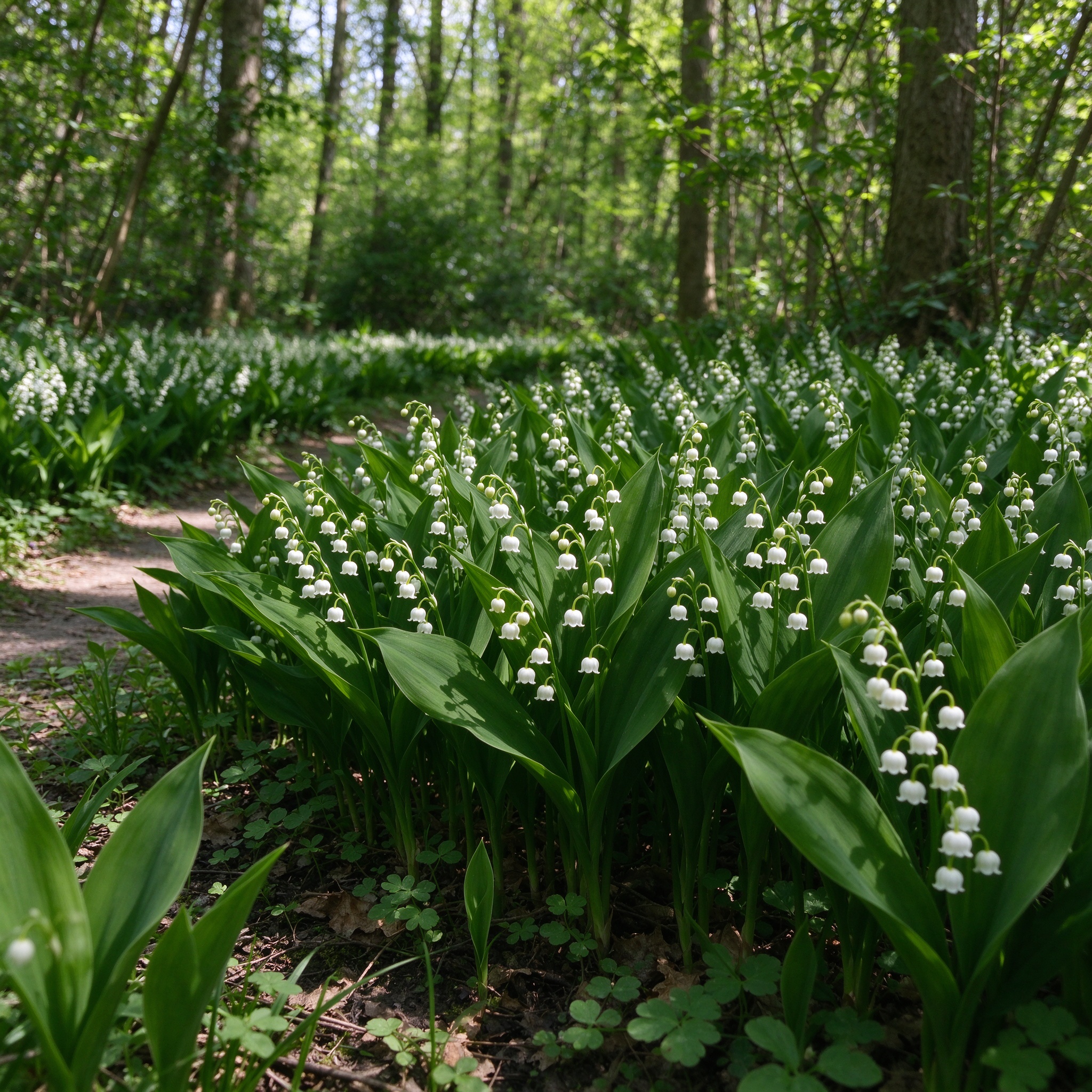
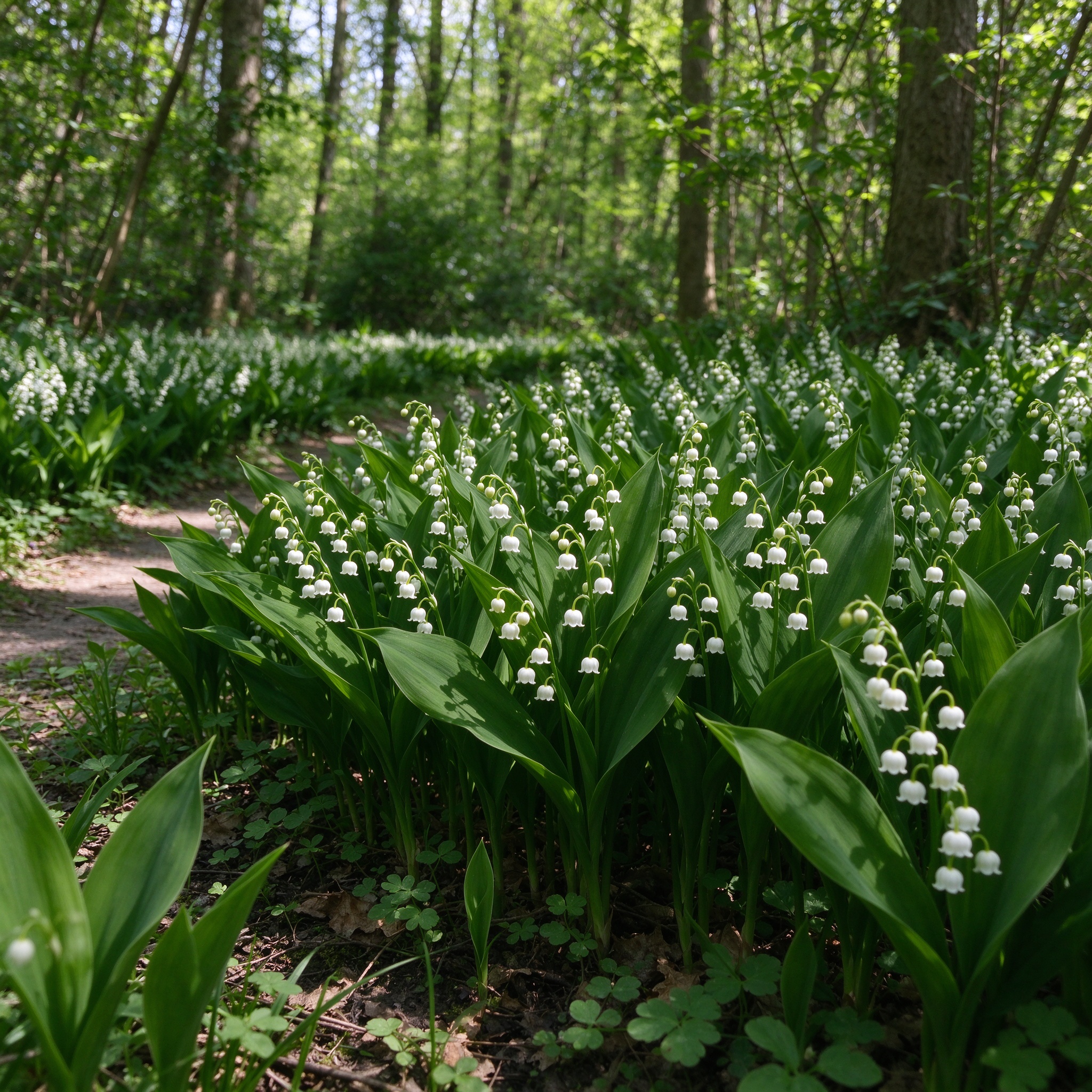
- •Lily of the valley is a low, rhizomatous perennial groundcover in the asparagus family (Asparagaceae), native to Eurasia and valued for its arching sprays of tiny, nodding, sweetly fragrant white bells in late spring.
- •Each plant sends up two broad, paired, elliptic leaves 5 to 10 inches long from a buried underground stem, with a slender one-sided flowering raceme 4 to 9 inches long tucked among them carrying six to sixteen nodding, fused white bell-shaped flowers about one-third inch long and wide, with six flaring lobes.
- •The bloom lasts roughly three weeks in late spring to early summer; if cross-pollinated between genetically different plants, a globoid red berry about one-third inch forms in summer, though berries are seldom produced in garden plantings.
- •The mat grows 6 to 10 inches tall and spreads 1 to 2 feet by shallow creeping rhizomes, forming a lush green carpet under trees and shrubs where few other flowering plants thrive.
- •It is deer and rabbit resistant, tolerates heavy clay and some summer drought once established, and naturalizes readily in cool, moist woodlands.
- •Every part of the plant contains cardiac glycosides and cardenolides and is poisonous to cats, dogs, and horses; this is a shade garden treasure that must be sited away from children and pets.
- •Note that lily of the valley is not a true lily: true lilies belong to the genus Lilium in the Liliaceae family and produce a different class of toxin.
📋 Quick Facts
- •Lily of the valley is a shade plant: NC State recommends planting in dappled shade, partial shade, or full shade, and MBG lists part shade to full shade with good performance in sun-dappled woodland shade.
- •It grows under deciduous trees, beneath shrubs, along a north-facing wall, and in the front of shaded beds where direct hot sun would scorch the broad leaves and dry the soil.
- •Morning light through a tree canopy suits the plant well, but hot midday and afternoon sun causes leaf scorch, crisp edges, and foliage decline in summer heat.
- •RHS records the plant in full or partial shade with a sheltered west-, east-, or north-facing aspect.
- •In very deep, dense shade under dense evergreens, flowering weakens and the mat thins; choose a position with at least some filtered light during the day rather than a permanently dark corner.
- •Indoor forcing pips need a cool dark rooting period followed by bright indirect light as leaves and racemes emerge.
- •Water newly planted pips regularly through the first growing season to keep the root zone evenly moist until the rhizomes establish.
- •MBG rates the plant water needs as medium, and NC State describes a moist, organically rich soil that nevertheless tolerates summer drought, heavy clay, and dry soils once mature.
- •In a shaded bed, natural rainfall usually supplies enough moisture; supplement only during extended dry spells so the soil does not turn bone dry.
- •Avoid overwatering in dense shade where the soil never dries and air movement is poor, because standing damp around rhizomes encourages stem rot and grey mould.
- •After bloom, ease watering as leaves mature in summer; established mats survive dry shade but bloom best when spring soil moisture is consistent.
- •Container-grown plants dry faster than groundcover mats, so check pots weekly and keep the mix moist but never saturated.
- •Rain barrels and drip irrigation keep water off the leaves and reduce leaf spot in humid climates.
- •Lily of the valley thrives in cool, temperate climates and is hardy across USDA zones 3 to 8 per MBG and the NC State Toolbox (3a through 7b), with established mats surviving sheltered zone 2 winters where snow cover insulates the rhizomes.
- •RHS hardiness rating H7 means the plant survives the severest European continental winters below -20°C (-4°F) in a sheltered position.
- •The plant prefers cool summer conditions; MBG notes foliage decline occurs in hot summers, and in zone 9 and warmer the combination of heat and humidity weakens the mat, shortens the flowering display, and causes leaves to yellow early.
- •It tolerates cold winter frosty roots under mulch and leaf litter, and does not require a warm indoor resting period outdoors.
- •Indoor forced pips should be kept cool (around 50 to 60°F / 10 to 15°C) through rooting and early growth to keep stems compact; a hot room stretches the racemes and fades the fragrance.
- •Grow lily of the valley in moist, fertile, organically rich, well-drained soil, per MBG; NC State lists clay, high organic matter, and loam textures with moist to occasionally dry or occasionally wet drainage, and RHS accepts clay or loam with acid, neutral, or alkaline pH and moist but well-drained or poorly drained conditions.
- •Before planting, work generous amounts of finished compost, leaf mold, or aged pine bark into the top 4 to 6 inches to hold moisture and feed the rhizome mat; the plant is not demanding about pH but performs best in cool, humusy woodland soil.
- •Heavy clay that stays soggy year-round should be loosened with compost and grit or planted on a slight mound to prevent rhizome rot.
- •RHS recommends an autumn top dressing of leaf mould, which mimics the forest floor and feeds the mat without a strong commercial fertilizer.
- •For containers, use a peaty, compost-rich mix with a small amount of grit for drainage rather than a fast-draining cactus blend.
- •Lily of the valley is cut for its intensely fragrant racemes, harvested early in the morning when the white bells are fully open but before the oldest flowers fade; hold the stem at its base, cut with a clean knife, and strip no foliage because the leaves feed the rhizome.
- •Racemes last three to five days in a small vase and carry their sweet scent into a room.
- •Do not harvest the leaves for drying or crafts, and never bring berries into a home with children or pets because all plant parts are poisonous.
- •After blooming, the spent flower stalks can be cut down to the leaves to keep the mat tidy, but the foliage is left in place until it yellows naturally in late summer or early fall, when it is cut back to the ground.
- •Leaves from garden clumps should not be used in herbal teas or remedies; the plant is toxic even in small amounts of cardiac glycoside medicine prepared under professional supervision.
- •The main landscape issue is aggressive spread: NC State notes dense rhizomes can spread and choke out other plants, and the species is reported invasive in Wisconsin and Arkansas; MBG calls the spread weedy in optimum conditions and invasive in parts of the northern United States, and the University of Maryland Extension lists European lily-of-the-valley among aggressive groundcovers that can escape into natural areas and displace wildflowers.
- •Site the mat where edging or a path contains it, or grow it in a container.
- •Foliage decline in hot, humid summers weakens bloom the following year; leaf spot, leaf blotch, anthracnose, stem rot, and grey mould appear on crowded, damp plants; aphids and spider mites may collect on new growth, and swift moth caterpillar can bore into rhizomes per RHS.
- •Poor flowering usually means dense deep shade, overcrowded matted rhizomes that need division, dry spring soil, or lack of autumn leaf mulch.
- •Red berries are seldom formed unless two genetically different plants are grown together for cross-pollination.
- •All parts are toxic, so no pest or animal browsing should be mistaken for safety; deer and rabbits leave it alone because of the bitter compounds rather than because the plant is harmless.
⚠️ Pet Safety Warning
This plant is toxic to both cats and dogs.
- •The ASPCA lists Convallaria majalis as toxic to dogs, cats, and horses, family Asparagaceae.
- •The toxic principles are cardenolides (convallarin and other cardiac glycosides), and clinical signs after ingestion are vomiting, irregular heartbeat, low blood pressure, disorientation, coma, and seizures.
- •NC State describes cardiac glycosides and saponins across all plant parts, with an irregular and slow pulse, abdominal pain and diarrhea, low blood pressure, disorientation, coma, and seizures; the plant is poisonous only if large quantities are eaten by people, but even small ingestion by a small pet can be serious.
- •Keep pips, rhizomes, leaves, racemes, and berries away from cats, dogs, and horses, and handle the plant with gloves per RHS guidance.
- •If a pet eats any part of a lily of the valley plant, contact a veterinarian or the ASPCA Animal Poison Control Center (888) 426-4435 immediately.
- •Important distinction: this is not a true lily (genus Lilium).
- •True lilies in the Liliaceae family cause acute kidney failure in cats and carry a different toxin; lily of the valley instead acts on the heart through cardiac glycosides, so emergency treatment differs.
- •For flowering and foliage plants safe to grow around cats and dogs, see the cat-safe plant guide linked below.
🌱 Related Guides
📅 When to Plant
- •Plant lily of the valley pips — the pointed growth buds produced on the creeping rhizomes — in autumn while the plant is dormant, matching RHS guidance to propagate by division in autumn.
- •NC State places planting depth at 3 inches to the base of the rhizome, spacing 15 to 25 plants per square foot for a dense groundcover mat; for a managed clump, set pips 6 to 12 inches apart so the rhizomes have room to spread before crowding.
- •MBG notes root division works in spring or fall, so spring-planted divisions taken from a garden mat also establish, though autumn planting gives roots all winter to settle.
- •Prepare a shaded bed of moist, organically rich soil, set each pip upright with the bud at about 3 inches deep, backfill, water in, and top with autumn leaf mulch.
- •Plant nursery pips as soon as they arrive in autumn; do not let dried-out rhizomes sit in a warm room before planting.
- •In cold zones, autumn planting lets roots establish before hard frost; in warm zone 8 gardens, choose a cool shaded position and understand that foliage and bloom decline in hot humid summers.
🌱 Growing Stages
 1
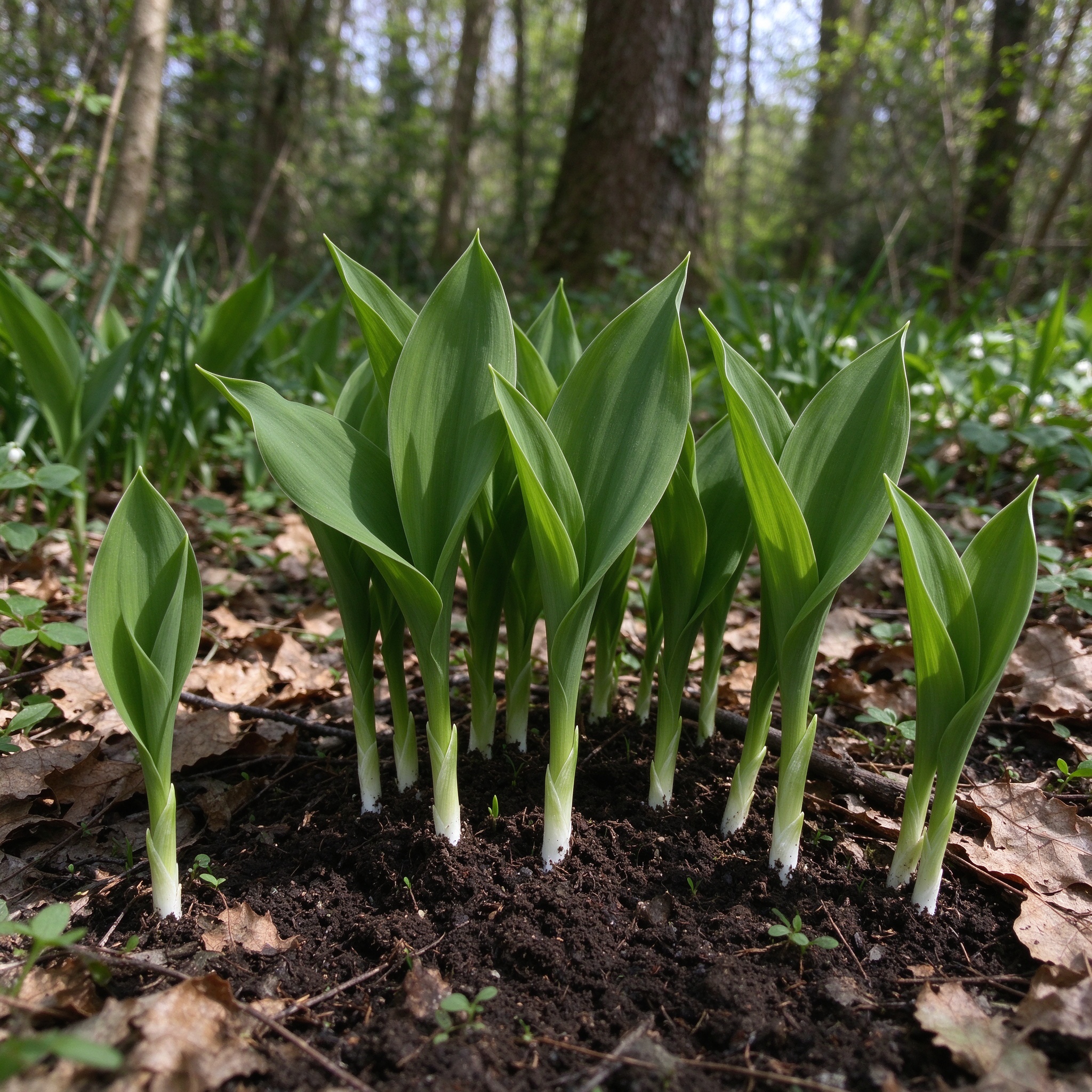
Dormant rhizome under winter litter
(Late fall through late winter)- •The creeping underground rhizome and its pips rest beneath leaf litter and mulch in cool shaded soil.
- •The plant is cold hardy across zones 3 to 8 and survives sheltered zone 2 winters under snow cover; RHS H7 hardiness tolerates the severest continental cold below -20°C.
- •Roots continue slowly through winter while the above-ground crown rests.
- •Do not fertilize during dormancy, and keep the bed from becoming waterlogged in cold, wet months that promote stem rot.
 2
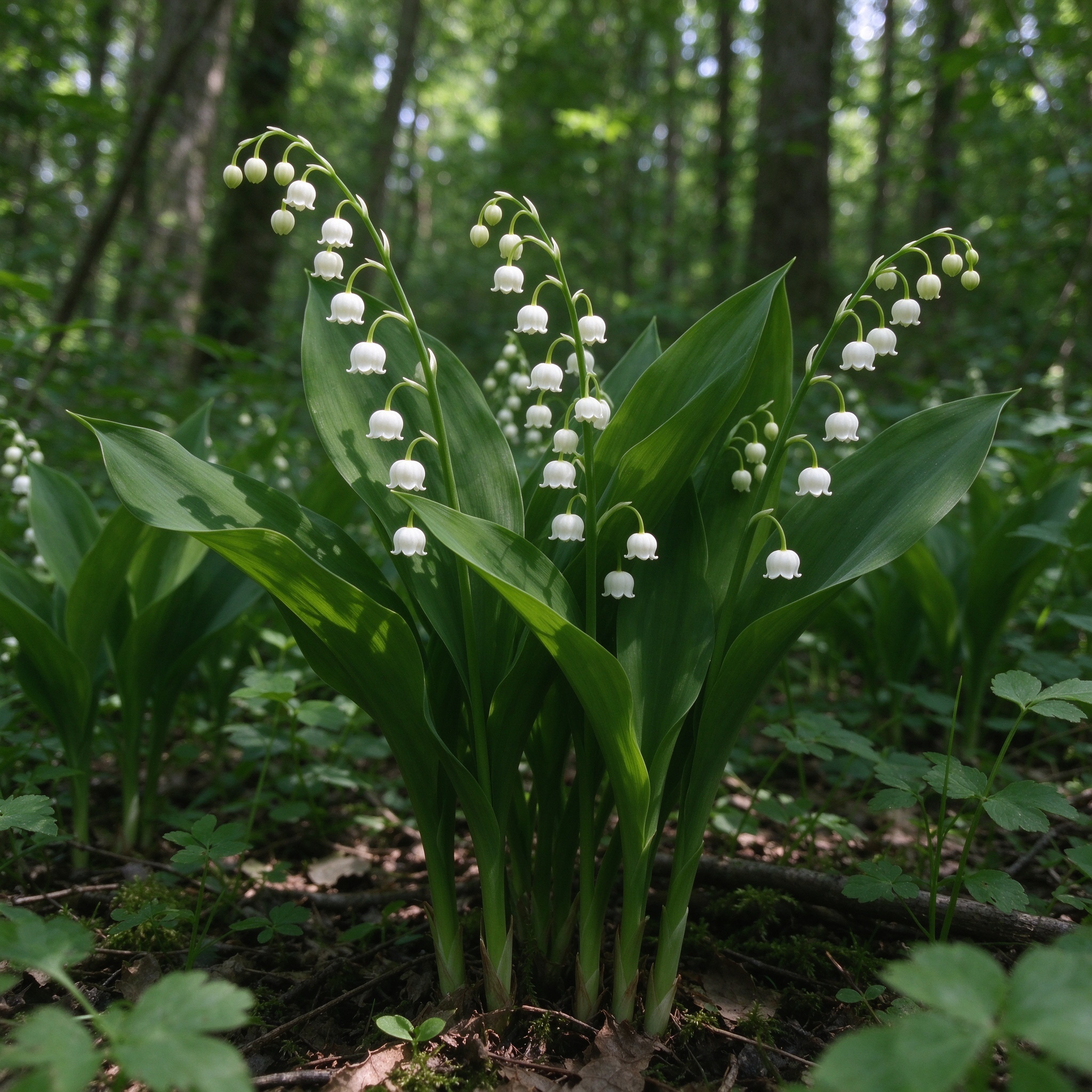
Spring leaf emergence
(Early to mid spring, before tree canopy closes)- •Paired elliptic leaves push through the mulch in early spring, unfolding to 5 to 10 inches long as filtered sunlight reaches the bed before deciduous trees leaf out.
- •New racemes rise between the leaves on the same shoot.
- •Keep soil evenly moist through this stage and apply a light compost dressing; spring growth in cool shade sets the size of the flowering display.
- •Air movement and a thin leaf layer prevent leaf spot on young foliage.
 3
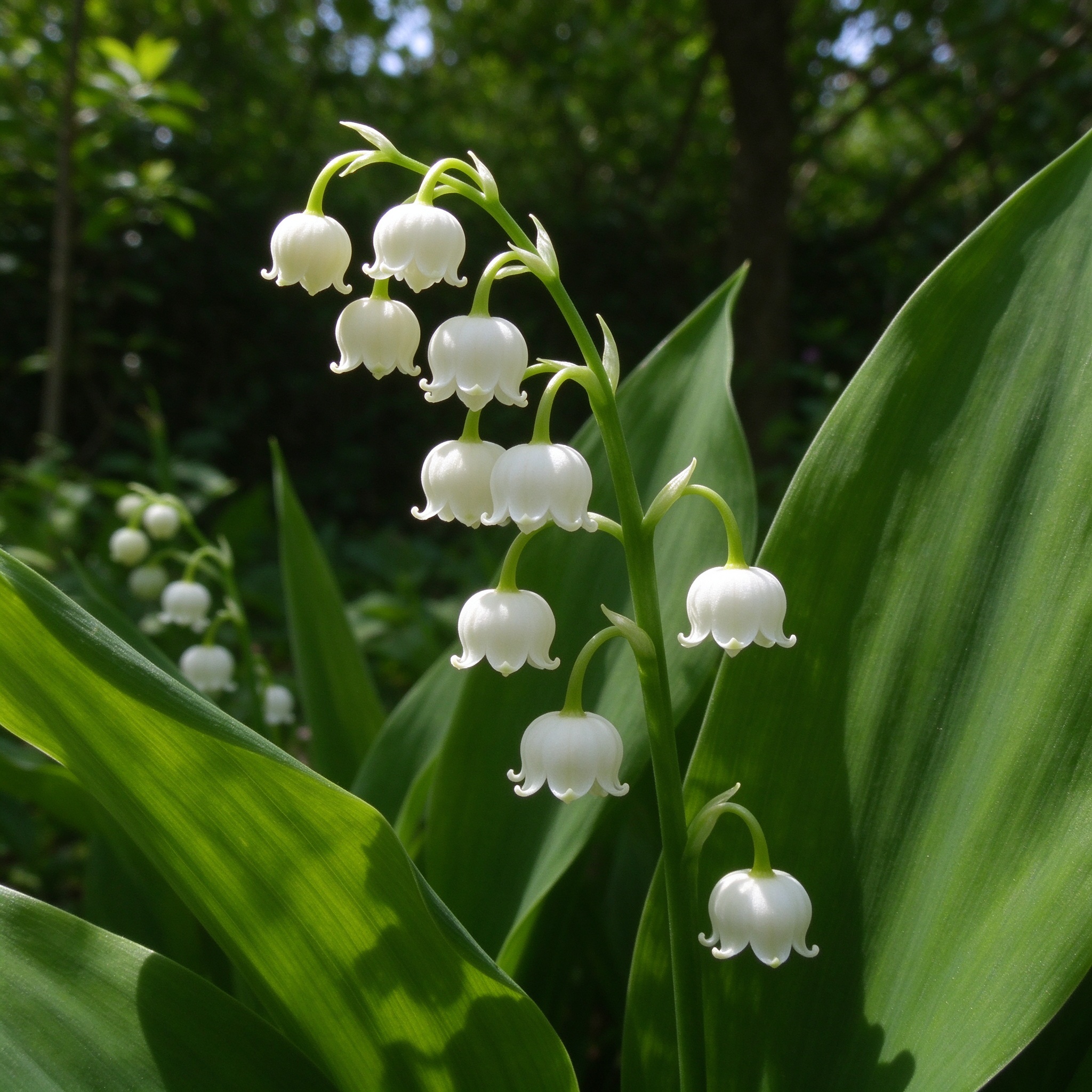
Fragrant bell bloom
(Late spring to early summer, about three weeks)- •A slender one-sided raceme 4 to 9 inches long carries six to sixteen nodding, fused white bells about one-third inch across, each with six flaring lobes and the intense sweet fragrance the species is grown for.
- •Blooms last roughly three weeks, per NC State, fading first at the base of the raceme.
- •Morning sun through tree shade supports flower color and scent; hot direct sun shortens display.
- •Cut racemes for bouquets early in the morning when fully open; remove spent stalks after bloom without damaging leaves.
 4
Post-bloom foliage, summer rest, autumn spread
(Late spring through fall)- •Foliage remains green after bloom, gathering sunlight through summer; in hot climates MBG notes foliage decline occurs, with leaves yellowing early.
- •Rhizomes spread sideways under the mat, filling gaps and occasionally producing red berries only when genetically different plants cross-pollinate.
- •Leaves are cut to the ground when yellowed in late summer or early fall, and an autumn leaf mould mulch feeds the rhizome layer.
- •Crowded mats are divided in fall; spread is contained by edging or regular lifting of off-target rhizomes.
💧 Detailed Care Guide
☀️ Light Requirements
- •Lily of the valley is a shade plant: NC State recommends planting in dappled shade, partial shade, or full shade, and MBG lists part shade to full shade with good performance in sun-dappled woodland shade.
- •It grows under deciduous trees, beneath shrubs, along a north-facing wall, and in the front of shaded beds where direct hot sun would scorch the broad leaves and dry the soil.
- •Morning light through a tree canopy suits the plant well, but hot midday and afternoon sun causes leaf scorch, crisp edges, and foliage decline in summer heat.
- •RHS records the plant in full or partial shade with a sheltered west-, east-, or north-facing aspect.
- •In very deep, dense shade under dense evergreens, flowering weakens and the mat thins; choose a position with at least some filtered light during the day rather than a permanently dark corner.
- •Indoor forcing pips need a cool dark rooting period followed by bright indirect light as leaves and racemes emerge.
💧 Watering
- •Water newly planted pips regularly through the first growing season to keep the root zone evenly moist until the rhizomes establish.
- •MBG rates the plant water needs as medium, and NC State describes a moist, organically rich soil that nevertheless tolerates summer drought, heavy clay, and dry soils once mature.
- •In a shaded bed, natural rainfall usually supplies enough moisture; supplement only during extended dry spells so the soil does not turn bone dry.
- •Avoid overwatering in dense shade where the soil never dries and air movement is poor, because standing damp around rhizomes encourages stem rot and grey mould.
- •After bloom, ease watering as leaves mature in summer; established mats survive dry shade but bloom best when spring soil moisture is consistent.
- •Container-grown plants dry faster than groundcover mats, so check pots weekly and keep the mix moist but never saturated.
- •Rain barrels and drip irrigation keep water off the leaves and reduce leaf spot in humid climates.
🌡️ Temperature
- •Lily of the valley thrives in cool, temperate climates and is hardy across USDA zones 3 to 8 per MBG and the NC State Toolbox (3a through 7b), with established mats surviving sheltered zone 2 winters where snow cover insulates the rhizomes.
- •RHS hardiness rating H7 means the plant survives the severest European continental winters below -20°C (-4°F) in a sheltered position.
- •The plant prefers cool summer conditions; MBG notes foliage decline occurs in hot summers, and in zone 9 and warmer the combination of heat and humidity weakens the mat, shortens the flowering display, and causes leaves to yellow early.
- •It tolerates cold winter frosty roots under mulch and leaf litter, and does not require a warm indoor resting period outdoors.
- •Indoor forced pips should be kept cool (around 50 to 60°F / 10 to 15°C) through rooting and early growth to keep stems compact; a hot room stretches the racemes and fades the fragrance.
🌱 Soil & Fertilizer
Soil:
- •Grow lily of the valley in moist, fertile, organically rich, well-drained soil, per MBG; NC State lists clay, high organic matter, and loam textures with moist to occasionally dry or occasionally wet drainage, and RHS accepts clay or loam with acid, neutral, or alkaline pH and moist but well-drained or poorly drained conditions.
- •Before planting, work generous amounts of finished compost, leaf mold, or aged pine bark into the top 4 to 6 inches to hold moisture and feed the rhizome mat; the plant is not demanding about pH but performs best in cool, humusy woodland soil.
- •Heavy clay that stays soggy year-round should be loosened with compost and grit or planted on a slight mound to prevent rhizome rot.
- •RHS recommends an autumn top dressing of leaf mould, which mimics the forest floor and feeds the mat without a strong commercial fertilizer.
- •For containers, use a peaty, compost-rich mix with a small amount of grit for drainage rather than a fast-draining cactus blend.
Fertilizer:
- •Lily of the valley is a light feeder that grows well on woodland litter; RHS recommends an autumn top dressing of leaf mould rather than concentrated fertilizer.
- •Apply a 1- to 2-inch layer of shredded leaves, leaf mold, or finished compost over the mat each fall as leaves drop, and let it break down over winter into the rhizome layer.
- •In spring, a thin scattering of balanced compost or an all-purpose organic feed can support flowering, but high-nitrogen lawn fertilizers and heavy chemical feeds push lush leaves at the expense of racemes and weaken the mat over time.
- •Established woodland beds usually need no additional fertilizer once a humus layer builds up.
- •Do not feed freshly planted pips in their first autumn; wait until the following spring, when new shoots emerge.
- •Container plants benefit from a dilute balanced feed once during spring growth, kept away from the crown to avoid soft, disease-prone foliage.
- •Dividing crowded mats every few years into fresh compost-rich soil renews vigor better than repeated fertilizing.
📝 Step-by-Step Planting Guide
- 1
Choose a shaded position under trees or a north wall
- •Select a site under deciduous shrubs or trees, along a north-facing foundation, in a shaded border front, or on a sheltered shaded slope where the plant receives dappled to partial shade rather than hot afternoon sun.
- •NC State places lily of the valley in dappled, partial, or full shade; MBG recommends part shade to full shade and sun-dappled woodland light.
- •Avoid dense dark corners under evergreens where flowering weakens, and keep the bed away from paths where children or pets could nibble the poisonous pips and berries.
- •Plan for the rhizome mat to spread, and mark an edging line or choose a contained bed before planting.
- 2
Prepare moist, humus-rich soil
- •Work finished compost, leaf mold, or aged pine bark into the top 4 to 6 inches of a moist, fertile, organically rich soil that drains moderately; MBG describes moist, fertile, organically rich, well-drained soil in part to full shade, and NC State accepts clay, loam, and high-organic textures with occasional dryness or wetness.
- •Loosen heavy clay with compost and a little grit so rhizomes do not sit in permanent sogginess; RHS notes the plant tolerates acid, neutral, and alkaline pH.
- •Rake the bed level and incorporate the autumn leaf litter that mimics a forest floor; remove fallen twigs and roots that would block rhizome spread.
- 3
Plant pips in autumn at 3 inches depth
- •Set lily of the valley pips upright at a depth of 3 inches to the base of the rhizome, per NC State, with the pointed bud just under the soil surface.
- •For a dense groundcover, space 15 to 25 plants per square foot as NC State recommends; for a managed clump in a border, space pips 6 to 12 inches apart so rhizomes can fill the gap before crowding.
- •Backfill with amended soil, firm gently by hand, and orient the buds toward the surface so racemes emerge cleanly through the mat.
- •MBG notes root division may also be done in spring, but autumn planting aligns with RHS division guidance and lets roots settle over winter.
- 4
Water in and apply autumn mulch
- •Water the planted bed thoroughly to settle soil around the rhizomes and remove air pockets.
- •NC State recommends topping the planting with mulch every fall; RHS specifies an autumn top dressing of leaf mould, which mimics the woodland floor, holds soil moisture, and feeds the mat slowly.
- •Apply a 1- to 2-inch layer of shredded leaves, leaf mold, or bark over the bed after planting in autumn, keeping the mulch away from the crowns so they are not buried.
- •In cold zones the mulch also insulates rhizomes from frost heave; refresh the layer every autumn as leaves fall.
- 5
Maintain even moisture in the first season
- •Keep the root zone evenly moist through the first growing season while rhizomes establish; supplement rainfall during dry spells so the soil does not dry completely.
- •In mature shaded beds, natural rain usually meets MBG's medium water requirement, and NC State notes established plants tolerate summer drought and clay, but consistent spring moisture produces fuller racemes.
- •Check container and edge pips weekly because pots dry faster.
- •Avoid overwatering in dense shade, where poor air movement and wet soil invite stem rot and grey mould.
- •Remove weeds while the mat is young; once rhizomes knit together they suppress most weeds on their own.
- 6
Contain the spread and divide crowded mats
- •Plan for aggressive rhizome growth: NC State reports dense rhizomes can choke out other plants and notes invasiveness in Wisconsin and Arkansas; MBG calls the spread weedy in optimum conditions and invasive in parts of the northern United States, and UMD Extension lists the species among aggressive groundcovers.
- •Install vertical edging several inches below the soil surface around a bed, grow the mat in a container, or lift spreading rhizomes that reach a lawn or neighboring planting.
- •Divide overcrowded clumps in autumn when bloom declines and centers become matted, replanting fresh pips in compost-amended soil; division both renews flowering and limits the colony to its intended area.
🌱 Recommended Varieties
Convallaria majalis — classic fragrant white bells
- •The straight species carries the familiar paired elliptic green leaves and arching one-sided racemes of six to sixteen nodding, white, highly fragrant bells, reaching 6 to 10 inches tall in a spreading rhizome mat.
- •It is the most vigorous form, flowers reliably in shaded gardens, and naturalizes under deciduous trees where soil stays cool and moist.
- •Use it for a woodland carpet, foundation planting on a north side, or erosion cover on a shaded slope; its spread must be contained by edging or a path.
Convallaria majalis 'Rosea' — soft pink bells
- •'Rosea' carries the same nodding bell form in a soft rose-pink rather than white, with the sweet lily scent retained.
- •It is slightly less vigorous than the green-leaved species and tends to form looser clumps rather than a tight mat, so it suits mixed shade borders and containers more than a massed groundcover.
- •Plant 'Rosea' near a path or bench where the pink color and fragrance can be enjoyed; pair it with the white species for succession and better cross-pollination if berries are wanted.
Convallaria majalis 'Albostriata' — striped leaf foliage
- •This variegated selection carries leaves striped or edged with cream or white along the parallel veins, grown more for foliage contrast than flower display.
- •It is less vigorous than the species and tends to revert to solid green shoots, which should be removed promptly to keep the variegation.
- •Give it filtered part shade rather than dense full shade, where the pale markings fade, and divide crowded clumps in autumn to keep the striped foliage healthy.
- •The flowers are still white and fragrant, but the leaves are the main feature in shaded borders and patio pots.
🪴 Growing in Containers
- Contained shade patio pot:
- •Lily of the valley grows well in a shaded patio planter because the rhizome is confined and cannot choke neighboring plants.
- •Use a pot at least 8 to 10 inches deep with drainage holes, fill with a compost-rich, peaty mix with a little grit, and plant pips 3 inches deep spaced close together for a lush spring display.
- •Place the pot on a north or east-facing patio in dappled shade, keep the mix medium-moist rather than saturated, and give a dilute balanced feed once in spring.
- •Because the mat fills a pot in two to three years, plan to divide or refresh the rhizomes each autumn; container growth also makes it easier to keep a toxic plant away from pets and small children.
- Underplanting in shrub border tubs:
- •Grow lily of the valley as a green underplanting beneath a larger shaded shrub in a large tub, mimicking its role under garden trees.
- •Plant around the shrub's root zone with a 1- to 2-inch mulch of leaf mold, keep the soil moist and humus-rich, and let the small white racemes layer beneath the shrub's foliage in spring.
- •Choose a compact variegated selection such as 'Albostriata' for foliage contrast, or the pink 'Rosea' for color.
- •Restrict the mat to its own container or a sunken-edged compartment so rhizomes do not reach the shrub's root ball or neighboring pots; repot and divide every second autumn to keep the underplanting vigorous.
- Forcing pips for indoor fragrant spring bloom:
- •Lily of the valley pips are traditionally forced indoors for small fragrant spring displays, similar to forcing bulbs.
- •Plant pips closely in a pot of compost-rich mix, water once, and keep the container cool and dark at about 40 to 50°F (4 to 10°C) for several weeks to root; then bring into a cool room of 50 to 60°F (10 to 15°C) in bright indirect light so leaves and racemes develop together.
- •Keep the mat away from pets and children indoors because all parts are poisonous; after flowering, forced pips are usually discarded or planted back outside in a shaded bed to recover.
- •Do not reuse the rhizomes in another forcing pot the same year, and keep the cool period to avoid stretched, scentless stems.
✂️ Pruning & Maintenance
- ✓
Cut spent racemes after bloom
- •After the white bells fade, cut the spent flowering stalk down to the leaves to keep the mat tidy and prevent seed or berry development where cross-pollination between different clones could occur.
- •Snip the stalk close to the soil level with a clean knife or scissors, taking care not to slice the paired leaves that continue feeding the rhizome.
- •If red berries are wanted for observation, leave selected racemes on established mixed-clone mats, but keep them out of reach of children and pets because berries are among the most toxic parts of the plant.
- ✓
Cut back foliage once it yellows in fall
- •Leave the green leaves in place through summer to photosynthesize and rebuild the rhizome.
- •Once foliage yellows and dies back in late summer or early fall, NC State and MBG guidance is to cut the mat cleanly to ground level; RHS requires no formal pruning.
- •Remove cut leaves from the bed to reduce overwintering grey mould and leaf spot spores, and apply the autumn leaf mould top dressing RHS recommends over the bare rhizomes.
- •Do not braid or tie leaves, as with bulbs; lily of the valley foliage dies back naturally and should not be tucked under shrubs.
- ✓
Divide and thin crowded colonies in autumn
- •When the mat becomes thick and matted, flowering declines and the center grows crowded with intertwined rhizomes.
- •In autumn, lift a section of the mat with a fork, separate individual pips and short rhizome pieces each bearing a firm bud, and replant at the 3-inch depth in compost-amended soil, spaced 6 to 12 inches apart.
- •Discard old, woody, or rotted rhizomes and any section with signs of stem rot or swift moth caterpillar damage.
- •MBG notes division works in spring or fall, and RHS specifies autumn division; thinning both renews bloom and controls the aggressive spread that can crowd neighboring perennials.
🐛 Pest & Disease Control
Common Pests
Aphids
Symptoms: Green or pink aphids cluster on new spring shoots and racemes, curling young leaves and coating them with sticky honeydew that grows black sooty mould; dense colonies can distort the emerging flower stalk.Control:- •Knock colonies off with a strong jet of water in early spring and encourage lady beetles and lacewings that prey on aphids.
- •On small clumps, wipe stems with soapy water; heavy outbreaks respond to insecticidal soap or horticultural oil applied in cool weather, following the label.
- •Keep the bed open and airy rather than overcrowded, and remove mulch buildup around crowns to reduce the shelter aphids prefer.
Spider mites
Symptoms: Fine pale speckling on upper leaf surfaces, fine webbing between leaves and stems in hot, dry shade, and a dull bronze cast to the foliage; infestations weaken summer leaves and reduce the next spring's flowering shoot.Control:- •Spray the undersides of leaves with water to raise humidity and dislodge mites; release or encourage predatory mites in outdoor beds.
- •Treat heavy infestations with horticultural oil or insecticidal soap at the labeled rate, avoiding hot midday application that burns leaves.
- •Water the mat during dry spells so stressed foliage is less vulnerable, and divide crowded plants to improve air movement through the clump.
Swift moth caterpillar
Symptoms:- •RHS notes swift moth caterpillar may bore into rhizomes, causing weak shoots, poor flowering, and plants that lift or pull away easily because the underground stem has been tunneled.
- •Damage appears gradually over seasons rather than in a single flush.
Control:- •Lift and inspect rhizomes during autumn division; cut out tunneled sections and destroy infested rhizomes rather than composting them.
- •Keep soil improved and well-aerated so plants are less stressed, avoid heavy organic mulch piled directly against crowns, and clear plant debris where moths lay eggs.
- •There is no practical chemical control in a shade garden; removal of damaged material and good cultivation are the usual defenses.
Slugs and snails
Symptoms: Irregular holes and slime trails on tender new spring leaves and racemes in damp shaded conditions, with young shoots rasped back before they unfold fully.Control:- •Rake away loose mulch and leaf litter around crowns so slugs have no daytime shelter, hand-pick at dusk, or set shallow beer traps sunk to soil level.
- •Iron phosphate bait around emerging shoots is a low-toxicity option that breaks down harmlessly; copper barriers along a bed edge help keep the gastropods out of a contained mat.
- •Avoid overwatering dense shade beds where damp conditions favor slug activity.
Common Diseases
Leaf spot
Symptoms: Circular or angular brown spots with yellow halos appear on leaves during wet spring weather, enlarging and coalescing until foliage turns blotchy; NC State and MBG both list leaf spot as a minor but recurring problem on crowded damp mats.Control:- •Space divisions for air movement, water at the base of the plant rather than overhead, and rake and destroy infected fallen leaves in autumn.
- •Remove affected foliage during the season where practical and avoid splashing soil onto lower leaves when watering.
- •Copper-based fungicide may be applied at labeled rates to severely affected shade beds, but improved spacing and dry leaf surfaces usually reduce the problem more than spraying.
Stem rot
Symptoms: Rhizomes and lower stems soften, turn brown or black, and emit a damp, musty smell; shoots wilt and collapse even though the bed looks shaded and moist, especially where soil stays saturated in poor-draining or dense shade.Control:- •Plant in organically rich but moderately drained soil, avoid permanent sogginess around rhizomes, and do not pile mulch directly on crowns.
- •Lift affected sections promptly, cut away rotted rhizome tissue, let divisions dry briefly, and replant in fresh compost-amended soil.
- •MBG and NC State list clay tolerance, but a bed that never dries will rot; amend heavy ground on a slight mound or use a contained container rather than planting in a waterlogged depression.
Grey mould (Botrytis)
Symptoms: RHS lists grey moulds among the possible diseases; fuzzy grey fungal growth covers spent flowers, young leaves, and crowded stems in cold, damp spring air, with brown lesions spreading from infected tissue into healthy foliage.Control:- •Remove spent racemes immediately after bloom and thin overcrowded mats so air circulates between rhizomes.
- •Rake old leaves and plant debris in autumn, reduce overhead watering, and keep mulch from touching stems.
- •Apply a labelled botrytis fungicide only if the mould recurs in consecutive springs on weak plants; dividing the bed and opening the canopy usually solves the underlying dampness.
Anthracnose and leaf blotch
Symptoms: Large irregular brown or tan blotches with raised dark fruiting bodies appear on leaves in summer, often starting at the leaf tip or edge and moving inward; foliage yellows and dies back early, weakening next year's rhizome store.Control:- •MBG lists leaf blotch and anthracnose as occasional diseases alongside stem rot and leaf spot.
- •Collect and destroy affected leaves rather than composting them, improve bed ventilation by division, and maintain even spring moisture without wetting foliage.
- •Replace declining divisions with fresh pips from a clean source if the mat has built up years of infected litter in the soil.
🍅 When to Harvest
- •Lily of the valley is cut for its intensely fragrant racemes, harvested early in the morning when the white bells are fully open but before the oldest flowers fade; hold the stem at its base, cut with a clean knife, and strip no foliage because the leaves feed the rhizome.
- •Racemes last three to five days in a small vase and carry their sweet scent into a room.
- •Do not harvest the leaves for drying or crafts, and never bring berries into a home with children or pets because all plant parts are poisonous.
- •After blooming, the spent flower stalks can be cut down to the leaves to keep the mat tidy, but the foliage is left in place until it yellows naturally in late summer or early fall, when it is cut back to the ground.
- •Leaves from garden clumps should not be used in herbal teas or remedies; the plant is toxic even in small amounts of cardiac glycoside medicine prepared under professional supervision.
❓ Frequently Asked Questions
- 1
Is lily of the valley poisonous to dogs?
- •Yes.
- •The ASPCA lists Convallaria majalis as toxic to dogs, cats, and horses.
- •The toxic principles are cardenolides such as convallarin and other cardiac glycosides, and clinical signs include vomiting, irregular heartbeat, low blood pressure, disorientation, coma, and seizures.
- •NC State describes cardiac glycosides and saponins across all parts of the plant, producing an irregular and slow pulse, abdominal pain and diarrhea, low blood pressure, disorientation, coma, and seizures.
- •Keep pips, rhizomes, leaves, flowers, and berries away from dogs; if a dog eats any part of the plant, contact a veterinarian or the ASPCA Animal Poison Control Center at 888-426-4435 immediately.
- •Note that this plant's heart toxin differs from the kidney toxin in true lilies; emergency treatment should follow the cardiac glycoside exposure described by the vet or poison control.
- 2
Does lily of the valley grow in shade?
- •Yes, it is a classic shade groundcover.
- •NC State recommends planting in dappled shade, partial shade, or full shade in moist organically rich soil; MBG specifies part shade to full shade and good performance in sun-dappled woodland light.
- •It grows beneath deciduous trees and shrubs, on north-facing foundations, and in shaded borders where few flowering plants compete.
- •Hot midday and afternoon sun scorches the broad leaves and dries the bed, while extremely dense evergreen shade weakens flowering, so choose a position with some filtered daytime light.
- •In containers, place a forced or patio pot on a north or east patio out of direct afternoon sun.
- 3
When do lily of the valley bloom?
- •Lily of the valley blooms in late spring to early summer, with the white fragrant bells lasting about three weeks per NC State.
- •Each flowering shoot carries a one-sided raceme 4 to 9 inches long with six to sixteen nodding white bells, and the sweet fragrance carries across a shade bed before tree canopies fully close in summer.
- •Bloom timing shifts a little by zone: earlier in warm zone 8 gardens and later in colder zone 3 or 4 beds.
- •Poor flowering usually means dense deep shade, a crowded mat due for division, dry spring soil, or a lack of autumn leaf mulch.
- •After bloom, cut the spent racemes but leave the leaves to feed the rhizome for next year.
- 4
How do I plant lily of the valley pips?
- •Plant pips — the pointed buds on creeping rhizomes — in autumn while dormant, matching RHS autumn division guidance.
- •Prepare a shaded bed of moist, organically rich soil amended with compost or leaf mold; set each pip upright at a depth of 3 inches to the base of the rhizome, per NC State.
- •Space 15 to 25 plants per square foot for a dense groundcover mat, or 6 to 12 inches apart for a managed border clump.
- •Backfill, firm gently, water thoroughly to settle the soil, and apply an autumn leaf mould or shredded-leaf mulch.
- •MBG notes root division can also be done in spring, but autumn planting lets roots establish over winter.
- •Keep the bed evenly moist through the first growing season and contain the rhizome spread with edging.
- 5
Is lily of the valley invasive?
- •It can be.
- •NC State notes that in ideal growing conditions the dense rhizomes spread and can choke out other plants, and reports the species invasive in Wisconsin and Arkansas.
- •MBG describes the spread as weedy in optimum conditions, forming dense colonies that may negatively affect native woodland populations, and classifies it as invasive in parts of the northern United States.
- •The University of Maryland Extension lists European lily-of-the-valley among widely grown groundcovers that can escape into natural areas, displace wildflowers, and alter habitat.
- •Aggressive in a yard does not always mean invasive in nature, but the plant should be sited where a path, edging sunk several inches below soil, or a container contains the rhizome.
- •Divide and lift off-target spread annually, and consider native shade groundcovers such as wild blue phlox or native violet alternatives in woodland settings where escape is a concern.
- 6
How do I divide lily of the valley?
- •Divide in autumn after foliage yellows, or in spring per MBG; RHS specifies autumn division.
- •Lift a section of the rhizome mat with a garden fork, then separate individual pips and short rhizome pieces, each carrying a firm healthy bud.
- •Replant divisions at 3 inches deep in compost-amended moist soil, spaced 6 to 12 inches apart, and discard old woody, soft, or rotted rhizomes and any material bored by swift moth caterpillar.
- •Water the new divisions well and apply autumn leaf mould.
- •Division solves the crowding that weakens flowering, refreshes a matted colony, and produces spare pips for other shaded parts of the garden.
- •Wear gloves when handling because the plant is toxic to pets and the sap can irritate sensitive skin.
- 7
Is lily of the valley the same as a true lily?
- •No.
- •Lily of the valley, Convallaria majalis, belongs to the asparagus family Asparagaceae, while true lilies belong to the genus Lilium in the Liliaceae family; they are unrelated plants with different toxins.
- •True lilies cause acute kidney failure in cats even from pollen or vase water, whereas lily of the valley contains cardiac glycosides and cardenolides that act on the heart, causing vomiting, irregular heartbeat, low blood pressure, disorientation, coma, and seizures.
- •The shared word "lily" in the common name creates confusion at poison control, so note the botanical genus when describing an exposure to a vet.
- •Both groups are toxic, but the symptoms and emergency treatment differ; identify the plant as Convallaria majalis rather than a Lilium lily.
- 8
Why isn't my lily of the valley blooming?
- •Most bloom failures trace to shade that is too deep, a crowded mat that needs division, dry spring soil, or a shaded position opened by competing tree roots.
- •The plant needs at least some filtered light during the day; dense evergreen shade produces leaves but few racemes.
- •Old matted colonies build intertwined rhizomes that exhaust nutrients and should be divided in autumn into fresh compost-rich soil.
- •Consistent spring moisture and an autumn leaf mould mulch support flowering; drought-stressed mats skip bloom.
- •Hot summer heat also weakens next year's display in zone 8 and warmer gardens.
- •Other reasons include replanting pips too deep, planting in a fast-draining cactus mix, or using high-nitrogen fertilizer that pushes leaves instead of racemes.
- •Cut spent flowers after bloom and keep leaves intact through summer to rebuild the rhizome.
Source:
NC State Extension Gardener Plant Toolbox — Convallaria majalis (Lily-of-the-valley) — https://plants.ces.ncsu.edu/images/plants/convallaria-majalis/common-name/lily-of-the-valley/
Missouri Botanical Garden Plant Finder — Convallaria majalis — https://plantfinder.mobot.org/PlantFinderDetails.aspx?kempercode=c250
Royal Horticultural Society — Convallaria majalis (Lily of the Valley) — https://www.rhs.org.uk/images/plants/4327/convallaria-majalis/details
ASPCA Toxic and Non-toxic Plants — Lily of the Valley (Convallaria majalis) — https://www.aspca.org/pet-care/animal-poison-control/toxic-and-non-toxic-plants/lily-valley
University of Maryland Extension — Groundcovers — https://www.extension.umd.edu/resource/groundcovers
Photo credit: NC State Extension
Images courtesy of NC State Extension under CC BY license. Thank you to the photographers who make these educational images available.
License: CC BY-NC 2.0 / CC BY 4.0