
How to Grow Money Tree Plant: Complete Guide
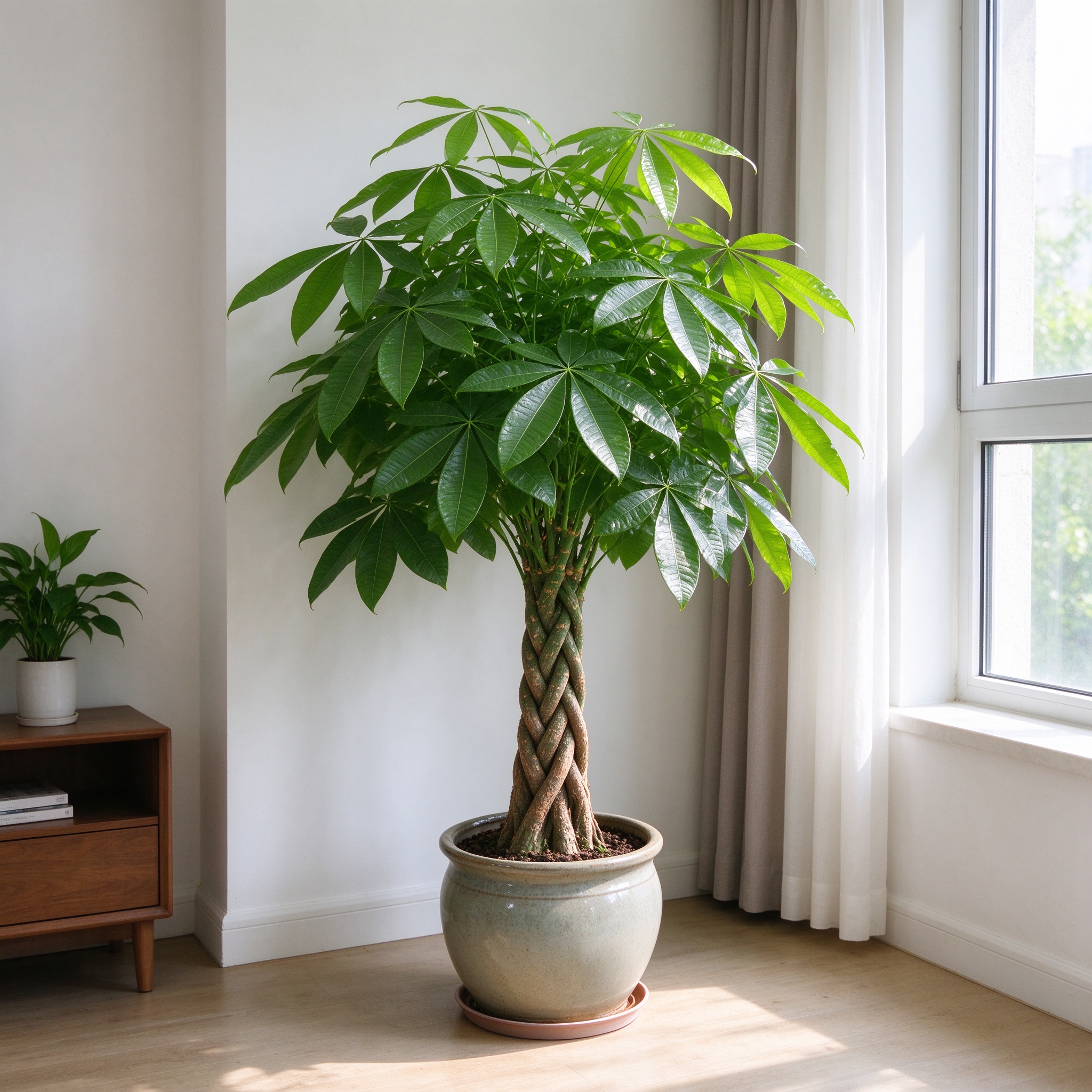
- •The money tree plant (Pachira aquatica) is a tropical broadleaf evergreen tree in the mallow family (Malvaceae), native to freshwater swamps, estuaries, and riverbanks from southern Mexico through Bolivia and northern Brazil, according to the NC State Extension Gardener Plant Toolbox.
- •In its native range it can reach 60 feet tall, and in open cultivation around 30 feet, but indoors it is normally kept to 6 to 8 feet as a potted accent plant.
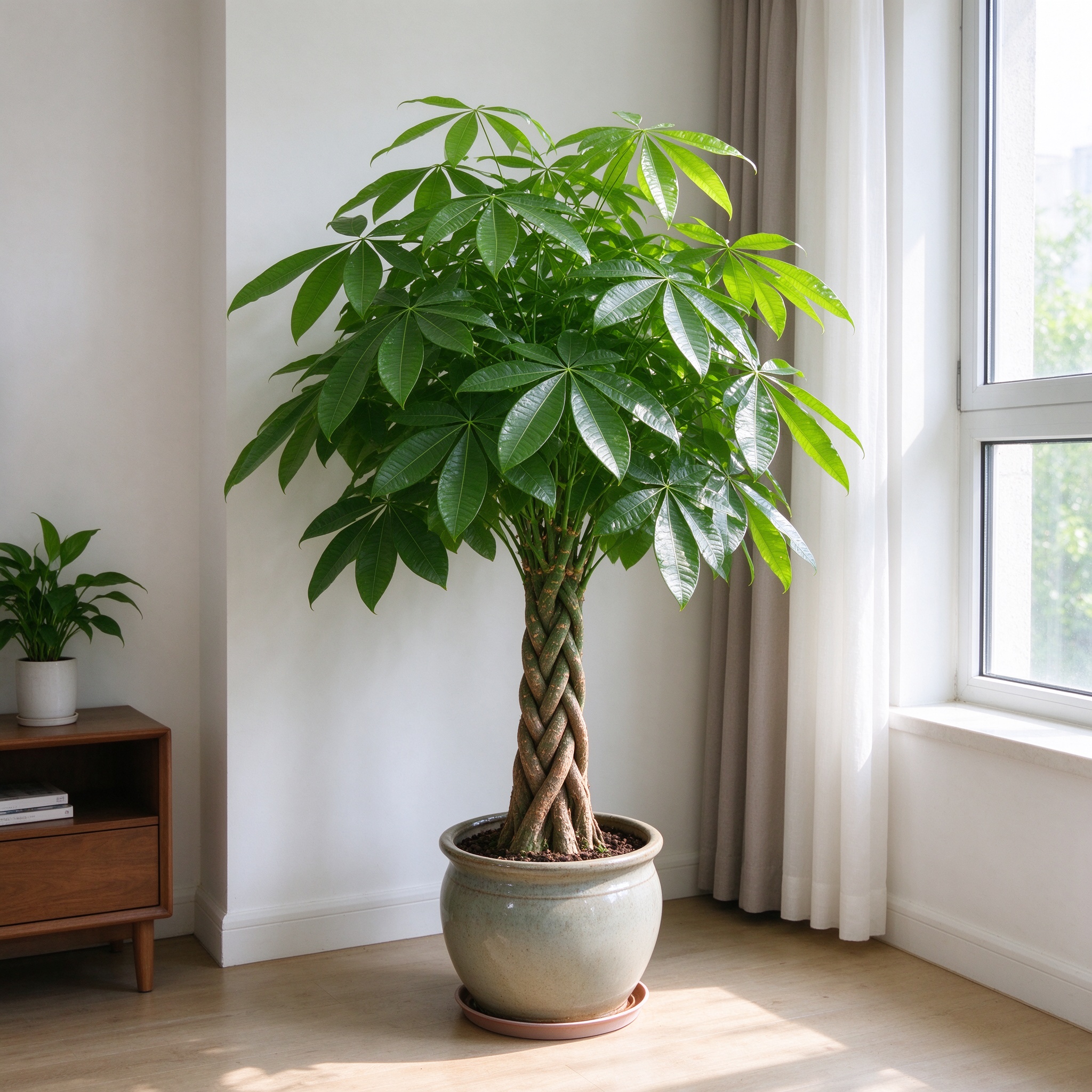
- •Its leaves are glossy green, palmately compound with five to nine leaflets, and its flexible seedling stems are commonly braided together at the nursery to form the characteristic trunk sold in stores.
- •This money tree care guide covers the plant purely from a horticultural standpoint: how to place, water, feed, repot, prune, and propagate a healthy indoor Pachira, and how to diagnose the common indoor problems such as leaf drop, yellowing, a softening trunk, and pest outbreaks.
- •The popular 'money' nickname comes from an East Asian marketing and folklore tradition rather than any botanical property of the species; this guide treats the plant purely as a houseplant and makes no claim about any financial association.
📋 Quick Facts
- •The money tree plant needs bright indirect light or a partial mix of sun and shade, and it cannot tolerate full direct sun behind a window for long.
- •NC State states that the species prefers indirect sunlight or a mix of sun and shade and that leaf scorch can occur from exposure to direct sunlight.
- •A position near a large east window, or three to six feet back from a south or west window where a sheer curtain softens the rays, delivers the right balance: enough brightness to keep the canopy dense and the leaflets a rich green, without the hot afternoon sun that bleaches or burns the foliage.
- •An indoor money tree will survive a darker corner for a while, but growth becomes thin, stems stretch toward the nearest window, and older leaves yellow and drop faster than usual.
- •Rotate the pot a quarter turn every week or two so the trunk grows straight instead of leaning toward the light.
- •Avoid placing the plant where hot afternoon sun hits the leaves through clean, unfiltered glass; outdoor summer exposure should also be gradual, and NC State advises protecting outdoor plants from strong wind.
- •Water on a soak-and-check rhythm, never on a fixed calendar.
- •NC State says the plant prefers moist, well-drained potting mix of peat moss, perlite, loam, or sand, and that standing water is not tolerated and can cause root rot; the UF/IFAS Gardening Solutions guidance for houseplants matches this: let the upper inch of soil dry between waterings, water thoroughly with room-temperature water until it runs out the drainage hole, and never leave the pot standing in a saucer of pooled water.
- •In practice, insert a finger or a wooden stick about one to two inches into the mix: when that layer is dry and the soil at that depth is no longer cool to the touch, water deeply.
- •In a bright, warm summer room that is often once every seven to fourteen days; in a cool, darker winter corner it can stretch to two or three weeks between drinks.
- •The swollen trunk stores water, which is why this plant tolerates a missed watering far better than soggy soil.
- •Money trees are sensitive to water chemistry as well as moisture level: NC State and common interiorscape practice point to yellowing or browning leaf tips when the plant sits in salty, fluoridated water or fertilizer buildup, so use room-temperature tap water allowed to stand overnight, or filtered water, and flush the pot annually with several volumes of water to leach accumulated salts.
- •Keep the money tree plant in a warm, stable room temperature.
- •The comfortable household range is roughly 61–81°F (16–27°C); the ideal band NC State notes for this humid-environment species is about 65–75°F (18–24°C).
- •Outside that comfort band it tolerates typical household warmth briefly and can stay comfortable as high as the mid-80s if humidity and ventilation are adequate, but it suffers below roughly 50°F (10°C).
- •NC State directs that in colder climates the tree should be brought indoors before temperatures drop to 45°F (7°C), which matters only if you summer a potted plant on an open patio or balcony.
- •Keep the plant away from heating vents, air-conditioning outlets, exterior doors that open often, and drafty windowsills: sudden cold blasts cause leaf drop just as dry hot air causes leaf tip browning.
- •Do not put a money tree against a radiator or in the path of a fan that blows directly on the canopy overnight.
- •Night temperatures in the low 60s are fine; prolonged exposure to a chilly unheated room above a cold floor in winter is one of the most common indoor stress triggers.
- •Use a loose, open, fast-draining potting mix that still holds some moisture.
- •NC State recommends a moist, well-drained mix of peat moss, perlite, loam, or sand across acid, neutral, or mildly alkaline conditions; the RHS advises an open, free-draining compost for indoor Pachira.
- •A reliable indoor blend is two parts standard peat-based or peat-free houseplant potting soil, one part perlite or pumice for aeration, and one part orchid bark or coarse sand to keep the mix from compacting after repeated watering.
- •The swollen trunk and surface roots rot quickly in dense, peat-heavy seed-starting mixes that stay wet for days, so drainage matters more than richness.
- •Do not garden soil or compost into the pot: it compacts hard in a container, holds water against the roots, and invites the root rot NC State warns against.
- •If your local tap water is hard, let water stand overnight before watering so chlorine dissipates and the soil pH does not drift sharply alkaline over time.
- •There is no edible harvest on an indoor money tree plant.
- •Mature outdoor trees in zones 10 to 12 produce woody brown capsules in summer that split to release edible-looking nuts; NC State reports the seeds or nuts are eaten raw, fried, or roasted in parts of the species' native range, while some sources flag cyclopropenoid fatty acids in the seed and advise research before eating them.
- •Indoor plants almost never flower, and NC State adds that a braided money tree will not flower at all, so houseplant owners should not expect seeds.
- •The indoor 'milestone' to watch for is healthy growth: a swollen, firm trunk base, new palmate leaves unfurling steadily through spring and summer, and a canopy that fills out without dropping leaves in clusters.
- •The leading indoor killer of the money tree plant is root rot from overwatering, a pot without a drainage hole, or a saucer left full of water; NC State specifically notes that standing water causes root rot, and UF/IFAS repeats the houseplant rule that no pot should stand in water.
- •The second cluster of problems is water and humidity stress: NC State records leaf drop when the soil is too dry and yellow leaves when humidity is too low or nutrients are inadequate; dry heated winter air makes leaflets brown at the tips and edges.
- •Insects to monitor are aphids, mealybugs, scale, and fungus gnats (NC State), and in very dry rooms spider mites may appear on the leaf undersides.
- •Diseases listed by NC State include anthracnose and powdery mildew, both favored by wet leaves and poor air circulation.
- •Other issues are direct-sun leaf scorch, cold-draft leaf drop, salt buildup from over-fertilizing, and a soft, wrinkling or molding trunk base that signals rot has already reached the caudex.
📅 When to Plant
- •Money tree plants are sold by nurseries and design shops year-round, so there is no sowing window for this houseplant: you can buy and repot one in any month.
- •The best time to repot, do major pruning, or take cuttings is spring, when growth resumes and the plant recovers fastest from root disturbance.
- •NC State notes that outdoor plantings in zones 10 to 12 are established in the warm months; everywhere else this species stays indoors, and the RHS classifies indoor Pachira as a houseplant grown in open, free-draining compost.
- •If you have moved the plant home from the store, keep it in its nursery pot for the first two to four weeks while it acclimates to your light, temperature, and watering routine before you repot it into a permanent decorative container.
🌱 Growing Stages
 1
Nursery acclimation
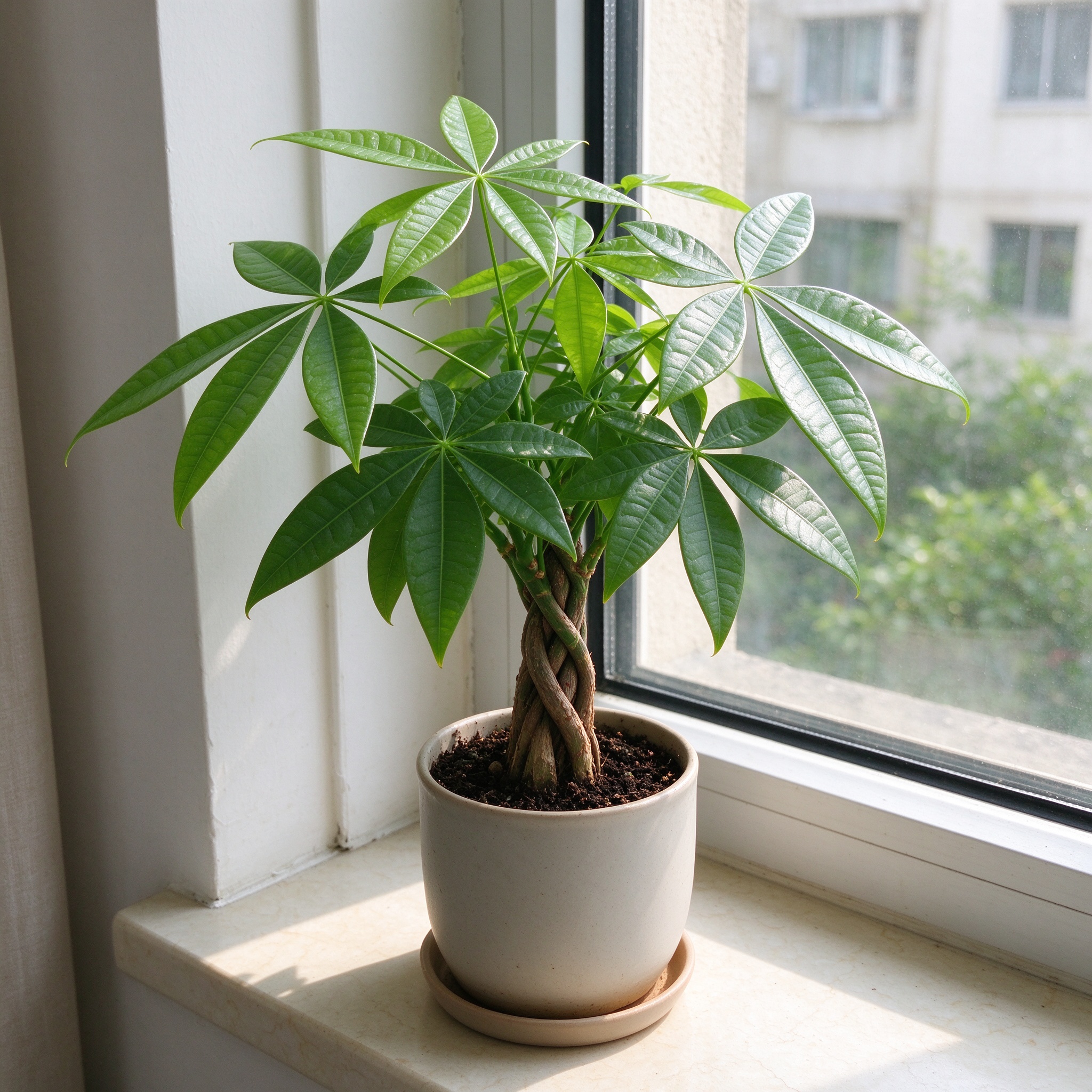
(First 2 to 4 weeks after purchase)- •A new money tree plant has just moved from a humid, warm greenhouse into your home, and the drop in humidity and light level shocks it enough to drop one or two older lower leaves; that is normal acclimation rather than a disease.
- •Place it in its intended bright indirect spot immediately, confirm the nursery pot drains, and water only when the top one to two inches of mix are dry.
- •Do not repot into a much larger decorative pot right away: an oversized container holds extra wet soil around the roots and is the fastest route to root rot.
- •Skip fertilizer during this stage, keep the plant away from drafts, and wait until a new leaf unfurls before changing anything about the watering routine.
 2
Root establishment
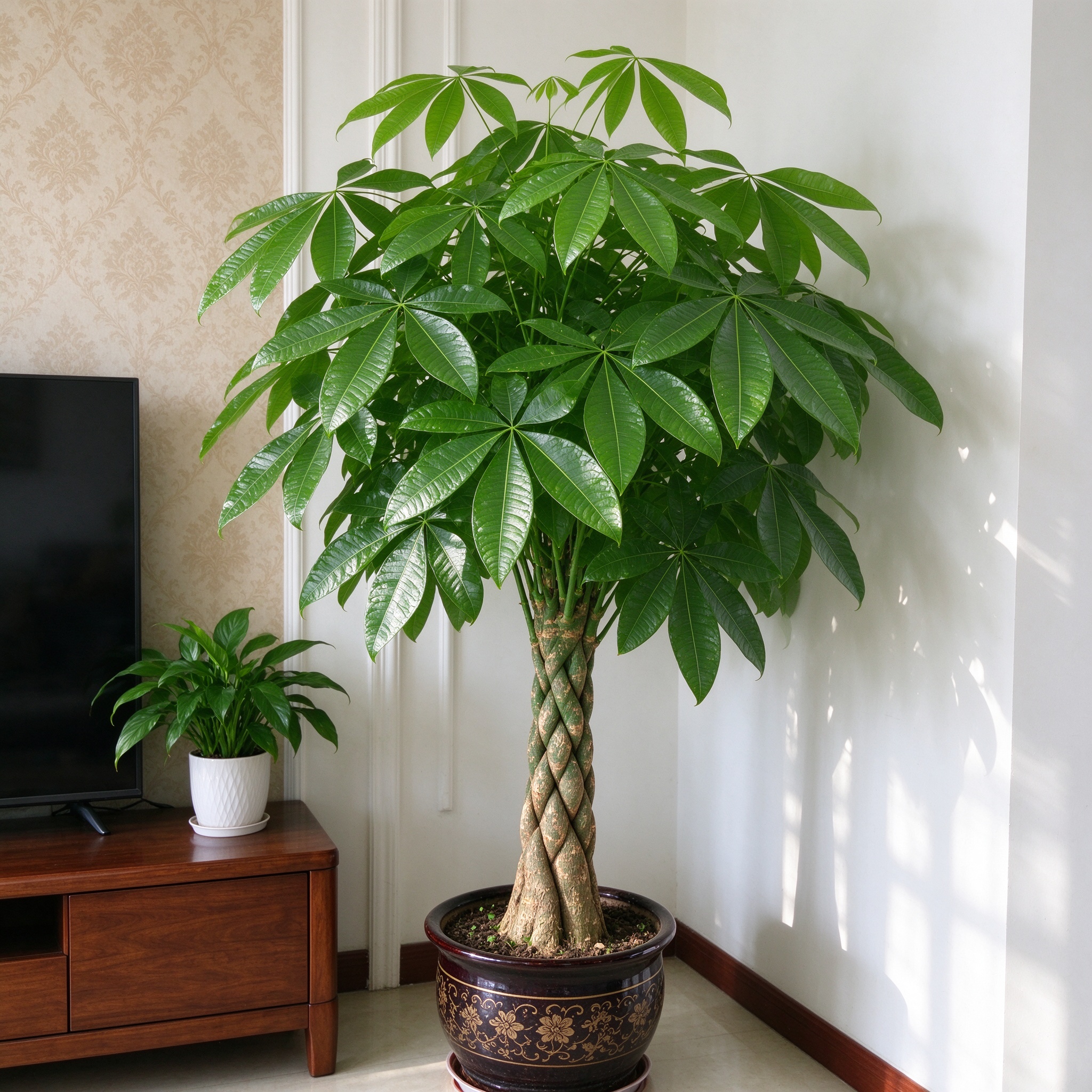
(Months 1 to 6)- •Once settled, the plant channels energy into expanding the root system and filling the nursery pot, while pushing one new palmate leaf cluster every few weeks through the growing season.
- •Keep to the soak-and-check watering schedule and feed at half strength monthly in spring and summer so the root mass develops evenly.
- •This stage is when overwatering in winter does the most damage: let the mix stay on the drier side from late fall onward and stop feeding.
- •Inspect leaf axils and leaf undersides at every watering so mealybugs, scale, or fungus gnats are caught while the population is still small and easy to wipe off.
 3
Active growth and canopy fill
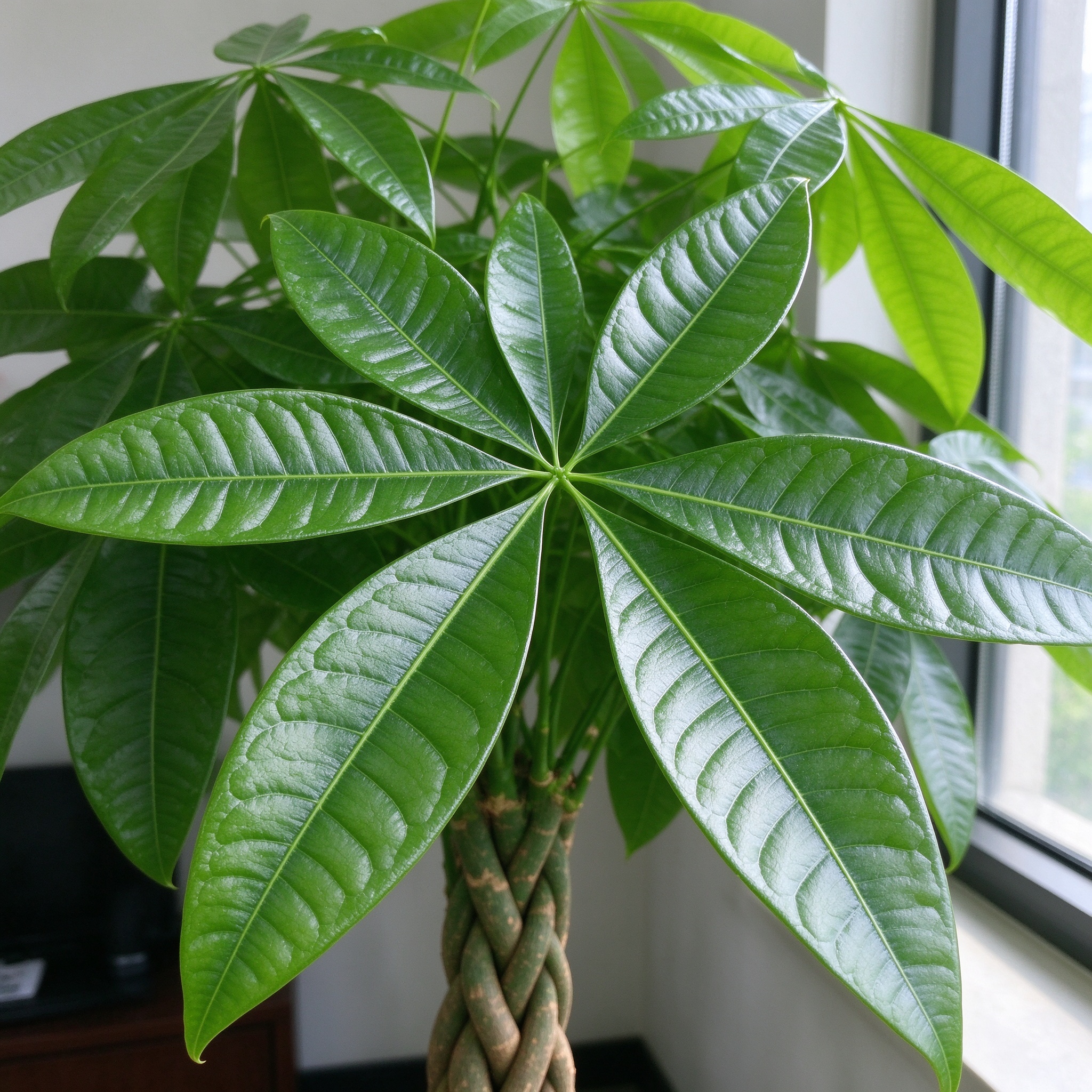
(Spring through summer, year after year)- •In the warm, bright months the canopy expands: new leaves emerge bronze-green and mature to a glossy deep green, the trunk thickens, and a single stem or braided cluster develops a fuller crown.
- •This is the season for any repotting, top pruning, canopy shaping, and stem cuttings, all of which recover fastest when the plant is actively growing.
- •Rotate the pot weekly so growth stays symmetrical, and wipe the leaflets with a soft damp cloth now and then to remove dust that blocks light and harbors mites.
- •A healthy canopy should keep its leaves; a cluster of leaves dropping at once points to a watering problem, a draft, or a recent move rather than normal aging.
 4
Winter rest
(Late fall through winter)- •Growth slows and may nearly stop in a short-day, cool room.
- •Water far less often, allowing the top two inches to dry and checking that the root ball does not stay cold and wet; NC State's guidance for warm-weather houseplants holds here: keep the plant drier in winter.
- •Hold fertilizer completely, and do not repot or prune for size during this rest period.
- •Maintain moderate humidity if the heating system dries the air hard, either with a pebble tray or a small humidifier nearby, and keep the trunk base away from cold floors and drafty exterior doors.
- •A slight wrinkling of the caudex between drinks in winter is normal; deep wrinkles plus a soft, dark base mean rot or a long dry spell that needs correction.
💧 Detailed Care Guide
☀️ Light Requirements
- •The money tree plant needs bright indirect light or a partial mix of sun and shade, and it cannot tolerate full direct sun behind a window for long.
- •NC State states that the species prefers indirect sunlight or a mix of sun and shade and that leaf scorch can occur from exposure to direct sunlight.
- •A position near a large east window, or three to six feet back from a south or west window where a sheer curtain softens the rays, delivers the right balance: enough brightness to keep the canopy dense and the leaflets a rich green, without the hot afternoon sun that bleaches or burns the foliage.
- •An indoor money tree will survive a darker corner for a while, but growth becomes thin, stems stretch toward the nearest window, and older leaves yellow and drop faster than usual.
- •Rotate the pot a quarter turn every week or two so the trunk grows straight instead of leaning toward the light.
- •Avoid placing the plant where hot afternoon sun hits the leaves through clean, unfiltered glass; outdoor summer exposure should also be gradual, and NC State advises protecting outdoor plants from strong wind.
💧 Watering
- •Water on a soak-and-check rhythm, never on a fixed calendar.
- •NC State says the plant prefers moist, well-drained potting mix of peat moss, perlite, loam, or sand, and that standing water is not tolerated and can cause root rot; the UF/IFAS Gardening Solutions guidance for houseplants matches this: let the upper inch of soil dry between waterings, water thoroughly with room-temperature water until it runs out the drainage hole, and never leave the pot standing in a saucer of pooled water.
- •In practice, insert a finger or a wooden stick about one to two inches into the mix: when that layer is dry and the soil at that depth is no longer cool to the touch, water deeply.
- •In a bright, warm summer room that is often once every seven to fourteen days; in a cool, darker winter corner it can stretch to two or three weeks between drinks.
- •The swollen trunk stores water, which is why this plant tolerates a missed watering far better than soggy soil.
- •Money trees are sensitive to water chemistry as well as moisture level: NC State and common interiorscape practice point to yellowing or browning leaf tips when the plant sits in salty, fluoridated water or fertilizer buildup, so use room-temperature tap water allowed to stand overnight, or filtered water, and flush the pot annually with several volumes of water to leach accumulated salts.
🌡️ Temperature
- •Keep the money tree plant in a warm, stable room temperature.
- •The comfortable household range is roughly 61–81°F (16–27°C); the ideal band NC State notes for this humid-environment species is about 65–75°F (18–24°C).
- •Outside that comfort band it tolerates typical household warmth briefly and can stay comfortable as high as the mid-80s if humidity and ventilation are adequate, but it suffers below roughly 50°F (10°C).
- •NC State directs that in colder climates the tree should be brought indoors before temperatures drop to 45°F (7°C), which matters only if you summer a potted plant on an open patio or balcony.
- •Keep the plant away from heating vents, air-conditioning outlets, exterior doors that open often, and drafty windowsills: sudden cold blasts cause leaf drop just as dry hot air causes leaf tip browning.
- •Do not put a money tree against a radiator or in the path of a fan that blows directly on the canopy overnight.
- •Night temperatures in the low 60s are fine; prolonged exposure to a chilly unheated room above a cold floor in winter is one of the most common indoor stress triggers.
🌱 Soil & Fertilizer
Soil:
- •Use a loose, open, fast-draining potting mix that still holds some moisture.
- •NC State recommends a moist, well-drained mix of peat moss, perlite, loam, or sand across acid, neutral, or mildly alkaline conditions; the RHS advises an open, free-draining compost for indoor Pachira.
- •A reliable indoor blend is two parts standard peat-based or peat-free houseplant potting soil, one part perlite or pumice for aeration, and one part orchid bark or coarse sand to keep the mix from compacting after repeated watering.
- •The swollen trunk and surface roots rot quickly in dense, peat-heavy seed-starting mixes that stay wet for days, so drainage matters more than richness.
- •Do not garden soil or compost into the pot: it compacts hard in a container, holds water against the roots, and invites the root rot NC State warns against.
- •If your local tap water is hard, let water stand overnight before watering so chlorine dissipates and the soil pH does not drift sharply alkaline over time.
Fertilizer:
- •Feed lightly and only during active growth.
- •Apply a balanced liquid houseplant fertilizer such as 10-10-10 or 20-20-20 diluted to half strength once a month from spring through early fall, matching NC State's note that yellow leaves can result from inadequate nutrients in the soil.
- •Stop fertilizing completely in fall and winter, when the plant rests and excess salts accumulate in a cool, slowly drying root ball.
- •Money trees are not heavy feeders; a concentrated or more frequent feed produces soft, leggy growth and builds the salt layer that burns leaf tips.
- •If you repot annually into fresh mix, you can halve the amount of fertilizer again.
- •Fertilizer salts show up as a white crust on the soil surface or around the drainage hole; when you see that crust, flush the pot with several pots of room-temperature water, let it drain fully, and skip the next feeding.
📝 Step-by-Step Planting Guide
- 1
Choose a bright indirect position away from drafts
- •Set the money tree plant near a large east window or three to six feet back from a south or west window behind a sheer curtain, matching NC State's preference for indirect sunlight or a mix of sun and shade and its warning that direct sunlight scorches the leaves.
- •Keep it at least a few feet from heating vents, air-conditioning outlets, and doors that open often; NC State warns against wind on outdoor plants, and indoor drafts produce the same leaf-drop stress.
- •Pick a stable spot the plant will occupy long-term, because money trees drop leaves after repeated moves.
- 2
Use a pot with drainage in the right size
- •Choose a container with at least one working drainage hole, only one size larger than the root ball; UF/IFAS Gardening Solutions stresses thorough watering that drains out the bottom and forbids standing water.
- •A young plant in a 6 to 8 inch diameter pot moves to an 8 to 10 inch pot when roots circle the inside; never jump straight into a very large planter, since the unused wet soil around a small root ball drives root rot.
- •A heavy ceramic or weighted pot helps stabilize a tall, top-heavy canopy.
- 3
Mix a free-draining soil blend
- •Combine two parts houseplant potting soil with one part perlite or pumice and one part orchid bark or coarse sand, matching NC State's moist but well-drained mix of peat moss, perlite, loam, or sand and the RHS call for an open, free-draining compost.
- •The blend should hold enough moisture for a few days while water passes straight through; dense, compacted soil that stays soggy for days is incompatible with this species.
- 4
Set the plant at its original depth and water thoroughly
- •Water the root ball first so it slides out of the nursery pot without tearing roots, then place the plant at the same depth it was growing before: the top of the caudex where roots meet trunk should sit level with the soil surface, not buried under a mound of fresh mix.
- •Fill around the roots, firm lightly, and water with room-temperature water until it flows freely from the drainage hole; empty the saucer after ten minutes, following UF/IFAS guidance that the pot must never stand in water.
- 5
Water by soil check and feed monthly in growth
- •Water only when the top one to two inches of mix are dry, then soak thoroughly and drain fully; follow NC State's moist, well-drained preference and its warning that standing water causes root rot, alongside the UF/IFAS rule of drying between thorough waterings.
- •From spring to early fall, apply a balanced liquid houseplant fertilizer at half strength once a month; stop in winter, matching the rest period NC State implies by grouping the species with warm-season tropicals.
- 6
Repot in spring and propagate from stem cuttings
- •Repot every two to three years in spring, moving up one pot size, when roots circle the pot and water runs straight through without soaking in.
- •To propagate, take a 4 to 6 inch semi-ripe stem cutting in spring or summer, strip the lower leaves, and root it in water or in moist free-draining mix; the RHS lists propagation by semi-ripe cuttings and air-layering, and NC State lists stem cutting and layering among the recommended strategies.
- •Keep the cutting warm and humid until roots form, then pot it into the same blend used for the mother plant.
🌱 Recommended Varieties
Braided standard money tree (the store form)
- •The plant sold in most nurseries is formed from several flexible Pachira seedlings braided together while young, then grown on so the woody stems set into one sculptural trunk.
- •NC State explains that the trunks are so flexible they can be braided together and notes that the braiding of seedling stems originated in Taiwan as a commercial training practice rather than a botanical trait.
- •The foliage is the standard glossy green palmate leaf; care, light, and watering are identical to an unbraided plant, and NC State adds that a braided plant will not flower indoors.
Single-stem or multi-stem unbraided plant
- •Growers also sell Pachira aquatica as an unbraided single stem or as a loose cluster of stems in one pot, without the woven trunk.
- •These forms let the plant develop a more natural, bushy habit and are simpler to repot and prune into a custom shape.
- •The species itself is the same; NC State describes the genus as a flexible-stem tree that can reach 6 to 8 feet indoors, so the unbraided form can be trained onto a stake or allowed to branch lower as it matures.
Floor-sized statement tree
- •A two to three-year-old plant grown on into a 12 to 16 inch pot makes a floor-level accent between a sofa and a window, reaching roughly 5 to 7 feet indoors with an open canopy of palmate leaves.
- •NC State records an indoor height of 6 to 8 feet and an outdoor width matching the height in warm climates; indoors the canopy stays narrower.
- •This form needs the brightest indirect spot in the room, a stable heavy pot, and occasional top pruning to keep it from exceeding the ceiling.
Compact baby plant or small-table specimen
- •Young Pachira seedlings in 4 to 6 inch pots are sold as small desk or shelf plants and stay under two feet tall for their first year or two.
- •These small specimens are forgiving for beginners but need the same bright indirect light, drainage, and soak-and-check watering as the mature tree; a compact plant should be moved up a pot size only when roots appear at the drainage hole.
- •NC State notes the species grows rapidly, so a small money tree can outgrow its starter pot within a couple of growing seasons.
🪴 Growing in Containers
- Drainage hole is non-negotiable:
- •Choose a pot with at least one clear drainage hole.
- •NC State states standing water is not tolerated and causes root rot, and UF/IFAS Gardening Solutions repeats the houseplant rule of watering until water runs out the bottom and never letting the pot stand in water.
- •A decorative cachepot can hide a plain nursery pot; lift the inner pot out to water, let it drain, then set it back.
- •If you fall for a hole-less decorative planter, keep the plant in its nursery pot inside it and never pour water directly into the cachepot.
- Size up only one pot size at a time:
- •When repotting, move to a pot only about one to two inches wider in diameter than the existing root ball.
- •An oversized planter keeps a large volume of wet soil around a small root system, the classic indoor setup for root rot on this species.
- •For a 6 inch nursery plant, the next pot is 8 inches; go to 10 inches only after the roots have filled that one.
- •Repot in spring so fresh mix dries on the plant's active-growth timetable rather than staying cold and wet over winter.
- Terracotta versus plastic and glazed ceramic:
- •Unglazed terracotta breathes and dries the mix faster, which suits a money tree if you tend to water often: the porous sides help the root ball lose moisture and slow rot risk.
- •Plastic and glazed ceramic hold moisture longer, useful in a very dry heated room or for someone who forgets to water, but riskier for a heavy-handed waterer.
- •Match the pot material to your habit rather than to decor alone; the RHS recommends an open, free-draining compost regardless of pot material.
- Stability for a tall, top-heavy canopy:
- •A mature money tree is top-heavy: a light plastic pot can tip when the canopy catches a draft or during a rotation.
- •Choose a heavy ceramic, concrete, or weighted pot that can stand up to a 5 to 7 foot plant, or set a plastic nursery pot inside a decorative heavy cachepot.
- •Keep the pot on pot feet or a tray of pebbles so air circulates under the drainage hole and the base never sits in pooled water; empty the saucer after every watering.
- Cachepot and humidity tray:
- •If the room is dry in winter, place the pot on a shallow tray filled with pebbles and a small amount of water; the evaporating moisture raises local humidity without leaving the roots standing in water.
- •NC State notes the species thrives in a humid environment, and the pebble tray provides that buffer around the canopy.
- •Keep the water level below the top of the pebbles so the pot itself does not sit in liquid, and refresh the tray weekly to keep it from growing algae or breeding gnats.
✂️ Pruning & Maintenance
- ✓
Remove yellow, brown, or damaged leaflets
- •Cut yellowed, browned, or mechanically damaged leaves cleanly where the petiole meets the stem using sanitized shears.
- •NC State notes yellow leaves can result from low humidity or poor nutrients and brown leaf tips from salt buildup, so grooming also gives you a chance to inspect the rest of the canopy.
- •Removing spent foliage redirects energy into new leaf clusters and improves airflow around the crown.
- •A single old leaf yellowing each month is normal; several at once signals overwatering, dry soil, or a draft and should be diagnosed rather than trimmed away.
- ✓
Top the main stem to control height
- •Once the tree reaches your desired indoor height, snip the top growing tip back in spring, just above a leaf node or leaf scar; this stops upward growth and encourages side branches lower on the stem for a fuller, tree-like shape.
- •NC State lists a 6 to 8 foot indoor height and RHS recommends semi-ripe cuttings taken at this time.
- •Never top a plant that is still acclimating or showing stress; wait for active growth and a healthy canopy before reducing the leader.
- ✓
Thin leggy stems and reshape the canopy
- •When a stem grows long and sparse toward the light, cut it back to a healthy node in spring; fresh shoots usually emerge below the cut within a few weeks.
- •On a braided standard, keep pruning to leafy stems above the braid so the woven trunk stays intact; on an unbraided cluster, you can remove a whole weak stem at soil level to open the center to air and light.
- •Rotating the pot weekly during growth reduces the legginess that makes this pruning necessary.
- ✓
Keep tools clean and watch the sap
- •Wipe shears with rubbing alcohol between cuts and between plants to avoid spreading anthracnose or scale.
- •The cut stem may release a small amount of sap; wear gloves if you have sensitive skin, and wipe the cut with a clean cloth rather than leaving a sticky residue on the trunk.
- •NC State lists anthracnose and powdery mildew among the possible diseases, both favored by wet foliage, so make pruning cuts clean and do not leave clipped foliage sitting on the soil surface.
🐛 Pest & Disease Control
Common Pests
Mealybugs
Symptoms:- •Cottony white ovals cluster in the leaf axils, along the stems, and on the underside of leaflets; sticky honeydew coats nearby foliage, and tender new growth emerges curled or distorted as the insects suck sap.
- •NC State names mealybugs among the insects to monitor on Pachira.
Control:- •Dab every visible mealybug with a cotton swab dipped in rubbing alcohol, then wipe the whole canopy with diluted insecticidal soap or neem oil, repeating every ten days for a month because eggs hidden in crevices keep hatching.
- •Check neighboring houseplants, raise air circulation around the plant, and isolate it while treating so the infestation does not spread to nearby pots.
Scale insects
Symptoms:- •Small raised brown or tan bumps stick to the stems and leaf veins and do not move when touched; sooty black mold grows on the honeydew they excrete, and leaflets yellow or drop early.
- •NC State lists scale among the pests to monitor on this species.
Control:- •Scrape each bump off with a fingernail or alcohol-dampened swab, then spray the whole plant with horticultural oil or neem to kill the mobile crawler stage; repeat every seven to ten days for a month.
- •Prune heavily infested stems and seal them in a bag before disposal so crawlers do not transfer to other houseplants.
Aphids
Symptoms:- •Clusters of small green, brown, or black insects gather on tender new growth and the tips of stems, curling young leaflets and excreting sticky honeydew that supports sooty mold.
- •NC State names aphids among the insects to watch for on Pachira aquatica.
Control:- •Wash the insects off under a gentle lukewarm shower or with a soft cloth and dilute insecticidal soap, paying attention to the stem tips and leaf undersides.
- •Repeat every few days until no aphids remain; neem oil applied in the shade helps break the cycle.
- •Keep the canopy open and well ventilated, since aphids favor soft, succulent growth promoted by over-fertilizing.
Fungus gnats
Symptoms:- •Tiny black flies dart around the soil surface and crawl across the pot rim; the larvae live in moist mix and feed on fine roots, contributing to wilting and yellowing in a chronically wet container.
- •NC State lists fungus gnats among the monitored insects on this species.
Control:- •Let the top one to two inches of mix dry between waterings, because gnat larvae survive only in continuously damp soil; place yellow sticky cards on the soil to catch adults and stop egg-laying.
- •If the infestation is established, treat the mix with Bti (Bacillus thuringiensis israelensis) drench and check that the pot drains fully after every watering.
- •Reducing moisture is the permanent fix; insect sprays alone do not remove the larvae.
Common Diseases
Root rot (overwatering)
Symptoms:- •Leaflets yellow, wilt, and drop even though the soil is wet; the base of the trunk or caudex feels soft and dark instead of firm, and roots pulled from the pot are brown and slimy rather than pale and solid.
- •NC State states standing water is not tolerated and can cause root rot; this is the most common cause of a sudden indoor money tree collapse.
Control:- •Stop watering immediately and tip the plant out of the pot.
- •Clip away every brown, mushy root with sterile shears, remove soggy old mix, and repot into fresh free-draining blend in a clean pot with a working drainage hole.
- •Let the mix dry before watering again and keep the plant on the soak-and-dry schedule going forward.
- •If the caudex itself has turned mushy beyond recovery, propagate any healthy stem section rather than trying to save the rotting base.
Anthracnose leaf spot
Symptoms:- •Tan to dark brown, slightly sunken spots with yellow halos develop on leaflets, often starting at the tips or edges and spreading across the blade; centers may dry and crack.
- •NC State lists anthracnose among the potential diseases of Pachira, favored by water sitting on foliage and stagnant, humid air.
Control:- •Stop wetting the canopy when watering; water the soil rather than the leaves.
- •Pick off and bag every spotted leaf, disinfecting shears between cuts, and improve air circulation around the plant.
- •A general houseplant fungicide applied every ten days until new growth stays clean slows spread; watering in the morning so any accidental splash dries before evening prevents reinfection.
Powdery mildew
Symptoms: A thin white powdery coating spreads across leaflet surfaces and young stems, leaves curling and distorting as the fungus blocks light; NC State lists powdery mildew among the species' possible diseases, triggered by still air and humid conditions with wet foliage.Control:- •Increase spacing and airflow around the canopy, wipe affected leaves with diluted neem or a baking-soda solution, and remove the worst-dusted leaves for disposal.
- •Avoid overhead watering and keep the room ventilated; in severe cases use a labeled houseplant fungicide every seven to ten days until the mildew stops appearing on new growth.
Salt burn and leaf tip browning (physiological)
Symptoms:- •Leaflet tips and edges turn brown and crisp, often with a yellow band between the dead tip and green tissue; a white crust may form on the soil surface or around the drainage hole.
- •This is not a pathogen but a reaction to hard water, fluorides, or accumulated fertilizer salts, consistent with NC State's note that inadequate moisture and poor growing conditions yellow the foliage.
Control:- •Use room-temperature filtered water or tap water left to stand overnight, cut fertilizer to half strength in the growing season and stop in winter, and flush the pot with several volumes of water to leach built-up salts.
- •Trim the brown tips with sterile shears, following the natural contour of the leaflet, and monitor new growth to confirm the tips emerge green rather than brown.
🍅 When to Harvest
- •There is no edible harvest on an indoor money tree plant.
- •Mature outdoor trees in zones 10 to 12 produce woody brown capsules in summer that split to release edible-looking nuts; NC State reports the seeds or nuts are eaten raw, fried, or roasted in parts of the species' native range, while some sources flag cyclopropenoid fatty acids in the seed and advise research before eating them.
- •Indoor plants almost never flower, and NC State adds that a braided money tree will not flower at all, so houseplant owners should not expect seeds.
- •The indoor 'milestone' to watch for is healthy growth: a swollen, firm trunk base, new palmate leaves unfurling steadily through spring and summer, and a canopy that fills out without dropping leaves in clusters.
❓ Frequently Asked Questions
- 1
Why is my money tree plant losing leaves?
- •Leaf drop is the money tree's main stress signal and it usually traces to one of four causes.
- •Overwatering or root rot makes leaves yellow and fall while the soil stays wet, often with a softening trunk base; underwatering makes the whole canopy wilt and shed leaves after the mix goes bone dry.
- •A recent move, a cold draft near a door or window, or a heating vent blowing on the canopy also triggers a round of leaf drop, and NC State notes that leaf drop can occur when the soil is too dry.
- •Check the soil first: if wet and soggy with a soft base, you likely have root rot and need to unpot, trim, and repot into fresh mix; if bone-dry, soak thoroughly and return to a soak-and-check schedule.
- •A plant dropping one or two leaves after relocation usually settles once conditions stabilize.
- 2
Does a money tree plant need sunlight?
- •Yes, but bright indirect light rather than direct sun.
- •NC State states the species prefers indirect sunlight or a mix of sun and shade and that leaf scorch can occur from exposure to direct sunlight.
- •Put it near a large east window or three to six feet back from a south or west window behind a sheer curtain.
- •It can survive a darker corner for a while, but low light produces leggy stems, sparse foliage, and faster leaf drop; direct afternoon sun behind glass burns the leaflets.
- •Rotate the pot weekly so growth stays even on all sides.
- 3
How often should I water a money tree plant?
- •Do not water on a fixed schedule.
- •Check the top one to two inches of soil: water thoroughly with room-temperature water until it drains freely, then wait until that layer is dry before the next drink.
- •NC State calls for moist but well-drained mix and warns standing water causes root rot; UF/IFAS says to let the upper inch dry between thorough waterings and never let the pot stand in water.
- •In a bright warm summer room that is often every seven to fourteen days; in a cool dark winter corner two to three weeks may pass between drinks.
- •Empty the saucer after every watering.
- 4
Why is my money tree trunk soft?
- •A soft, spongy, dark or blackening base on the trunk is a root-rot warning, not a normal state.
- •NC State states standing water causes root rot; when the base of the caudex softens, the roots are already decaying from chronically wet soil, a hole-less pot, or a saucer left full.
- •Act quickly: tip the plant out, cut away brown and mushy roots and any soft trunk tissue with sterile shears, and repot into fresh free-draining mix in a pot with a working drainage hole.
- •Let the mix dry before watering again.
- •If most of the base has turned soft and smelly, save the plant by cutting a healthy stem section and rooting it as a new plant.
- 5
Is a money tree plant toxic to cats?
- •No.
- •The ASPCA lists Pachira aquatica as non-toxic to cats, dogs, and horses and identifies no toxic principle in the plant; this makes it one of the safer tree-like houseplants for pet households.
- •As with any foliage, a pet that chews a large amount may still get mild nausea, vomiting, or loose stool, so keep fallen leaves cleaned up and place the plant where bored pets cannot groom the canopy.
- •Browse our cat-safe plant list at /cat-safe for more options.
- •The seeds formed only on mature outdoor trees are a separate matter flagged by some sources, but indoor money trees never flower or set seed.
- 6
Why are my money tree leaves turning yellow and brown?
- •Yellowing from the base upward with wet soil points to overwatering and early root rot; NC State notes that yellow leaves can occur when humidity is too low or the soil lacks nutrients, and brown crispy tips usually come from dry heated air, hard or salty water, or fertilizer buildup.
- •Start by checking moisture: let the top one to two inches dry before watering again, raise local humidity with a pebble tray, flush the salts out of the pot, and cut fertilizer to half strength during spring and summer only.
- •If the whole canopy yellows after a cold draft or a move, return the plant to a stable warm spot and remove only the worst leaves.
- 7
Can I untie or remove the braided trunk?
- •The braid is a nursery training practice, not a botanical feature.
- •NC State reports the stems are flexible when young and that braiding seedling stems originated as a commercial technique; once the stems lignify and harden, the woven form sets into the wood and will not unravel on its own.
- •You can leave the braid for the plant's whole life without any harm; care and watering are the same as an unbraided plant.
- •If you want to free a mature braid, do it gradually over several seasons rather than cutting the wrap all at once, because the constrained stems may not stand upright once released.
- •NC State also notes that a braided plant will not flower indoors.
- 8
How do I propagate a money tree plant?
- •Root a stem cutting in spring or summer.
- •NC State lists stem cutting and layering among the recommended propagation strategies, and the RHS lists semi-ripe cuttings and air-layering.
- •Take a 4 to 6 inch cutting with several leaf nodes, strip the lower leaves, and either stand it in a glass of room-temperature water on a bright indirect windowsill or plant it in moist free-draining perlite-and-mix blend.
- •Keep it warm and humid, change the water weekly if rooting in water, and move the rooted cutting into the standard money tree soil blend once roots are two to three inches long.
- •Seed propagation works only for outdoor warm-climate trees; indoor plants rarely produce seed.
- 9
Why are the leaf tips brown and crispy?
- •Brown crispy tips most often mean dry air, water chemistry, or salt buildup rather than a disease.
- •NC State links yellowing and poor condition to inadequate moisture and growing conditions; in practice, low winter humidity, hard fluoridated tap water, and fertilizer salts all dehydrate the leaflet edges first.
- •Raise humidity around the canopy with a pebble tray or humidifier, water with room-temperature filtered water or water left to stand overnight, and flush the pot with several volumes of water to leach salts.
- •Trim the brown tips along the natural leaflet contour with sterile shears, and watch whether new leaflets unfurl green; recurring brown tips mean one of those three conditions is still present.
Source:
NC State Extension Gardener Plant Toolbox — https://plants.ces.ncsu.edu/images/plants/pachira-aquatica/
NC State Extension Gardener Plant Toolbox — https://plants.ces.ncsu.edu/images/plants/pachira-aquatica/
Royal Horticultural Society (RHS) — https://www.rhs.org.uk/images/plants/12078/pachira-aquatica/details
Missouri Botanical Garden Plant Finder — https://plantfinder.mobot.org/PlantFinderDetails.aspx?bt=1&isprofile=0&taxonid=277941
ASPCA Animal Poison Control Center — https://www.aspca.org/pet-care/aspca-poison-control/toxic-and-non-toxic-plants/money-tree
UF/IFAS Extension Gardening Solutions — https://gardeningsolutions.ifas.ufl.edu/images/plants/houseplants/houseplant-care.html
Photo credit: NC State Extension
Images courtesy of NC State Extension under CC BY license. Thank you to the photographers who make these educational images available.
License: CC BY-NC 2.0 / CC BY 4.0