
How to Grow Peace Lily: Complete Guide
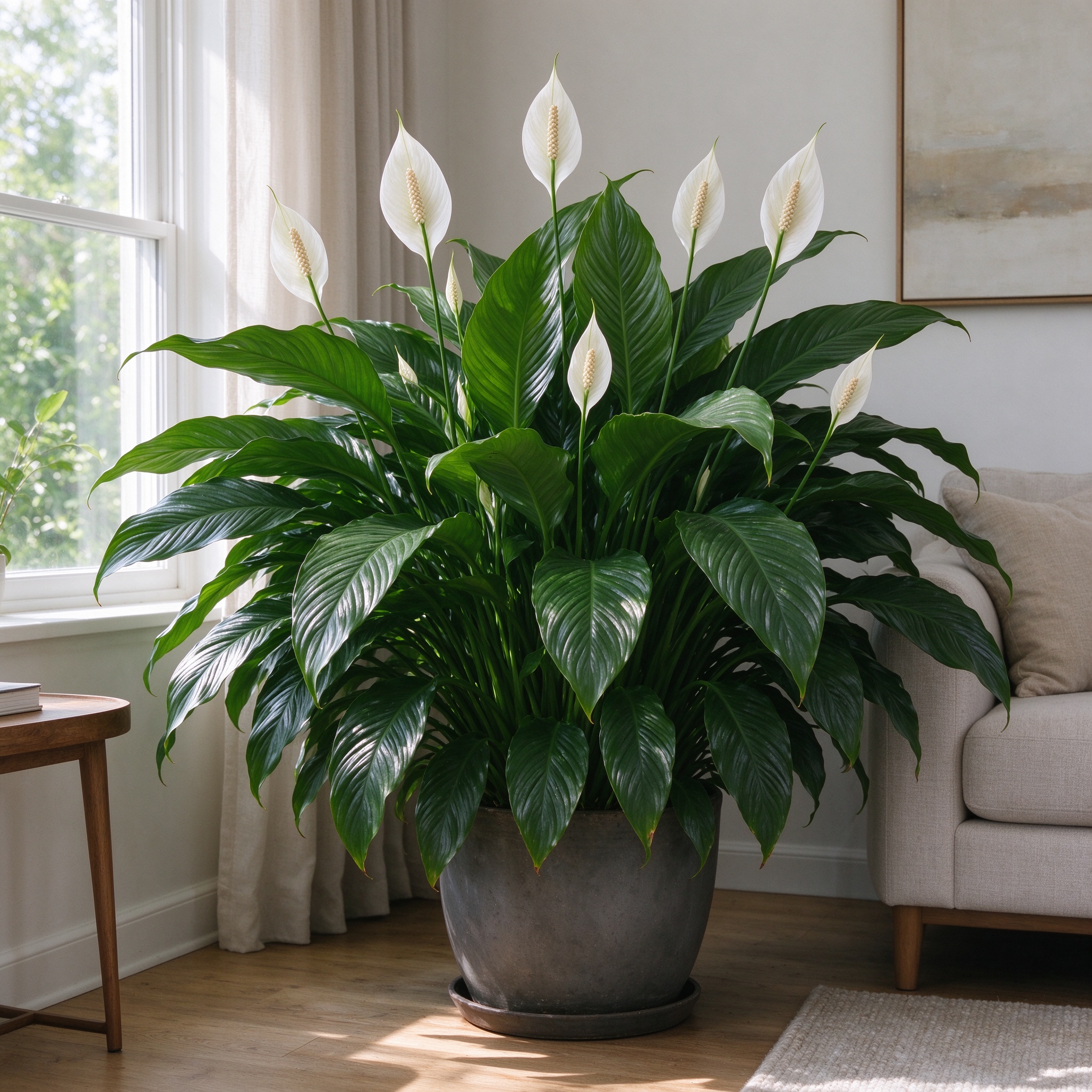
- •The peace lily (genus Spathiphyllum), also sold as spathiphyllum, white sails, or spathe flower, is a semi-evergreen rhizomatous perennial in the Araceae (aroid) family.
- •NC State Extension records about 60 species native to Mexico, tropical America, Malesia, and the islands of the western Pacific; the compact houseplant most often sold, Spathiphyllum wallisii, originates in Colombia and Venezuela.
- •Plants form basal rosettes of glossy, dark green, lance-shaped to elliptical leaves on long petioles rising directly from a stemless crown.
- •Indoors most varieties reach 1 to 3 feet tall and wide, while large cultivars such as 'Sensation' can mature at 5 to 6 feet.
- •What people call the flower is actually a spadix — a central fleshy spike packed with tiny true flowers — wrapped in a showy, sail-like white spathe that opens above the foliage.
- •Despite the common name, the peace lily is not a true lily (Lilium) and shares no relationship with the highly toxic true lilies that can cause kidney failure in cats; it is an aroid in the same family as monstera and pothos.
- •NC State notes the white spathe changes to pale green after about ten days and remains attractive for at least another month, so a mature plant carries foliage and blooms almost continuously in a good room.
- •The UF/IFAS fact sheet EP477 describes Spathiphyllum as a very attractive houseplant even when not in bloom, and the RHS lists lightly fragrant white flowers resembling calla lilies among its ornamental features.
- •One of the few flowering houseplants that thrives in low light, it also communicates thirst clearly: the whole crown droops dramatically before recovering within hours of watering.
- •Keep the plant out of reach of nibbling pets: the ASPCA lists Spathiphyllum as toxic to both cats and dogs because insoluble calcium oxalate crystals inside the plant cells cause oral and gastrointestinal irritation.
- •This peace lily care guide walks through light, watering, humidity, soil, feeding, pests, flowering, division, and repotting, so beginners and experienced growers alike can keep a healthy, freely blooming specimen year-round.
📋 Quick Facts
- •The peace lily is one of the most shade-tolerant flowering houseplants available, which is why it performs in hallways and north-facing rooms where most blooming plants fail, but light level directly controls how many spathes it produces.
- •NC State Extension places Spathiphyllum under partial shade to deep shade (less than two hours to no direct sunlight) and instructs not to place plants in direct sun; UF/IFAS EP477 specifies bright indirect light with no direct sun, and the RHS peace lily guide says to keep plants in bright indirect light near a window but out of direct summer sun, adding that plants survive in deeper shade but will rarely flower and grow very slowly.
- •In practice an east-facing window, a position a few feet back from a south or west window behind a sheer curtain, or a bright room without direct rays gives the best balance: glossy dark green leaves, steady new growth, and regular spathes.
- •Direct sun through glass scorches the broad blades within days: NC State lists excessive direct sunlight among the causes of brown leaf tips, and the UF/IFAS interiorscape guidelines EP161 explain that excessive light bleaches leaves to a pale color often mistaken for nutrient deficiency; those guidelines recommend production shade of 1,500 to 2,500 foot-candles, corresponding indoors to a softly lit room rather than a sunny sill.
- •In a genuinely dark corner the plant stays alive for months but growth slows to a crawl, leaves turn smaller and paler, and no flowers form; a full-spectrum grow light on a 10-to-12-hour timer compensates in winter or in low-light bathrooms.
- •Rotate the pot a quarter turn every few weeks so the rosette grows evenly instead of leaning toward one window.
- •A few hours of gentle morning sun through an east window is tolerated by acclimated plants; hot midday or afternoon sun through glass should always be filtered or avoided.
- •Water on a moist-but-not-soggy rhythm rather than a rigid weekly schedule.
- •NC State directs keeping the soil moist but not soggy, allowing it to dry between waterings, and notes that watering from below works very well for peace lilies; UF/IFAS EP477 repeats to keep the medium moist but never allow the plant to sit in water, and the RHS guide says to let the top of the compost dry out between waterings and reduce watering in winter, when long-wet compost produces root rot.
- •The clearest indoor method: water thoroughly until liquid runs freely from the drainage hole, then wait until the top 1 to 2 inches (2.5 to 5 cm) of mix feel dry before watering again.
- •In a bright, warm room that usually means every five to seven days in spring and summer; in a cool, dim corner it stretches to ten to fourteen days in winter, and the RHS advises watering sparingly while growth rests.
- •Peace lilies are famously dramatic when thirsty: the entire crown droops, spathes nod, and older leaves sag.
- •The UF/IFAS interiorscape guidelines EP161 call this severe wilt or crash the single most common maintenance problem, caused by underwatering.
- •NC State notes slight drought tolerance and UF/IFAS records the species as slightly drought tolerant, so a missed watering rarely kills a plant; when the droop appears, soak the root ball and the crown stands back upright within one to three hours.
- •Chronic repeated wilting, however, permanently damages older leaves, so water a day or two before the plant reaches that signal.
- •Use room-temperature water; cold water shocks the roots.
- •Never let the pot stand in a saucer of pooled water: NC State and Clemson HGIC both warn that sitting in excess water leads to root rot, so empty the saucer within a few minutes of watering.
- •The species has no salt tolerance (UF/IFAS), and like other aroids it is sensitive to fluoride, chlorine, and fertilizer salts that accumulate at the leaf tips; if brown tips appear on an otherwise correctly watered plant, switch to filtered, rain, or standing tap water, and flush the pot with plain water every few months to leach built-up salts.
- •A warm, stable room suits a peace lily year-round.
- •NC State records warm conditions between 68 and 85°F (20–29°C) during the day with no more than a 10°F drop at night; temperatures of 40 to 60°F (4–15°C) slow growth considerably, and extended periods below 40°F (4°C) damage leaves, stems, and roots.
- •Clemson HGIC 1512 matches this with warm daytime temperatures of 68 to 85°F and nights about 10°F cooler, advising against anything below 60°F (15.5°C) because cold damage may occur.
- •UF/IFAS EP477 gives a warm tropical preference of 75 to 85°F (24–29°C), notes moderate chill tolerance down to 35°F for some cultivars, and records that active growth is reduced at or below 50°F (10°C); the RHS guide lists average room temperatures between 12 and 24°C (55–75°F) as acceptable.
- •Keep the plant away from cold drafts, exterior doors, poorly sealed winter windows, and air-conditioning vents that blow cold air across the leaves; Clemson specifically warns not to place it where heat or air-conditioning vents blow directly on it, and NC State identifies cold and drafty conditions as a major growth slowdown.
- •Also keep it away from radiator tops and hot air outlets, which dehydrate leaf edges.
- •Humidity is the companion variable: peace lilies prefer moderate to high humidity, the RHS instructs watering and misting freely while maintaining high humidity during growth, and the RHS peace lily guide warns that leaves start to turn brown when the air is too dry.
- •Aim for relative humidity above 50% if you can: set the pot on a saucer over a tray of damp pebbles (keep the water level below the pot so roots do not stand in it), group the plant with other leafy houseplants, or run a cool-mist humidifier in a dry heated bedroom.
- •Bathrooms with a frosted window naturally suit the combination of warm air, soft light, and humidity.
- •Occasional misting helps with dust but is less reliable than a pebble tray or humidifier for raising sustained humidity; wipe the broad leaves regularly with a damp cloth to remove dust, as NC State recommends for both appearance and pest removal.
- •Peace lilies want a loose, organic, moisture-retentive but freely draining mix.
- •NC State specifies a potting mix high in organic matter with good drainage and an acid pH; UF/IFAS EP477 recommends a rich, organic peat- or bark-based bagged potting soil; the RHS peace lily guide prescribes a peat-free multipurpose compost mixed with perlite at roughly a three-to-one ratio to improve drainage, and Clemson HGIC notes the plant flourishes in almost any well-drained potting mix.
- •A reliable indoor blend is two parts quality peat-free houseplant compost or loam-based compost, one part perlite or pumice for drainage, and half a part orchid bark or coco coir for open structure; the mix must hold moisture for a few days while letting excess water pass through quickly.
- •Dense, compacted seed-starting mixes or heavy garden soil that stay soggy for weeks after watering suffocate the roots and invite root rot; if you tend to overwater, raise the perlite fraction to a third of the volume.
- •NC State records acid pH tolerance while the RHS lists acid, neutral, and alkaline as acceptable across the genus, so a home grower does not need to chase a narrow pH range.
- •Repotting into fresh mix every one to two years replaces organic matter that has degraded and compacted; stale, exhausted mix is a common hidden cause of brown tips and weak new leaves on an otherwise correctly watered plant.
- •There is no edible harvest from a peace lily.
- •The plant is "ready" for propagation when a mature clump has filled its pot and pushed several rooted crowns (offsets) around the mother plant; that is the moment to divide and share, following NC State's recommended division strategy and the RHS note that division works best in winter or immediately after flowering.
- •Mature peace lilies flower intermittently rather than on a single calendar date: NC State states the plants have no specific bloom time but flower freely, while the RHS growing guide records blooms from spring to summer with each spathe lasting up to about four weeks.
- •UF/IFAS research on Spathiphyllum flowering shows that natural bloom initiation responds to short days/long nights and lower temperatures in late winter; most season-dependent cultivars flower mainly in spring and early summer once mature, while some age-dependent hybrids flower continuously after maturing.
- •Commercial market plants are often treated with gibberellic acid to bloom year-round, an induction that is not part of natural home culture.
- •Individual spathes last roughly a month on the plant; trim spent flowers at the base once they brown and fade so energy is redirected back into leaves and new crowns rather than spent on a drying bloom.
- •The most common problem is root rot from overwatering, a pot without drainage, or a saucer left full: the RHS warns that keeping the compost too wet for long periods results in root rot, Clemson states root and stem diseases are the most common problems and are usually associated with over-watering, and NC State ties soggy conditions to decline.
- •Second is brown leaf tips and edges, a symptom NC State lists together under excessive direct sunlight, underwatering, or low humidity; in practice brown tips most often come from dry heated air in winter, fluoride or salts in tap water, or fertilizer salt buildup, and the tips never regreen once brown, so trim them at an angle following the natural leaf shape.
- •Third is failure to flower, which the RHS guide attributes first to insufficient light; other causes include a plant younger than one year, a too-large pot that keeps the soil wet, over-fertilizing, and the gibberellic-acid flush wearing off on a newly bought plant.
- •Yellow leaves have distinct readings: lower leaves yellowing on wet soil signal overwatering and early root rot; leaves yellowing after the soil has been allowed to dry completely point to underwatering; Clemson notes a magnesium deficiency stunts the plant with interveinal yellowing on older leaves while veins stay green.
- •Pests indoors are limited: NC State names mealybugs the most common insect indoors, Clemson lists fungus gnats, mealybugs, spider mites, and scales, and UF/IFAS EP477 lists mealybug and scale; spider mites multiply in hot dry heated air, spinning fine webbing on leaf undersides, while mealybugs cluster as white cottony ovals in leaf axils.
- •Natural aging — one older lower leaf yellowing and dropping each month on an otherwise healthy rosette — is expected and not a disease.
- •Cold drafts, chilled foliage, and placing the plant above a radiator are other major causes of sudden leaf collapse and browning.
⚠️ Pet Safety Warning
This plant is toxic to both cats and dogs.
- •Toxic to cats and dogs per the ASPCA Animal Poison Control Center.
- •Peace lilies contain insoluble calcium oxalate crystals that, when chewed or swallowed, cause intense burning and irritation of the mouth, tongue, and lips, excessive drooling, vomiting, and difficulty swallowing.
- •NC State rates the plant medium severity and notes contact with the sap may irritate skin or eyes.
- •It is not a true lily and does not cause the kidney failure associated with Lilium species, but ingestion still warrants keeping the plant out of reach of pets and children.
- •For non-toxic alternatives for multi-pet homes, browse our cat-safe plants guide.
📅 When to Plant
- •Peace lilies are sold year-round as flowering houseplants, so there is no outdoor sowing or planting window; you can buy a plant and settle it into your home in any month.
- •The best time to repot or divide is spring, when growth resumes and the plant recovers fastest from root disturbance.
- •NC State recommends repotting when necessary in February or March, the RHS advises potting on only when root growth has overfilled the container, and Clemson HGIC 1512 notes repotting can be done any time of year but recovery is quickest during the growing season.
- •Commercial plants often arrive in bloom because growers commonly apply a gibberellic acid treatment to force early flowering; do not expect that first flush to repeat immediately, since the plant may rest for a full growing season before initiating its own spathes under natural conditions.
- •Outdoors the species is hardy only in USDA zones 11a to 12b per NC State, and UF/IFAS EP477 lists outdoor year-round culture as suitable only for zones 10B through 12; everywhere else the plant lives indoors permanently.
- •If you summer your peace lily on a shaded patio, acclimate it to outdoor light gradually over a week or two, and bring it back indoors before nights fall toward 50°F (10°C), below which UF/IFAS records that active growth slows considerably.
🌱 Growing Stages
 1
Nursery acclimation
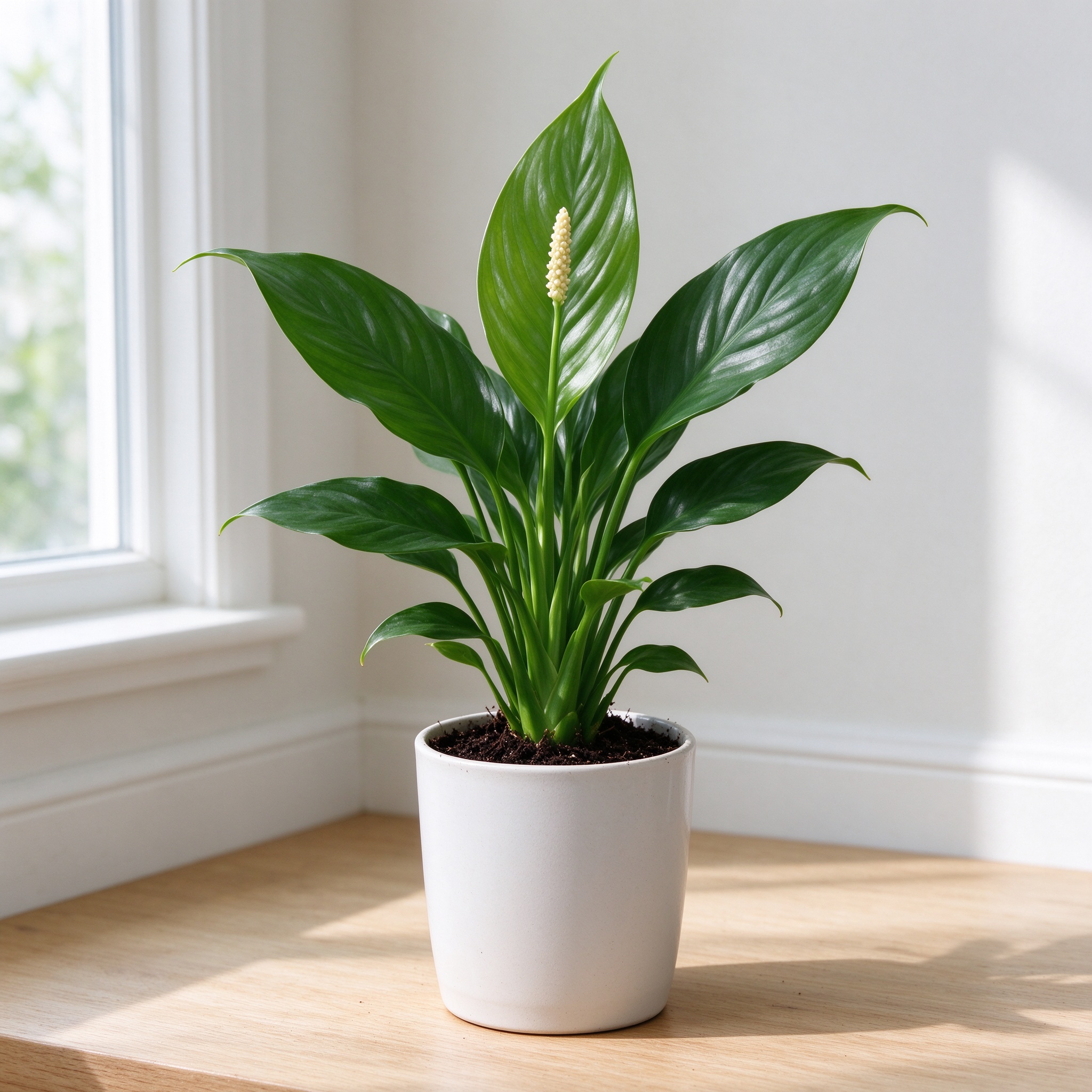
(First 2–4 weeks)- •A newly purchased peace lily has just moved from a greenhouse or grower's treatment program into your home, and the shift in light, temperature, and watering habit shocks it.
- •Expect the lower leaves to yellow and one or two spathes to brown during this period; that is normal acclimation, not a disease.
- •Place the plant in its final bright indirect position, confirm the nursery pot drains, and water only when the top 1 to 2 inches of mix feel dry.
- •Do not repot immediately into a much larger pot: an oversized container holds extra wet soil around a sluggish root ball and invites root rot.
- •Wait at least four to six weeks before repotting so the plant settles into its new light level first.
 2
Root and crown establishment
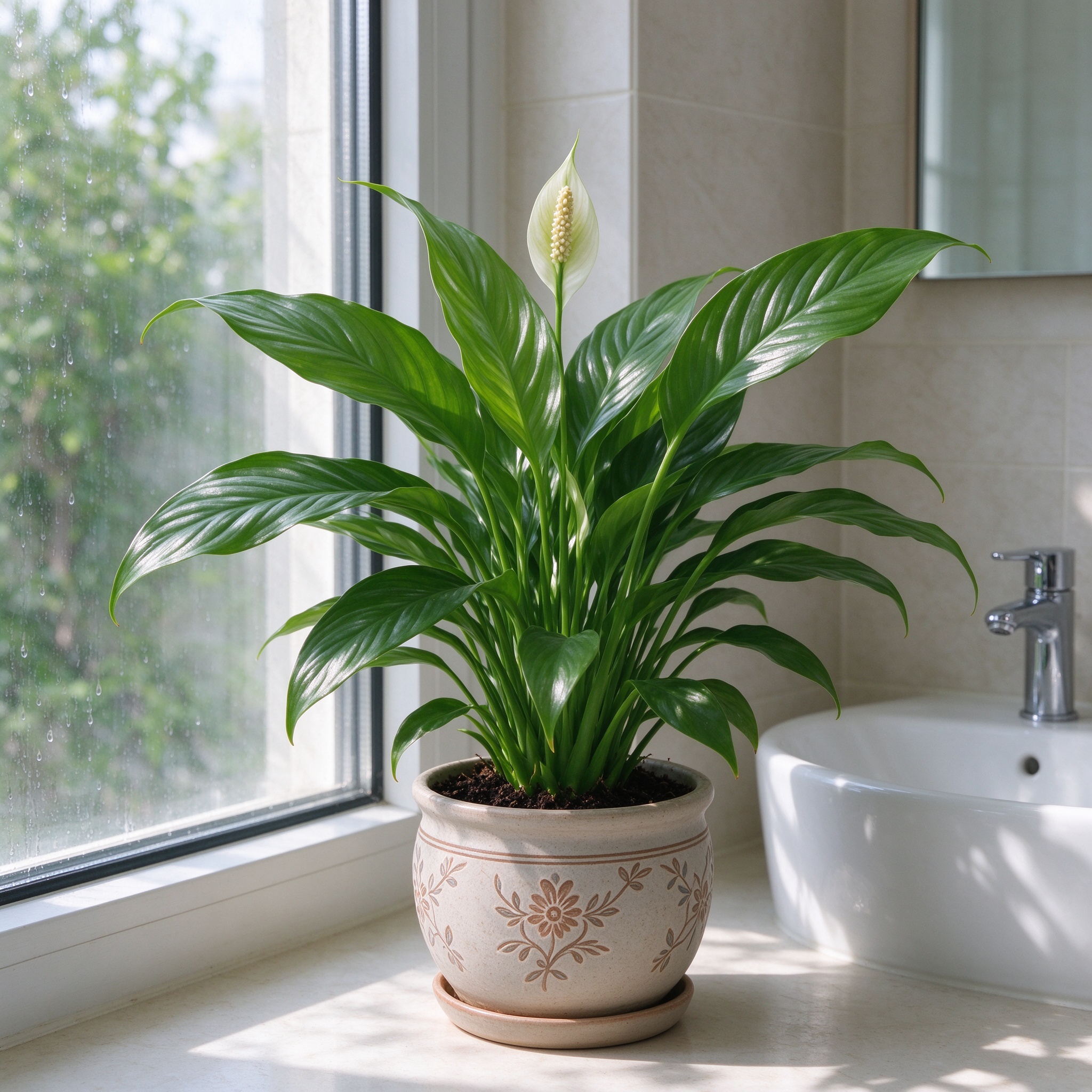
(Months 1–12)- •Once settled, the plant moves energy into expanding the fleshy root system and the basal crown, pushing a new leaf spear every few weeks during the growing season.
- •Keep the mix on the soak-and-dry rhythm and feed at quarter strength monthly in spring and summer so the root mass fills the nursery pot slightly pot-bound, which NC State notes encourages flowering.
- •This is the stage where the plant is most likely to suffer in winter: keep the mix drier and stop feeding from fall onward.
- •Inspect leaf backs and leaf axils at every watering so mealybugs, spider mites, or scale are caught while the population is still small.
 3
Mature flowering clump
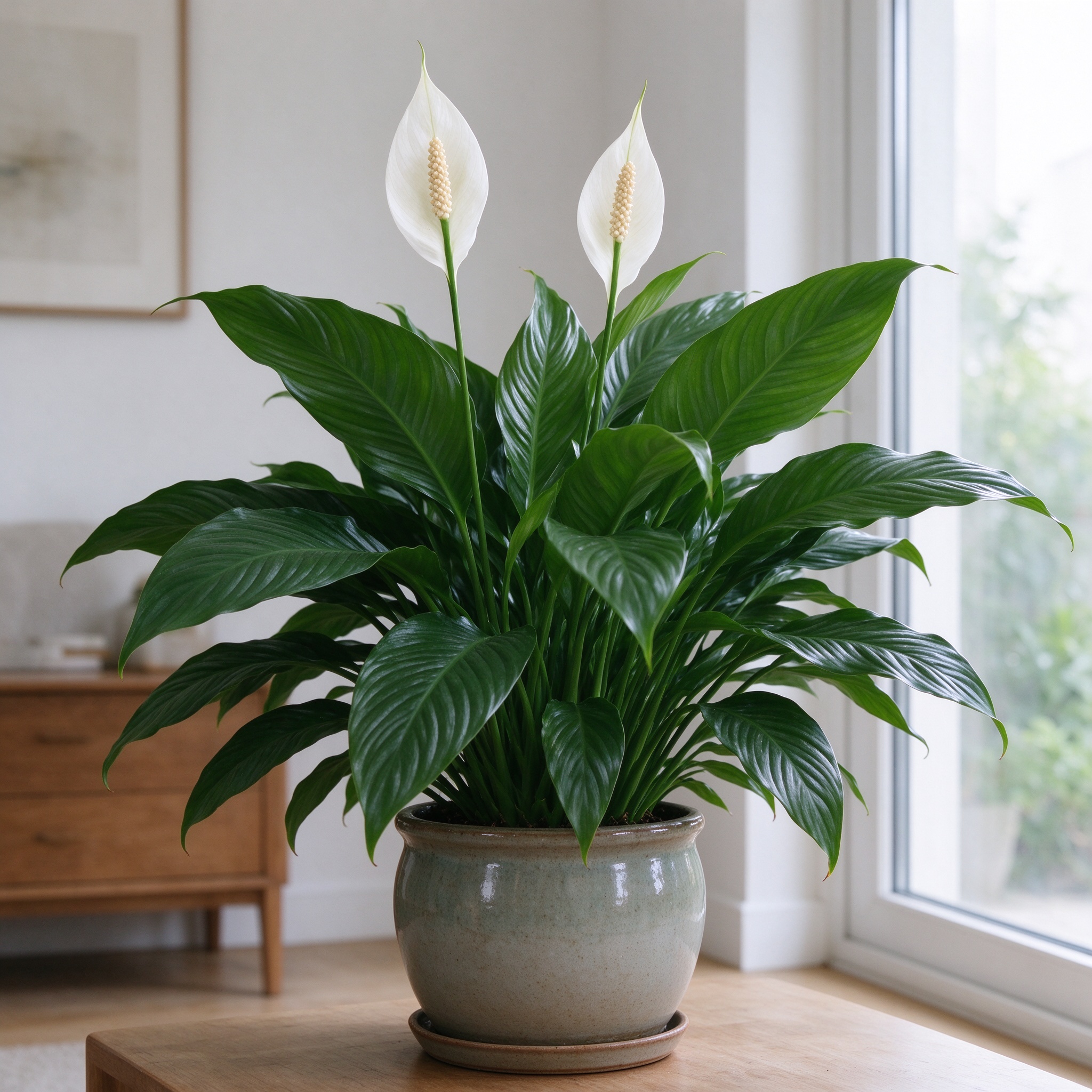
(Year 2 onward)- •At maturity the crown spreads outward with several rooted offsets, and under good light it produces white spathes mainly in spring and early summer, with occasional sporadic blooms year round.
- •NC State records that peace lilies have no specific bloom time but flower freely; mature, slightly pot-bound plants in bright indirect light flower more heavily than young plants in deep shade.
- •This stage is when division becomes possible: crowded offsets with their own root system can be separated to make new plants.
- •Continue wiping leaves, flushing salts each spring, and trimming spent spathes at the base to keep the crown productive.
- 4
Winter rest
(December–February)- •Under weak winter light the peace lily slows growth and enters a light resting period even though it never drops its leaves.
- •Let the top of the compost dry out between waterings, stop all fertilizer, and keep temperatures above 60°F (15.5°C) per Clemson HGIC to avoid cold damage.
- •This is the season when dry heated air most often causes brown leaf edges, so raise humidity with a pebble tray or humidifier rather than over-watering to compensate.
- •New growth resumes with longer spring days, which is also the recommended window for repotting and division.
💧 Detailed Care Guide
☀️ Light Requirements
- •The peace lily is one of the most shade-tolerant flowering houseplants available, which is why it performs in hallways and north-facing rooms where most blooming plants fail, but light level directly controls how many spathes it produces.
- •NC State Extension places Spathiphyllum under partial shade to deep shade (less than two hours to no direct sunlight) and instructs not to place plants in direct sun; UF/IFAS EP477 specifies bright indirect light with no direct sun, and the RHS peace lily guide says to keep plants in bright indirect light near a window but out of direct summer sun, adding that plants survive in deeper shade but will rarely flower and grow very slowly.
- •In practice an east-facing window, a position a few feet back from a south or west window behind a sheer curtain, or a bright room without direct rays gives the best balance: glossy dark green leaves, steady new growth, and regular spathes.
- •Direct sun through glass scorches the broad blades within days: NC State lists excessive direct sunlight among the causes of brown leaf tips, and the UF/IFAS interiorscape guidelines EP161 explain that excessive light bleaches leaves to a pale color often mistaken for nutrient deficiency; those guidelines recommend production shade of 1,500 to 2,500 foot-candles, corresponding indoors to a softly lit room rather than a sunny sill.
- •In a genuinely dark corner the plant stays alive for months but growth slows to a crawl, leaves turn smaller and paler, and no flowers form; a full-spectrum grow light on a 10-to-12-hour timer compensates in winter or in low-light bathrooms.
- •Rotate the pot a quarter turn every few weeks so the rosette grows evenly instead of leaning toward one window.
- •A few hours of gentle morning sun through an east window is tolerated by acclimated plants; hot midday or afternoon sun through glass should always be filtered or avoided.
💧 Watering
- •Water on a moist-but-not-soggy rhythm rather than a rigid weekly schedule.
- •NC State directs keeping the soil moist but not soggy, allowing it to dry between waterings, and notes that watering from below works very well for peace lilies; UF/IFAS EP477 repeats to keep the medium moist but never allow the plant to sit in water, and the RHS guide says to let the top of the compost dry out between waterings and reduce watering in winter, when long-wet compost produces root rot.
- •The clearest indoor method: water thoroughly until liquid runs freely from the drainage hole, then wait until the top 1 to 2 inches (2.5 to 5 cm) of mix feel dry before watering again.
- •In a bright, warm room that usually means every five to seven days in spring and summer; in a cool, dim corner it stretches to ten to fourteen days in winter, and the RHS advises watering sparingly while growth rests.
- •Peace lilies are famously dramatic when thirsty: the entire crown droops, spathes nod, and older leaves sag.
- •The UF/IFAS interiorscape guidelines EP161 call this severe wilt or crash the single most common maintenance problem, caused by underwatering.
- •NC State notes slight drought tolerance and UF/IFAS records the species as slightly drought tolerant, so a missed watering rarely kills a plant; when the droop appears, soak the root ball and the crown stands back upright within one to three hours.
- •Chronic repeated wilting, however, permanently damages older leaves, so water a day or two before the plant reaches that signal.
- •Use room-temperature water; cold water shocks the roots.
- •Never let the pot stand in a saucer of pooled water: NC State and Clemson HGIC both warn that sitting in excess water leads to root rot, so empty the saucer within a few minutes of watering.
- •The species has no salt tolerance (UF/IFAS), and like other aroids it is sensitive to fluoride, chlorine, and fertilizer salts that accumulate at the leaf tips; if brown tips appear on an otherwise correctly watered plant, switch to filtered, rain, or standing tap water, and flush the pot with plain water every few months to leach built-up salts.
🌡️ Temperature
- •A warm, stable room suits a peace lily year-round.
- •NC State records warm conditions between 68 and 85°F (20–29°C) during the day with no more than a 10°F drop at night; temperatures of 40 to 60°F (4–15°C) slow growth considerably, and extended periods below 40°F (4°C) damage leaves, stems, and roots.
- •Clemson HGIC 1512 matches this with warm daytime temperatures of 68 to 85°F and nights about 10°F cooler, advising against anything below 60°F (15.5°C) because cold damage may occur.
- •UF/IFAS EP477 gives a warm tropical preference of 75 to 85°F (24–29°C), notes moderate chill tolerance down to 35°F for some cultivars, and records that active growth is reduced at or below 50°F (10°C); the RHS guide lists average room temperatures between 12 and 24°C (55–75°F) as acceptable.
- •Keep the plant away from cold drafts, exterior doors, poorly sealed winter windows, and air-conditioning vents that blow cold air across the leaves; Clemson specifically warns not to place it where heat or air-conditioning vents blow directly on it, and NC State identifies cold and drafty conditions as a major growth slowdown.
- •Also keep it away from radiator tops and hot air outlets, which dehydrate leaf edges.
- •Humidity is the companion variable: peace lilies prefer moderate to high humidity, the RHS instructs watering and misting freely while maintaining high humidity during growth, and the RHS peace lily guide warns that leaves start to turn brown when the air is too dry.
- •Aim for relative humidity above 50% if you can: set the pot on a saucer over a tray of damp pebbles (keep the water level below the pot so roots do not stand in it), group the plant with other leafy houseplants, or run a cool-mist humidifier in a dry heated bedroom.
- •Bathrooms with a frosted window naturally suit the combination of warm air, soft light, and humidity.
- •Occasional misting helps with dust but is less reliable than a pebble tray or humidifier for raising sustained humidity; wipe the broad leaves regularly with a damp cloth to remove dust, as NC State recommends for both appearance and pest removal.
🌱 Soil & Fertilizer
Soil:
- •Peace lilies want a loose, organic, moisture-retentive but freely draining mix.
- •NC State specifies a potting mix high in organic matter with good drainage and an acid pH; UF/IFAS EP477 recommends a rich, organic peat- or bark-based bagged potting soil; the RHS peace lily guide prescribes a peat-free multipurpose compost mixed with perlite at roughly a three-to-one ratio to improve drainage, and Clemson HGIC notes the plant flourishes in almost any well-drained potting mix.
- •A reliable indoor blend is two parts quality peat-free houseplant compost or loam-based compost, one part perlite or pumice for drainage, and half a part orchid bark or coco coir for open structure; the mix must hold moisture for a few days while letting excess water pass through quickly.
- •Dense, compacted seed-starting mixes or heavy garden soil that stay soggy for weeks after watering suffocate the roots and invite root rot; if you tend to overwater, raise the perlite fraction to a third of the volume.
- •NC State records acid pH tolerance while the RHS lists acid, neutral, and alkaline as acceptable across the genus, so a home grower does not need to chase a narrow pH range.
- •Repotting into fresh mix every one to two years replaces organic matter that has degraded and compacted; stale, exhausted mix is a common hidden cause of brown tips and weak new leaves on an otherwise correctly watered plant.
Fertilizer:
- •Peace lilies are light feeders, and more fertilizer causes more problems than a little less.
- •NC State recommends fertilizing at one quarter of the recommended strength and flushing the soil between applications, warning that over-fertilizing and salt build-up burn the leaf tips and roots; UF/IFAS EP477 calls for a low dose of liquid fertilizer applied three times a year; the RHS applies a balanced liquid fertilizer monthly during growth; Clemson HGIC 1512 advises a balanced liquid houseplant fertilizer such as 20-20-20 every six to eight weeks during the spring and summer growing season, mixed at one quarter of the label strength.
- •A practical indoor program matches the middle ground: a balanced all-purpose houseplant feed diluted to half or one quarter strength once a month from March through August, then stop entirely in fall and winter, when weak light means the plant cannot use the nutrients and leftover salts accumulate in the mix.
- •Never apply fertilizer to bone-dry soil, where concentrated salts burn the roots; water first with plain water, then feed.
- •The NC State interiorscape guidelines EP161 set a soluble salts target of 0.8 to 1.2 dS/m under interior conditions and warn that high soluble salts burn leaf tips and margins.
- •Every spring, before the new growing season, flush the pot by running plain water through the mix several times to leach accumulated salts; white crust on the soil surface means salts have already built up.
- •Overfeeding also suppresses flowering in favor of soft, lush leaves, so a lightly fed mature peace lily out-blooms a heavily fed one.
📝 Step-by-Step Planting Guide
- 1
Choose a bright indirect position away from direct sun
- •Pick an east-facing window, a spot a few feet back from a south or west window behind a sheer curtain, or a bright hallway without direct rays.
- •NC State places Spathiphyllum under partial shade to deep shade and warns against direct sun, while the RHS keeps plants in bright indirect light near a window but out of direct summer sun.
- •North rooms work only if very bright; a dimmer corner supports survival but not flowering.
- •Keep the plant away from exterior doors, radiators, and air-conditioning vents that swing temperature and humidity up and down.
- 2
Mix a loose, organic, well-draining potting blend
- •Prepare two parts quality peat-free houseplant or loam-based compost, one part perlite or pumice, and half a part orchid bark or coco coir.
- •NC State asks for a mix high in organic matter with good drainage and acid pH; UF/IFAS EP477 recommends a rich peat- or bark-based bagged soil; the RHS prescribes peat-free multipurpose compost mixed with perlite at about three to one.
- •Avoid dense seed-starting mixes and garden soil that stay soggy for weeks after every watering.
- 3
Pot at the same depth in a snug, draining container
- •Choose a pot with at least one drainage hole and only one to two inches wider than the current root ball, following Clemson HGIC's note that peace lilies like to be slightly pot-bound and an oversized container keeps the mix too wet.
- •Plant at the same depth the crown grew in the nursery pot; burying the basal crown in deep compost invites crown rot.
- •A clean, rewashed nursery pot or a new pot with drainage is preferable to a freshly glazed unventilated container for a large specimen.
- 4
Establish the soak-and-dry watering rhythm
- •Water thoroughly until liquid runs freely from the drainage hole, then wait until the top 1 to 2 inches of mix feel dry before watering again.
- •NC State keeps soil moist but not soggy and allows it to dry between drinks; the RHS lets the top compost dry between waterings and reduces water in winter.
- •Empty the saucer within a few minutes of watering, because NC State and Clemson both tie standing water directly to root rot.
- •Use room-temperature filtered or standing water to reduce fluoride and chlorine exposure.
- 5
Feed lightly during the growing season only
- •Apply a balanced 20-20-20 or all-purpose houseplant feed diluted to one quarter to half strength once a month from March through August, matching NC State's quarter-strength recommendation, the RHS monthly balanced feed, and Clemson's every-six-to-eight-weeks schedule at quarter strength.
- •Stop feeding entirely in fall and winter.
- •Water first with plain water before applying feed so salts do not burn dry roots, and flush the pot with several volumes of plain water each spring to leach accumulated fertilizer salts.
- 6
Wipe leaves, inspect pests, and rotate the plant
- •NC State recommends cleaning foliage with a damp soft cloth to keep leaves free of dust, which blocks light and hides early pest colonies.
- •Wipe both leaf surfaces every two to four weeks, and look under leaves and in the axils for mealybugs, scale, and spider mites while you clean.
- •Rotate the pot a quarter turn every few weeks so the rosette grows evenly rather than leaning toward the window.
- •Treat any pest found early with diluted insecticidal soap or a rubbing-alcohol swab before the colony spreads to neighboring plants.
🌱 Recommended Varieties
'Sensation'
- •The largest commercially produced peace lily, maturing at 5 to 6 feet tall and wide per Clemson HGIC 1512, with dark green, tough, ribbed leaves that make it a dramatic statement plant even when not in bloom.
- •It produces large, well-shaped white spathes intermittently through the year.
- •Give it a large floor pot and a bright indirect position; its broad leaves accumulate dust quickly, so wipe them regularly with a damp cloth.
- •Its size also means it dries out faster than dwarf cultivars, so check the top of the mix before each watering rather than following a fixed calendar.
'Mauna Loa Supreme'
- •A classic medium-sized cultivar reaching about 2 to 3 feet tall, listed by Clemson HGIC with 9-inch long, 5-inch wide glossy lance-shaped leaves on 10- to 12-inch stalks and flower stems 15 to 20 inches long bearing spathes up to 4 inches wide.
- •It is the variety most often used in office landscaping because it tolerates fluorescent lighting while still flowering.
- •A slightly root-bound plant flowers most heavily; move up only one pot size when roots emerge through the drainage holes or circle the soil surface.
'Little Angel' and 'Wallisii'
- •Compact cultivars mature at 12 to 15 inches tall per Clemson HGIC; 'Little Angel' blooms more prolifically than many older large varieties, while 'Wallisii' carries delicate 3-inch blooms above 8- to 10-inch rippled leaves.
- •These small plants suit tabletops, shelves, and narrow bathroom windowsills, and their shallow root balls need only a lightly moistened mix.
- •The species S.
- •wallisii itself is the compact Colombian-Venezuelan plant behind most dwarf hybrids, and the RHS recognizes it for pure white spathes up to 10 cm long.
'Domino' and 'Gemini'
- •'Domino' features shiny, ruffled dark green leaves speckled with white streaks and matures at about 30 inches tall and wide, while 'Gemini' grows to roughly 12 inches with white-striped foliage and an abundance of white blooms per NC State's cultivar notes.
- •Variegated peace lilies need a little more bright indirect light than plain green cultivars to keep the markings vivid; too deep a shade causes the white streaks to fade and revert toward solid green.
- •Fertilize lightly, because excess nitrogen can also wash out leaf variegation.
'Allison' and 'Jetty'
- •'Allison' is a compact peace lily around 24 inches tall with medium dark green leaves and a prolific flowering habit, while 'Jetty' carries lush glossy green foliage with long-lasting white flowers and a height range of 19 to 24 inches, according to Clemson HGIC.
- •Both are garden-center favorites selected for heavy spathe production.
- •The long white flowers turn pale green as they age, a natural color change rather than a sign of disease; trim them out once they brown so the crown can push the next flush of blooms.
🪴 Growing in Containers
- Pot size and the slightly pot-bound habit:
- •Peace lilies flower best when the root mass is snug, and NC State notes that pot plants like to be somewhat pot-bound.
- •Choose a container only one to two inches wider than the existing root ball, as Clemson HGIC recommends; a large pot holds excess wet soil around the roots, delays flowering, and raises root rot risk.
- •Move up a size when roots push through the drainage holes or circle the surface of the mix, typically every one to two years in spring.
- Drainage holes and saucer discipline:
- •Every pot must have at least one working drainage hole.
- •UF/IFAS EP477 warns not to allow the plant to sit in water, NC State ties soggy soil to decline, and Clemson states standing water in a saucer leads to root rot.
- •After each watering, wait a few minutes, then empty the saucer, cachepot, or decorative outer pot of any pooled water.
- •A pot without a hole should be used only as a decorative sleeve around the nursery pot, not as the growing container itself.
- Terracotta versus plastic and glazed ceramic:
- •Unglazed terracotta breathes and dries out quickly, suiting a grower who tends to overwater and helping salts escape through the porous walls.
- •Plastic and glazed ceramic hold moisture longer, which can be useful in a very dry heated home but risks root rot for frequent waterers.
- •Large 'Sensation' plants become top-heavy with broad leaves, so favor a heavier weighted floor pot rather than a flimsy plastic one that tips over as the crown leans toward the light.
- Soil depth and crown placement:
- •Plant the basal crown at exactly the depth it occupied in the nursery pot.
- •Compost piled against the stem crown holds persistent moisture against tissue that evolved above ground, triggering crown rot and stem collapse.
- •Leave a half-inch rim at the top of the pot so water can soak in without spilling over the edge, and firm the mix gently around the root ball rather than packing it tight; compacted soil drains poorly and starves the roots of air.
- Pebble trays and bathroom placements:
- •The RHS guide recommends raising humidity by standing the plant on a saucer over damp gravel or pebbles; keep the water level below the pot's bottom so roots are not submerged.
- •Bathrooms with a frosted or east window naturally combine the warm air, soft light, and humidity peace lilies prefer.
- •If you use a decorative cachepot, line the bottom with an inch of pebbles and check after watering that no water has pooled between inner and outer pot.
✂️ Pruning & Maintenance
- ✓
Remove yellowed, brown, or damaged leaves
- •Cut yellow, brown, or tattered leaves cleanly at the base of the petiole with sanitized shears whenever you notice them.
- •Removing spent foliage redirects energy into new leaf spears and improves airflow around the crowded crown.
- •One or two older lower leaves yellowing each month on an otherwise healthy rosette is natural aging; a whole cluster turning yellow at once points to overwatering, a cold draft, or underwatering and should be diagnosed rather than hidden behind pruning.
- ✓
Cut spent spathes and flower stalks at the base
- •After a white spathe has turned pale green and then browned, cut the flower stalk cleanly where it emerges from the crown, rather than breaking it off by hand.
- •Leaving a dried stalk attached drains energy from the clump and can rot at its base, where decay then spreads into the crown.
- •NC State records that spathes last about a month after opening before fading, so expect each bloom cycle to end with a light trim.
- ✓
Trim brown leaf tips without shortening healthy blades
- •Once a leaf tip has turned brown it never regreens, so trim the dead portion off with sharp, clean scissors following the natural taper of the leaf rather than cutting the blade straight across.
- •Brown tips most often trace to dry heated air, fluoride or salts in tap water, or fertilizer buildup; pruning alone will not stop new tips from browning, so address the watering water and salt flush as well.
- •Never remove more than the browned fraction of a leaf, because the remaining green tissue is still photosynthesizing.
- ✓
Divide crowded crowns in spring
- •NC State lists division as the best propagation method, and the RHS advises dividing in winter or immediately after flowering.
- •When a mature clump has filled its pot with several rooted offsets, tip the plant out, tease the crowns apart where they naturally separate, and plant each offset into its own snug pot with fresh organic mix.
- •Keep divisions warm and evenly moist while they root; do not feed until new growth appears.
- •Re-potting and division both recover fastest during the growing season, per Clemson HGIC.
🐛 Pest & Disease Control
Common Pests
Mealybugs
Symptoms:- •Cottony white ovals cluster in the leaf axils, along the lower petioles, and on the underside of the midribs, often with a waxy white coating.
- •Sticky honeydew coats nearby foliage, and tender new leaf spears emerge curled or distorted as the insects suck sap.
- •NC State names mealybugs the most common insect pest found indoors on peace lilies, UF/IFAS EP477 lists mealybug among the key insects, and Clemson HGIC 1512 includes them in the common houseplant pest list.
Control:- •Dab visible mealybugs with a cotton swab dipped in rubbing alcohol, which kills them on contact, then wipe the whole plant down with diluted insecticidal soap or neem oil, repeating every ten days for a month because eggs hidden in crevices keep hatching.
- •Check neighboring plants on the same shelf, isolate an infested peace lily while you treat it, and raise air circulation around the crown so the leaf axils stay drier between waterings.
Spider mites
Symptoms:- •Fine pale stippling dots the upper leaf surface, foliage turns a dull bronze or dusty gray, and fine silk webbing appears on leaf undersides and in the axils in heavy infestations.
- •Mites thrive in the hot, dry air of heated rooms, which is why outbreaks most often appear in winter.
- •Clemson HGIC lists spider mites among peace lily pests, and the RHS peace lily guide links dry air to browning and weakening foliage that mites then exploit.
Control:- •Raise humidity around the plant with a pebble tray or humidifier, since mites multiply fastest in dry air.
- •Wipe or rinse both leaf surfaces with lukewarm water, then apply insecticidal soap or horticultural oil to the undersides, repeating weekly for three to four weeks to catch newly hatched mites.
- •Isolate the plant and inspect neighboring aroids, which share the same pest.
Scale insects
Symptoms:- •Small brown, tan, or gray bumps cling to stems and leaf veins, often fixed in place and hard to recognize as insects.
- •Soft scales excrete honeydew that blackens into sooty mold, and heavy infestations yellow leaves and slow growth.
- •UF/IFAS EP477 lists scale among the insects affecting Spathiphyllum, and Clemson HGIC 1512 includes scale in its houseplant pest list.
Control:- •Scrape mature scale off with a fingernail or a soft brush, then dab the bumps with a rubbing-alcohol swab.
- •Treat the whole plant with horticultural oil or insecticidal soap to kill the mobile crawlers that settle later, repeating at ten-day intervals for a month.
- •Keep checking the stems at repotting time, since scale can persist on a bare stem through a dry winter.
Fungus gnats
Symptoms:- •Tiny black flies rise from the soil surface when the pot is moved, and larvae live in persistently wet compost, feeding on fine roots and contributing to yellowing and weak growth.
- •Clemson HGIC 1512 lists fungus gnats among peace lily problems; the adult flies are a nuisance while the larvae are the damaging stage.
Control:- •Let the top 1 to 2 inches of mix dry between waterings, which kills larvae by drying out their moist habitat.
- •Apply a thin layer of horticultural sand or grit over the soil surface to block egg laying, and use yellow sticky traps to catch adults.
- •For persistent larvae, drench the mix with Bacillus thuringiensis israelensis (Bti) according to label directions rather than increasing pesticide sprays.
Common Diseases
Root rot (overwatering)
Symptoms:- •Leaves yellow, wilt, and droop even though the soil stays wet; the base of the crown feels soft and brown instead of firm, and roots pulled from the pot are brown and slimy rather than pale and solid.
- •The RHS guide warns that keeping the compost too wet for long periods results in root rot, Clemson states root and stem diseases are the most common problems and are usually associated with over-watering, and NC State ties soggy conditions to decline.
- •It is the most common cause of a sudden peace lily collapse indoors.
Control:- •Remove the plant from its pot immediately, clip away every brown, mushy root with sterile shears, and repot into fresh, open, fast-draining mix in a clean pot with a working drainage hole.
- •Let the mix dry out before watering again. Going forward, let the top 1 to 2 inches dry between drinks and empty the saucer after every watering.
- •If the crown itself has turned mushy, a healthy offset may be saved by division even when the mother plant cannot.
Fungal and bacterial leaf spot
Symptoms:- •Tan, brown, or water-soaked spots enlarge on leaves, often with a yellow halo, and may run together into large necrotic patches.
- •Spots spread when water sits on foliage overnight and when crowded leaves stay wet in still air.
- •NC State notes that peace lilies are susceptible to leaf spot organisms in persistently damp conditions, and the UF/IFAS interiorscape guidelines link wet foliage and high humidity to disease pressure on aroids.
Control:- •Remove and bag the worst spotted leaves, and stop wetting the foliage when watering; water the root zone rather than misting the leaves late in the day.
- •Improve air circulation around the crown and space the plant away from crowded neighboring pots.
- •For persistent spread, apply a copper-based fungicide according to label directions, and isolate the plant while the disease runs its course.
Magnesium deficiency and salt burn
Symptoms:- •Older leaves turn yellow between the veins while the veins themselves remain green, the plant stunts, and leaf edges turn brown.
- •Clemson HGIC 1512 identifies magnesium deficiency as a specific disorder of peace lilies; NC State and the UF/IFAS EP161 guidelines both tie brown tips and margins to high soluble salts from over-fertilizing, with white crust visible on the soil surface in salt-burn cases.
Control:- •For interveinal yellowing on older leaves, apply a diluted Epsom-salt (magnesium sulfate) drench or a balanced feed containing magnesium at label strength, then keep the feeding program light going forward.
- •For salt burn, stop fertilizer, flush the pot with several volumes of plain water to leach salts, and repot into fresh mix if the white crust persists.
- •Trim browned tips back to healthy tissue after correcting the root cause.
🍅 When to Harvest
- •There is no edible harvest from a peace lily.
- •The plant is "ready" for propagation when a mature clump has filled its pot and pushed several rooted crowns (offsets) around the mother plant; that is the moment to divide and share, following NC State's recommended division strategy and the RHS note that division works best in winter or immediately after flowering.
- •Mature peace lilies flower intermittently rather than on a single calendar date: NC State states the plants have no specific bloom time but flower freely, while the RHS growing guide records blooms from spring to summer with each spathe lasting up to about four weeks.
- •UF/IFAS research on Spathiphyllum flowering shows that natural bloom initiation responds to short days/long nights and lower temperatures in late winter; most season-dependent cultivars flower mainly in spring and early summer once mature, while some age-dependent hybrids flower continuously after maturing.
- •Commercial market plants are often treated with gibberellic acid to bloom year-round, an induction that is not part of natural home culture.
- •Individual spathes last roughly a month on the plant; trim spent flowers at the base once they brown and fade so energy is redirected back into leaves and new crowns rather than spent on a drying bloom.
❓ Frequently Asked Questions
- 1
Why are my peace lily leaves turning brown?
- •Brown leaf tips and edges are the single most common peace lily complaint, and NC State lists excessive direct sunlight, underwatering, and low humidity together as causes.
- •In most homes the real culprit is dry heated air in winter, followed by fluoride or chlorine in tap water and fertilizer salts that accumulate at the leaf margins.
- •NC State also warns that over-fertilizing and salt build-up burn leaf tips and roots.
- •Check the soil: if it has gone bone dry, water thoroughly and the crown will recover; if it stays wet for days, the problem is overwatering leading toward root rot.
- •Raise humidity with a pebble tray, switch to filtered or standing water, and flush the pot with plain water each spring.
- •Once a tip has turned brown it will not regreen, so trim the dead portion along the natural leaf taper with clean scissors.
- 2
Why is my peace lily not flowering?
- •The RHS peace lily guide names insufficient light as the leading reason a peace lily fails to flower: plants survive in deep shade but rarely bloom there.
- •Move the plant to bright indirect light near a window, out of direct summer sun.
- •Other common causes are a plant younger than one year, a too-large pot that keeps the soil wet and delays flowering, over-fertilizing that pushes soft leaves instead of spathes, and the commercial gibberellic-acid bloom treatment wearing off after purchase.
- •NC State notes that peace lilies flower best when slightly pot-bound, and UF/IFAS research shows natural bloom initiation responds to short days and cooler late-winter temperatures.
- •Expect mature plants to flower mainly in spring and early summer, with sporadic blooms through the rest of the year under good conditions.
- 3
How often should I water a peace lily?
- •Water on a moisture check rather than a fixed schedule.
- •NC State directs keeping the soil moist but not soggy and allowing it to dry between waterings; UF/IFAS EP477 repeats to keep the medium moist but never let the plant sit in water.
- •In a bright, warm room that usually means watering every five to seven days in spring and summer; in a cool, dim corner it stretches to ten to fourteen days in winter, when the RHS advises watering sparingly.
- •Test the top 1 to 2 inches of mix: water thoroughly until liquid drains from the hole, then empty the saucer within a few minutes.
- •Peace lilies droop dramatically when thirsty and recover within hours after a soak, but chronic repeated wilting damages older leaves, so water before the crown reaches that signal.
- •Use room-temperature filtered or standing water to limit fluoride and salt exposure.
- 4
Is peace lily toxic to cats?
- •Yes.
- •The ASPCA Animal Poison Control Center lists Spathiphyllum species as toxic to both cats and dogs, with toxic principles of insoluble calcium oxalates.
- •Chewing or swallowing any part of the plant releases these crystals, causing intense burning and irritation of the mouth, tongue, and lips, excessive drooling, vomiting, and difficulty swallowing.
- •NC State rates the plant medium severity and notes that contact with the sap can irritate skin or eyes.
- •An important distinction: the peace lily is an aroid, not a true lily (Lilium), so it does not cause the fatal kidney failure associated with true lilies in cats, but ingestion still warrants keeping the plant out of reach and contacting a veterinarian or pet poison hotline after any chewing episode.
- •For non-toxic options in multi-pet homes, browse our cat-safe plants guide.
- 5
Can peace lilies grow in low light?
- •Yes, and this is one of the plant's signature strengths: Clemson HGIC notes peace lilies are one of the few foliage plants that will flower in low light, while NC State places the genus under partial shade to deep shade.
- •The RHS guide, however, draws the line between survival and performance: plants survive in deeper shade but rarely flower and grow very slowly.
- •In a dim corner the peace lily stays alive for months but produces smaller, paler leaves and no spathes; for regular flowering give it bright indirect light, such as an east window or a position a few feet back from a south or west window behind a sheer curtain.
- •A full-spectrum grow light on a 10-to-12-hour timer compensates in dark bathrooms or winter months.
- •Never place it in direct sun, which NC State and Clemson both note scorches the broad leaves.
- 6
Why are my peace lily flowers turning green?
- •Greening spathes are normal, not a disease.
- •NC State records that the white spathe changes to pale green after about ten days and remains attractive for at least another month, and Clemson HGIC describes the long-lasting pure white flowers turning pale green as they age.
- •The green color comes from chlorophyll developing in the spathe as the true flowers on the central spadix finish blooming; the structure then photosynthesizes for a few weeks before browning.
- •Once the spathe has turned fully green and starts to curl or brown, cut the stalk at the base to redirect energy back into leaves and new crowns.
- •If newly opened spathes emerge pale green rather than white, the plant may be under-fertilized or sitting in too deep a shade; check light level and switch to a light balanced feed in the growing season.
- 7
Why are my peace lily leaves turning yellow?
- •Read the pattern before acting.
- •Lower leaves yellowing on soil that stays wet point to overwatering and early root rot: stop watering, confirm the pot drains, and empty the saucer after every drink.
- •Leaves yellowing after the mix has been allowed to dry completely point to underwatering; UF/IFAS EP477 notes the species is slightly drought tolerant, but repeated severe wilt permanently damages older foliage.
- •Clemson HGIC adds that excessive drying turns leaves and edges yellow, and identifies magnesium deficiency as a disorder that stunts the plant with interveinal yellowing on older leaves while veins stay green.
- •One older lower leaf yellowing each month on an otherwise healthy rosette is natural aging.
- •Cold drafts, chilled foliage, and a recent move can also trigger a flush of yellow leaves; keep the plant between 68 and 85°F by day and above 60°F at night.
- 8
How do I propagate a peace lily?
- •Division is the reliable method: NC State lists division as the best propagation strategy, and the RHS advises dividing in winter or immediately after flowering.
- •Wait until a mature clump has filled its pot and pushed several rooted offsets around the mother plant.
- •Tip the plant out of the pot, gently tease the crowns apart where they naturally separate, and make sure each offset carries its own root system.
- •Plant each division into a snug pot with fresh organic, well-draining mix, water in lightly, and keep it warm and evenly moist while roots establish.
- •Do not feed until new growth appears.
- •Stem cuttings and leaf cuttings rarely root successfully on peace lilies, and seed is not practical for indoor cultivars, which are mostly hybrids.
- 9
Why is my peace lily drooping?
- •Drooping is usually a water signal, and the RHS guide notes peace lilies often droop dramatically when short of water but recover promptly after watering.
- •Check the soil first: if the top 1 to 2 inches are dry, soak the root ball thoroughly and the crown should stand back upright within one to three hours.
- •The opposite case matters too: if the soil is wet and the plant still droops, suspect root rot from overwatering, a pot without drainage, or a full saucer; remove the plant, trim mushy roots, and repot into fresh dry mix.
- •Other causes include a cold draft or air-conditioning blast, temperatures below 60°F, and a recent move or repotting shock.
- •NC State records that temperatures of 40 to 60°F slow growth considerably and below 40°F damage leaves, stems, and roots, so keep the plant away from exterior doors and winter windowsills.
Source:
NC State Extension Gardener Plant Toolbox — Spathiphyllum (Peace Lily) — https://plants.ces.ncsu.edu/images/plants/spathiphyllum/
UF/IFAS Extension — EP477, Florida Foliage House Plant Care: Spathiphyllum — https://edis.ifas.ufl.edu/publication/EP477
RHS — Spathiphyllum wallisii Plant Profile — https://www.rhs.org.uk/images/plants/17623/i-spathiphyllum-wallisii-i/details
RHS — How to grow peace lilies — https://www.rhs.org.uk/images/plants/peace-lilies/how-to-grow-peace-lilies
ASPCA Animal Poison Control Center — Peace Lily (Spathiphyllum spp.) — https://www.aspca.org/pet-care/animal-poison-control/toxic-and-non-toxic-plants/peace-lily
UF/IFAS Extension — ENH958/EP161, Cultural Guidelines for Commercial Production of Interiorscape Spathiphyllum — https://ask.ifas.ufl.edu/publication/EP161
Clemson University HGIC 1512 — Peace Lily — https://hgic.clemson.edu/factsheet/peace-lily/
Photo credit: NC State Extension
Images courtesy of NC State Extension under CC BY license. Thank you to the photographers who make these educational images available.
License: CC BY-NC 2.0 / CC BY 4.0