
How to Grow Philodendron Plant: Complete Guide
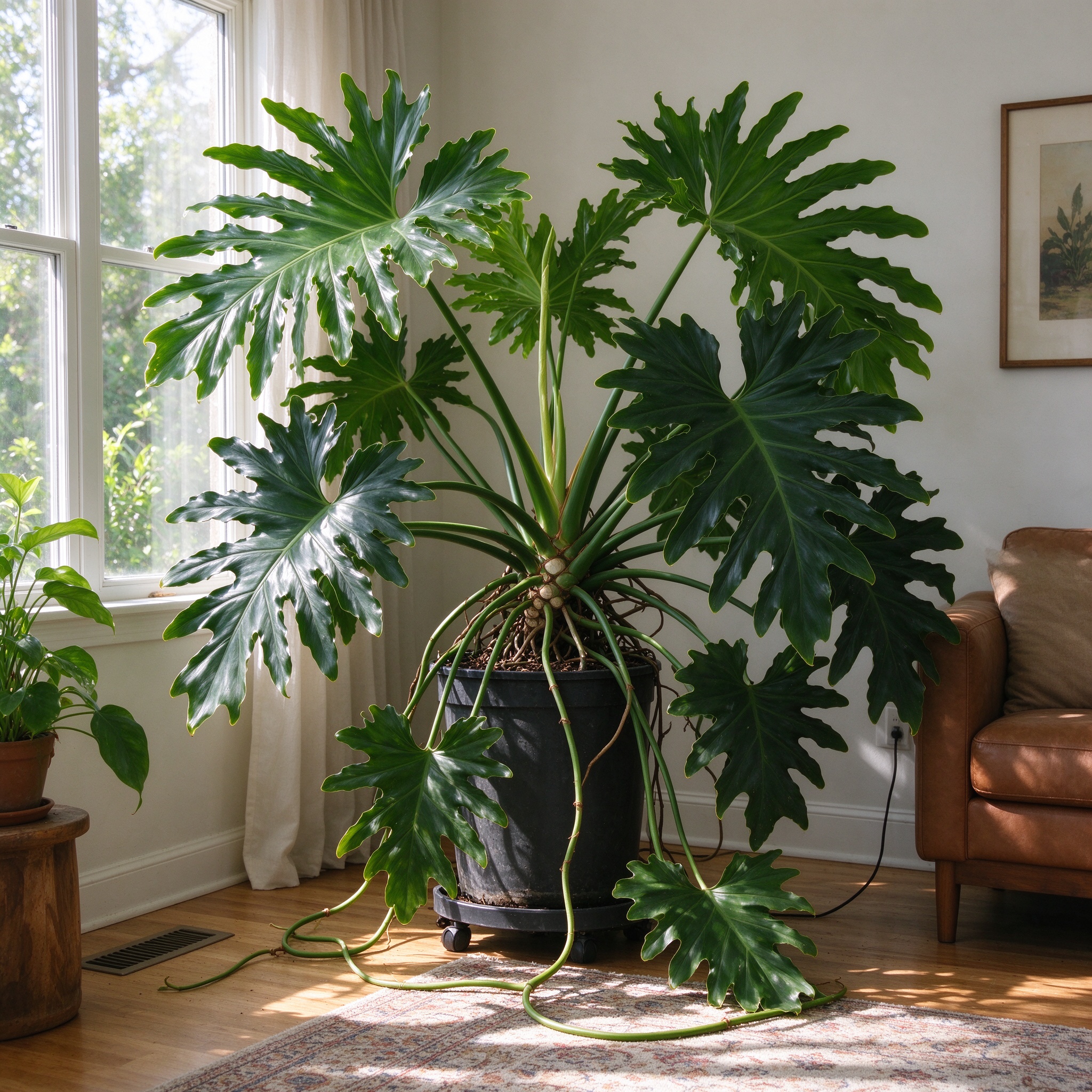
- •The philodendron plant is a large group of tropical evergreen vines and bushy shrubs in the arum family (Araceae), native from Mexico through the Caribbean and Central and South America, according to the Missouri Botanical Garden Plant Finder and NC State Extension.
- •The most common indoor species, heartleaf philodendron (Philodendron hederaceum), trails from a hanging basket or climbs a moss pole, with glossy heart-shaped leaves on slender stems; other popular cultivars include the striped Brasil, the white-veined Birkin, the pink-splashed Pink Princess, the orange-emerging Prince of Orange, and the mounded, self-heading Xanadu.
- •NC State describes the genus as a trailing or climbing houseplant that tolerates very low light for long periods, while the RHS advises bright but indirect light, warm rooms above 15°C (59°F), and support for climbing stems.
- •This guide covers light, watering, humidity, soil, feeding, pruning, support, pests, diseases, and propagation for both trailing and upright types.
- •One naming note: the plant sold as a 'split-leaf philodendron' is usually Monstera deliciosa, a separate genus with its own mature fenestrated leaves; see our Monstera guide at /how-to-grow-monstera for that plant's care.
- •All philodendrons are toxic to cats and dogs (see the pet safety warning below).
📋 Quick Facts
- •Give philodendrons bright but indirect light, and keep them out of direct summer sun that scorches the leaves, per the RHS.
- •NC State says the genus refers medium light but will tolerate low light, and the Missouri Botanical Garden places heartleaf philodendron in part shade: bright indirect light near an east window, or three to six feet back from a south or west window behind a sheer curtain, suits most cultivars.
- •The plain green heartleaf is the most shade-tolerant and will survive a darker corner for a while; variegated types such as Brasil, Birkin, and Pink Princess need brighter indirect light to hold their pattern, because too little light makes variegation revert to solid green.
- •Insufficient light makes plants leggy: the RHS notes philodendrons become leggy and produce fewer, smaller leaves when light is poor, with long bare internodes between leaves.
- •Direct afternoon sun behind glass bleaches and burns the foliage, especially on variegated cultivars.
- •Wipe the leaves occasionally to remove dust, which blocks light and harbors mites (RHS).
- •Water on a soak-and-check rhythm and never let the pot stand in water.
- •NC State advises keeping the soil slightly moist and slowing down on watering in winter; the Missouri Botanical Garden says to water regularly in the growing season but reduce watering from fall through late winter, and warns root rot occurs in overly moist soil.
- •In practice, water thoroughly until liquid drains from the bottom, then wait until the top inch of mix feels dry before the next drink; in a bright warm room that is often once a week in summer, stretching to two or three weeks in a cool dark winter corner.
- •The RHS propagation guidance and NC State both point to a free-draining root zone: a pot without a drainage hole, a saucer left full, or dense soil that stays soggy for days rots the roots fastest.
- •Yellowing and drooping on wet soil means roots are failing; dry, crispy leaves mean the mix went too dry for too long.
- •Use room-temperature water; cold water shocks the roots of this tropical genus.
- •Philodendrons like typical warm room temperatures.
- •The RHS sets a minimum of 15°C (59°F) and keeps plants away from hot radiators and cold draughts; NC State says the genus prefers average indoor air temperatures and tolerates dry air, though it prefers medium humidity.
- •A comfortable indoor range of 18 to 27°C (65 to 80°F) suits trailing and bushy types alike.
- •Night temperatures below about 13°C (55°F) slow growth and, combined with wet soil, invite root rot; a cold draft from an exterior door, a drafty windowsill, or an air-conditioning outlet can trigger leaf drop just as a radiator directly behind the plant dries the air and crisps the leaves.
- •Do not place a philodendron against a heater vent or in the path of a fan that blows directly on the foliage overnight.
- •If you summer a plant outdoors in a warm climate, bring it back before nights fall toward 15°C.
- •Use a loose, free-draining, moisture-retentive potting mix.
- •The Missouri Botanical Garden recommends a soil-based potting mix; the RHS recommends a free-draining blend for rooted cuttings, commonly two parts orchid bark or loam-based compost to one part perlite or peat-free coir.
- •A reliable indoor blend is two parts standard houseplant potting soil, one part perlite or pumice for aeration, and one part orchid bark or coco coir to keep the mix open between waterings.
- •Philodendrons are epiphytic or semi-epiphytic in nature: their aerial roots gather moisture and air, so dense, compacted soil that stays waterlogged around the root ball causes rot faster than it would on a terrestrial plant.
- •Avoid heavy garden soil or pure peat that compacts in a container; the mix should hold moisture for a few days while allowing water to pass through freely.
- •There is no edible harvest on a philodendron.
- •The plant rarely flowers indoors; the Missouri Botanical Garden notes greenish-white arum-family flowers appear infrequently on mature indoor plants, and NC State records the spadix and spathe only on mature specimens.
- •The indoor milestone to watch for is healthy vegetative growth: new leaves unfurl steadily through spring and summer, climbing stems develop aerial roots that grip a support, and trailing stems lengthen without shedding leaves in clusters.
- •Mature plants in warm, bright rooms may reach several feet on a pole or trail several feet from a basket; bushy self-heading types such as Xanadu fill out a pot with a dense mound of lobed leaves.
- •The leading indoor problem is root rot from overwatering, a hole-less pot, or a full saucer; NC State and the Missouri Botanical Garden both note root rot in overly wet soil.
- •Second is poor light: the RHS describes leggy growth with fewer, smaller leaves in dim rooms, and variegated cultivars revert to green when light is too low.
- •Third is humidity and temperature stress: NC State notes the genus tolerates dry air but prefers medium humidity, and dry heated winter air crisps leaf edges and encourages spider mites.
- •Insects to monitor are aphids, spider mites, mealybugs, and scale (NC State, MBG); leaf spots may appear on wet foliage, and the RHS notes the sap can irritate skin, so gloves are required when pruning.
- •Other issues are direct-sun scorch, cold-draft leaf drop, yellowing from overwatering or nutrient imbalance, and trailing stems that lose their lower leaves and look bare at the base.
⚠️ Pet Safety Warning
This plant is toxic to both cats and dogs.
- •The ASPCA lists philodendrons (Philodendron spp.) as toxic to cats, dogs, and horses because all parts contain insoluble calcium oxalate crystals.
- •Chewing releases microscopic needle-like crystals that cause oral irritation, pain and swelling of the mouth, tongue and lips, excessive drooling, vomiting, and difficulty swallowing; UF/IFAS likewise notes all parts are poisonous and can cause intense burning of the mouth and painful swallowing.
- •Keep climbing stems and hanging baskets out of reach of nibbling pets, and wear gloves when pruning because the sap can irritate skin.
- •For non-toxic alternatives, browse our cat-safe plant list at /cat-safe.
📅 When to Plant
- •Philodendrons are sold as houseplants year-round, so there is no sowing window: you can buy, repot, or take cuttings in any month, with spring to late summer the preferred season for repotting, pruning, and propagation.
- •The RHS lists stem cuttings taken from spring through late summer, and the Missouri Botanical Garden recommends propagating by stem cuttings in spring.
- •If you bring a new plant home, keep it in its nursery pot for the first two to four weeks while it settles into your light and humidity before repotting; repotting a stressed plant into a much larger container traps wet soil around the roots and invites root rot.
- •In zones 11 to 12, species can move outdoors to a shaded sheltered spot for the warm months, but the RHS and NC State both group the common types as indoor plants in temperate climates.
🌱 Growing Stages
 1
Nursery acclimation
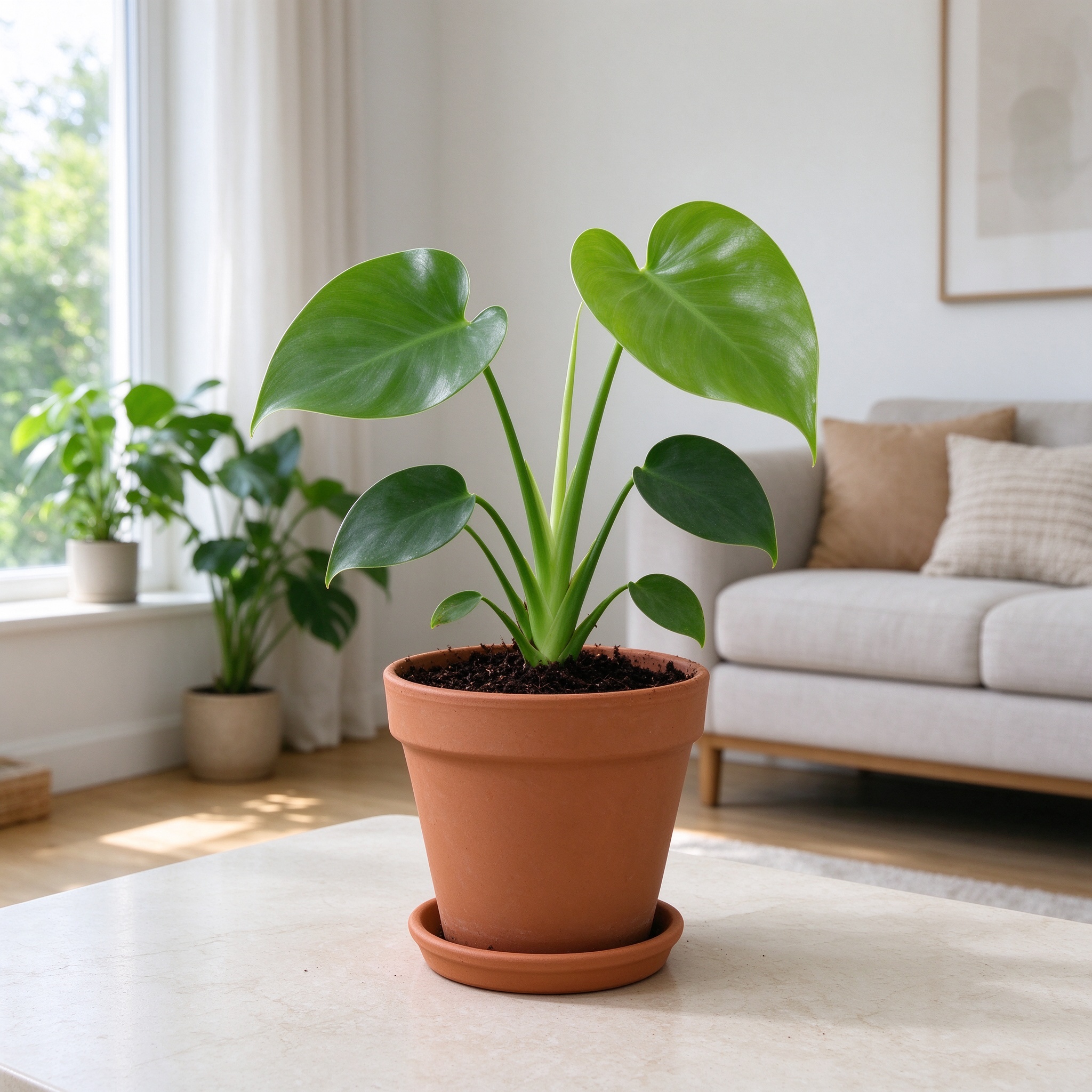
(First 2 to 4 weeks after purchase)- •A new philodendron has moved from a humid greenhouse into your home, and the lower humidity and changed light can make one or two older leaves yellow or drop; this is normal acclimation rather than disease.
- •Place it in its intended bright indirect spot, confirm the nursery pot drains, and water only when the top inch of mix feels dry.
- •Do not repot into a much larger pot right away: oversized soil holds extra wetness around a small root system and causes rot.
- •Skip fertilizer during this stage, keep the plant away from radiators and cold draughts, and wait for a new leaf to unfurl before changing the watering routine.
 2
Root and stem establishment
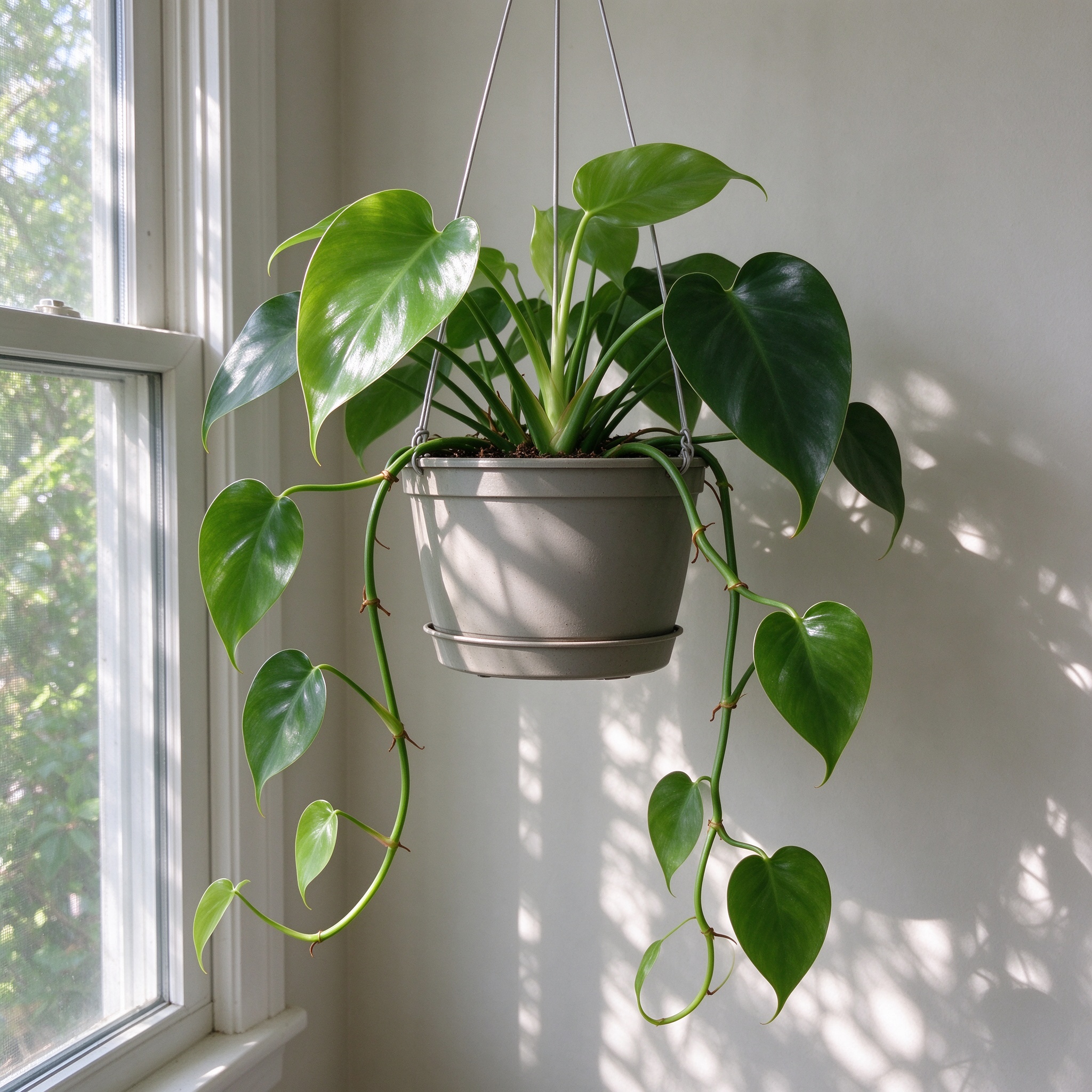
(Months 1 to 6)- •Once settled, the plant expands its root system and pushes new leaves from the growing tip.
- •Climbing types develop aerial roots along the stem that will grip a moss pole or trellis; trailing types lengthen from the pot edge.
- •Keep the soil on the slightly moist side during growth, per NC State, and feed at half strength monthly in spring and summer so the root mass fills the nursery pot.
- •This stage is most vulnerable to winter overwatering: let the mix stay drier from fall onward and stop feeding.
- •Check leaf undersides and axils at every watering so aphids, mealybugs, scale, or spider mites are caught while the population is small.
 3
Active growth and canopy fill
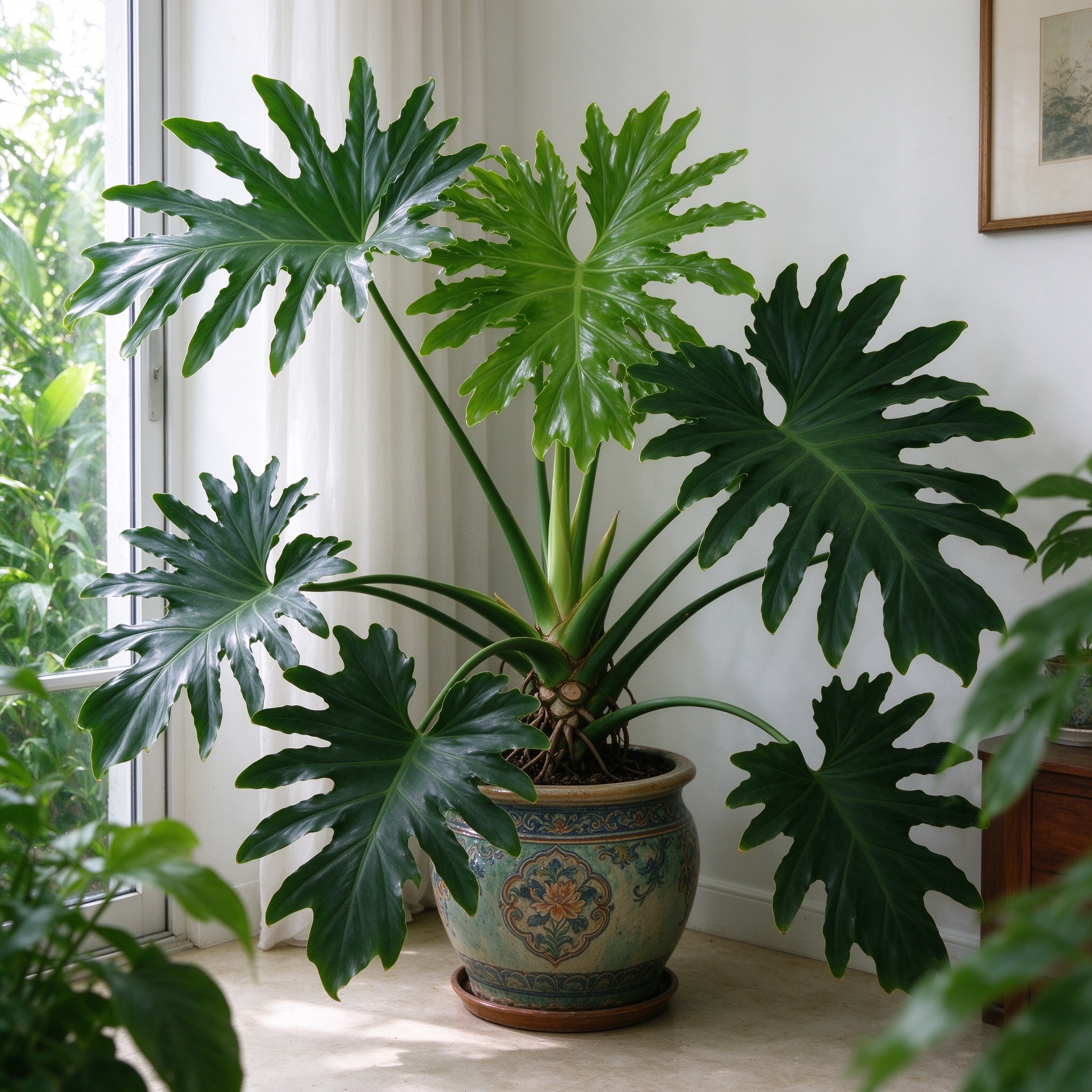
(Spring through summer, year after year)- •In warm, bright months the plant pushes new leaves steadily: climbing stems climb the support, trailing stems lengthen over the basket edge, and bushy types mound outward.
- •This is the season for repotting, pruning, pinching, and taking stem cuttings, all of which recover fastest under active growth.
- •Rotate the pot weekly so foliage develops evenly on all sides, and wipe the leaves to remove dust.
- •A healthy plant keeps its leaves along the stem; a bare, stretched stem means too little light, while a cluster of yellow leaves at once points to wet soil or a recent draft.
- 4
Winter rest
(Late fall through winter)- •Growth slows in short days and cooler rooms.
- •Water far less often, letting the top inch or two dry between drinks, and stop feeding completely; the RHS advises watering sparingly outside the growing season.
- •Do not repot or prune for size during this rest period.
- •Maintain moderate humidity if heating dries the air hard, and keep the plant away from cold floors, drafty doors, and radiator heat.
- •Variegated cultivars in a dim winter corner may stretch toward the light; move them to a brighter indirect position rather than feeding harder to compensate.
💧 Detailed Care Guide
☀️ Light Requirements
- •Give philodendrons bright but indirect light, and keep them out of direct summer sun that scorches the leaves, per the RHS.
- •NC State says the genus refers medium light but will tolerate low light, and the Missouri Botanical Garden places heartleaf philodendron in part shade: bright indirect light near an east window, or three to six feet back from a south or west window behind a sheer curtain, suits most cultivars.
- •The plain green heartleaf is the most shade-tolerant and will survive a darker corner for a while; variegated types such as Brasil, Birkin, and Pink Princess need brighter indirect light to hold their pattern, because too little light makes variegation revert to solid green.
- •Insufficient light makes plants leggy: the RHS notes philodendrons become leggy and produce fewer, smaller leaves when light is poor, with long bare internodes between leaves.
- •Direct afternoon sun behind glass bleaches and burns the foliage, especially on variegated cultivars.
- •Wipe the leaves occasionally to remove dust, which blocks light and harbors mites (RHS).
💧 Watering
- •Water on a soak-and-check rhythm and never let the pot stand in water.
- •NC State advises keeping the soil slightly moist and slowing down on watering in winter; the Missouri Botanical Garden says to water regularly in the growing season but reduce watering from fall through late winter, and warns root rot occurs in overly moist soil.
- •In practice, water thoroughly until liquid drains from the bottom, then wait until the top inch of mix feels dry before the next drink; in a bright warm room that is often once a week in summer, stretching to two or three weeks in a cool dark winter corner.
- •The RHS propagation guidance and NC State both point to a free-draining root zone: a pot without a drainage hole, a saucer left full, or dense soil that stays soggy for days rots the roots fastest.
- •Yellowing and drooping on wet soil means roots are failing; dry, crispy leaves mean the mix went too dry for too long.
- •Use room-temperature water; cold water shocks the roots of this tropical genus.
🌡️ Temperature
- •Philodendrons like typical warm room temperatures.
- •The RHS sets a minimum of 15°C (59°F) and keeps plants away from hot radiators and cold draughts; NC State says the genus prefers average indoor air temperatures and tolerates dry air, though it prefers medium humidity.
- •A comfortable indoor range of 18 to 27°C (65 to 80°F) suits trailing and bushy types alike.
- •Night temperatures below about 13°C (55°F) slow growth and, combined with wet soil, invite root rot; a cold draft from an exterior door, a drafty windowsill, or an air-conditioning outlet can trigger leaf drop just as a radiator directly behind the plant dries the air and crisps the leaves.
- •Do not place a philodendron against a heater vent or in the path of a fan that blows directly on the foliage overnight.
- •If you summer a plant outdoors in a warm climate, bring it back before nights fall toward 15°C.
🌱 Soil & Fertilizer
Soil:
- •Use a loose, free-draining, moisture-retentive potting mix.
- •The Missouri Botanical Garden recommends a soil-based potting mix; the RHS recommends a free-draining blend for rooted cuttings, commonly two parts orchid bark or loam-based compost to one part perlite or peat-free coir.
- •A reliable indoor blend is two parts standard houseplant potting soil, one part perlite or pumice for aeration, and one part orchid bark or coco coir to keep the mix open between waterings.
- •Philodendrons are epiphytic or semi-epiphytic in nature: their aerial roots gather moisture and air, so dense, compacted soil that stays waterlogged around the root ball causes rot faster than it would on a terrestrial plant.
- •Avoid heavy garden soil or pure peat that compacts in a container; the mix should hold moisture for a few days while allowing water to pass through freely.
Fertilizer:
- •Feed lightly during active growth only.
- •The RHS advises watering moderately and applying a balanced liquid fertilizer monthly while in growth, and watering sparingly at other times.
- •For an indoor philodendron, a balanced all-purpose houseplant fertilizer diluted to half strength once a month from spring through summer matches this guidance; stop feeding entirely in fall and winter, when the plant rests and fertilizer salts accumulate in a slowly drying root ball.
- •Philodendrons are moderate feeders: over-fertilizing produces soft, leggy growth, builds a salt crust on the soil surface, and burns the root tips.
- •Variegated cultivars do not need extra strength food; brighter light, not heavier fertilizer, preserves their pattern.
- •If you repot annually into fresh mix, halve the fertilizer dose.
- •Flush a salt-crusted pot with several volumes of room-temperature water and skip the next feeding.
📝 Step-by-Step Planting Guide
- 1
Choose a bright indirect position and a support for climbers
- •Set the plant near an east window or three to six feet back from a south or west window behind a sheer curtain, matching the RHS advice of bright but indirect light out of summer direct sun, and NC State's medium-light preference with low-light tolerance.
- •For climbing species, place a moss pole, trellis, or bark slab in the pot at planting time; the RHS notes climbing philodendrons are trained or tied onto a moss pole into which they eventually root if kept moist.
- •Trailing types go in a hanging basket or on a high shelf where stems can drape.
- •Keep the plant away from radiators, cold draughts, and air-conditioning outlets.
- 2
Use a free-draining soil-based mix
- •Prepare two parts soil-based houseplant potting mix, one part perlite or pumice, and one part orchid bark or coco coir, matching the MBG soil-based potting mix and the RHS free-draining blend.
- •The mix must stay open after repeated watering; dense, compacted soil that remains soggy for days rots the aerial-root-adapted root system fastest.
- •If you tend to overwater, add a little extra perlite; if your home is very dry, a touch more coir helps hold moisture between drinks.
- 3
Pot at the right depth in a draining container
- •Choose a pot with at least one drainage hole, only one size larger than the root ball.
- •Water the root ball first so it slides out without tearing roots, then set the plant at the same depth it was growing before; do not bury the stem base under a mound of fresh mix.
- •Fill around the roots, firm lightly, and water with room-temperature water until it drains freely; empty the saucer after ten minutes.
- •For a climber, position the support beside the main stem and tie the stem loosely with soft plant tie until aerial roots grip on their own.
- 4
Water on a soak-and-check rhythm by season
- •Water thoroughly when the top inch of mix is dry, then let it drain fully; follow NC State's slightly moist soil in growth and reduced watering in winter, alongside the MBG rule of regular watering in the growing season and less from fall to late winter.
- •In a bright warm room this is often weekly in summer, every two to three weeks in a cool winter corner.
- •Never leave the pot standing in a saucer of water; that standing moisture is the direct cause of the root rot NC State and MBG both warn against.
- 5
Feed monthly in growth and groom the foliage
- •From spring through summer, apply a balanced liquid houseplant fertilizer at half strength about once a month, matching the RHS monthly balanced feed during growth; stop entirely in fall and winter.
- •Wipe leaves every few weeks with a soft damp cloth to remove dust, which the RHS notes blocks light and reduces the plant's ability to absorb it.
- •Check leaf undersides while grooming so mites and scale are spotted early.
- •Pinch or trim trailing stems in spring to encourage branching and a fuller basket.
- 6
Repot in spring and propagate by stem cuttings
- •Repot every one to two years in spring, moving up one pot size when roots circle the container and water runs straight through.
- •To propagate, take a 10 cm (4 in) stem cutting in spring to late summer, cutting just below a leaf joint, strip the lower leaves, and root it in a glass of water on a bright indirect windowsill; the RHS reports roots in a couple of weeks, after which the cutting goes into free-draining mix.
- •NC State and MBG both list stem cuttings in spring as the recommended method. Wear gloves when cutting, because the sap can irritate skin (RHS).
🌱 Recommended Varieties
Heartleaf philodendron (Philodendron hederaceum)
- •The classic trailing houseplant: glossy, heart-shaped dark green leaves on slender cascading stems, the species NC State describes as a tropical evergreen trailing or climbing member of the arum family.
- •It is the most shade-tolerant philodendron and the most forgiving for beginners, trailing from a basket or climbing a pole if given support.
- •MBG notes indoor plants reach roughly four feet while wild plants grow much larger.
- •The plain green foliage matches the species description in NC State: alternate, simple, cordate, glossy green leaves with slender petioles.
'Brasil' heartleaf
- •A variegated clone of heartleaf with a central stripe of yellow to light green and dark green borders, listed by NC State among the P.
- •hederaceum cultivars.
- •The pattern holds best in brighter indirect light; a dim room makes the stripe fade and the stems stretch.
- •Care, watering, and propagation match the plain heartleaf: trailing basket, moss pole, or shelf, slightly moist soil in growth, reduced water in winter.
'Birkin' (striped upright philodendron)
- •A compact, self-heading cultivar with broad dark green leaves heavily striped and veined in white and cream, sold as a slow-growing tabletop plant.
- •It needs brighter indirect light than the plain heartleaf to keep the white variegation, and a free-draining mix because its thicker stems and leaves rot faster in soggy soil.
- •Birkin does not trail; keep it in a moderate-size pot on a table or desk where the patterned leaves can be seen up close.
'Pink Princess' climbing philodendron
- •A climbing cultivar with dark green leaves splashed and marbled in pink, grown on a moss pole for large mature leaves.
- •It needs the brightest indirect light of this group to keep the pink variegation; low light returns solid green, and direct sun burns the pink patches.
- •The RHS support guidance applies: tie the stem to a moist moss pole so aerial roots grip, and prune back in spring if the plant outgrows the room.
- •Wear gloves when handling because the sap irritates skin.
'Prince of Orange' self-heading philodendron
- •A bushy, upright cultivar whose new leaves emerge bright orange and bronze before maturing to deep green, forming a compact rosette rather than a vine.
- •It stays manageable in a tabletop pot and needs medium to bright indirect light; too little light dulls the orange flush on new growth.
- •Water on the same soak-and-check rhythm, keep the crown open for airflow, and remove older green leaves as they age to keep the center compact.
Xanadu (self-heading split-leaf bush)
- •A mounded, non-climbing philodendron with deeply lobed glossy leaves that forms a dense two to three foot bush in a pot.
- •It is often confused with Monstera because of its cut foliage, but it stays compact and does not climb or develop the holes of a mature Monstera deliciosa.
- •Give it bright indirect light, a wide pot to match its spreading habit, and a free-draining soil-based mix.
- •Note: the plant commonly sold as 'split-leaf philodendron' with fenestrated leaves is Monstera deliciosa, a separate genus covered at /how-to-grow-monstera.
🪴 Growing in Containers
- Drainage hole and basket choice:
- •Choose a pot or hanging basket with at least one working drainage hole.
- •NC State and MBG both tie root rot to overly wet soil; a hole-less decorative planter should hold the nursery pot as a cachepot rather than being planted directly.
- •Trailing heartleaf and Brasil look best in a hanging basket or on a high shelf; climbing Pink Princess and Birkin sit in a pot with a moss pole; bushy Prince of Orange and Xanadu need a wide, stable pot for their spreading mound.
- Size up only one pot size at a time:
- •Move to a pot only one to two inches wider than the root ball when repotting.
- •An oversized container holds wet soil around a small root system, the classic indoor setup for philodendron root rot.
- •Repot in spring so fresh mix dries on the active-growth timetable; a plant that roots tightly against the pot and dries out between waterings faster than expected is the signal to move up a size, not a fixed calendar date.
- Pot material for your watering habit:
- •Unglazed terracotta breathes and dries the mix faster, suiting someone who waters often and helps prevent rot on thick-stemmed cultivars such as Birkin.
- •Plastic and glazed ceramic hold moisture longer, useful in a very dry heated room or for trailing plants that dry out on a high shelf.
- •The RHS free-draining compost recommendation applies regardless of pot material; match porosity to your habit rather than decor.
- Moss pole and support setup:
- •For climbing philodendrons, install a moss pole, coir totem, or bark slab at repotting time rather than forcing it into a mature root ball later.
- •The RHS notes climbing types are trained or tied onto a moss pole into which they eventually root if it is kept moist.
- •Keep the pole damp so aerial roots adhere, and tie the stem loosely with soft plant tie until roots grip.
- •A bare, leafless lower stem on a climber can be hidden by looping the old stem around the pole or cutting it back in spring to regrow from the base.
- Cachepot and humidity tray:
- •If the room is dry in winter, set the pot on a pebble tray with a shallow layer of water below the pebbles; evaporation raises local humidity around the canopy without leaving roots standing in water, matching NC State's preference for medium relative humidity.
- •Keep the water level under the pebbles so the pot itself does not sit in liquid, and refresh the tray weekly to avoid algae and fungus gnats.
- •A cachepot can hide a plain nursery basket, but lift it out to water and drain before replacing.
✂️ Pruning & Maintenance
- ✓
Wear gloves and remove damaged leaves
- •Always wear gloves when handling and pruning philodendrons: the RHS notes the plants are poisonous and the sap can be a skin irritant.
- •Cut yellowed, browned, or damaged leaves cleanly at the petiole base with sanitized shears.
- •Removing spent foliage redirects energy into new leaves and improves airflow around the crown.
- •One old leaf yellowing at a time is normal; several at once points to wet soil, dry air, or a draft and should be diagnosed rather than trimmed away.
- ✓
Prune climbers back in spring
- •The RHS advises that if climbing or trailing philodendrons get too large for the indoor space, prune them back in spring just as they come into growth; cutting back straggly specimens encourages fresh leafy growth for a fuller look.
- •Make the cut just after a leaf node on the stem, so new shoots emerge below the cut.
- •A long bare stem can be cut back to a few nodes above the soil, and the removed section can be rooted as a cutting.
- ✓
Pinch trailing stems for bushiness
- •The Missouri Botanical Garden recommends pinching trailing stems to promote bushier growth.
- •Snip the growing tip just above a leaf node in spring; the stem branches below the cut instead of continuing as a single long runner.
- •Regular pinching keeps a hanging basket dense and trailing down rather than bare at the base.
- •Repeatedly cut back any stem that stretches toward a dark corner, since that leggy growth rarely regains compactness in place.
- ✓
Bushy species need little pruning
- •The RHS notes bushy philodendron species do not generally need pruning, training, or support.
- •For Xanadu, Prince of Orange, and Birkin, simply remove old yellowing leaves at the base and occasionally thin an overcrowded center to open airflow.
- •Do not cut the main growing tip off a self-heading rosette, because it will not resprout from the stem the way a trailing vine would; instead, remove outer mature leaves as the center pushes new growth.
🐛 Pest & Disease Control
Common Pests
Spider mites
Symptoms:- •Fine pale speckling across the leaves, faint webbing on undersides and between stems, and a dull cast on foliage that should be glossy; outbreaks flare in dry heated rooms in winter.
- •NC State and the MBG both list spider mites among the monitored pests of philodendron.
Control:- •Wash the leaves thoroughly, top and bottom, with lukewarm water, then raise humidity around the plant with a pebble tray or humidifier.
- •Treat persistent mites with insecticidal soap or neem oil on leaf undersides every week for a month.
- •Isolate the plant while treating so mites do not spread to neighboring houseplants, and wipe leaf surfaces at grooming time to catch early colonies.
Mealybugs
Symptoms:- •Cottony white ovals cluster in leaf axils, along stems, and on the underside of leaf veins; sticky honeydew coats nearby foliage and tender new growth emerges curled.
- •NC State and the MBG list mealybugs among the insects to watch for on philodendrons.
Control:- •Dab visible mealybugs with a cotton swab dipped in rubbing alcohol, then wipe the whole plant with diluted insecticidal soap or neem oil every ten days for a month, since eggs hidden in crevices keep hatching.
- •Check neighboring plants and isolate the infested one during treatment; improve air circulation around the crown so humid, still air no longer favors the colony.
Scale insects
Symptoms:- •Small raised brown or tan bumps stick to stems and leaf veins and do not move when touched; sooty black mold grows on the honeydew they excrete, and leaves yellow or drop early.
- •NC State and the MBG list scale among the monitored pests.
Control:- •Scrape each bump off with a fingernail or alcohol-dampened swab, then spray the whole plant with horticultural oil or neem to kill the mobile crawler stage; repeat every seven to ten days for a month.
- •Prune heavily infested stems and seal them in a bag before disposal so crawlers do not transfer to other houseplants.
Aphids
Symptoms:- •Clusters of small green, brown, or black insects gather on tender new growth and stem tips, curling young leaves and excreting sticky honeydew that supports sooty mold.
- •NC State names aphids among the insects to monitor.
Control:- •Wash the insects off under a gentle lukewarm shower or with a soft cloth and diluted insecticidal soap, paying attention to stem tips and leaf undersides; repeat every few days until none remain.
- •Keep the crown open and ventilated, and avoid over-fertilizing, which promotes the soft succulent growth aphids prefer.
Common Diseases
Root rot (overwatering)
Symptoms:- •Leaves yellow, wilt, and droop even though the soil is wet; stems at the base feel soft, and roots pulled from the pot are brown and slimy rather than pale and solid.
- •NC State and the MBG both note root rot can occur in overly wet soil; this is the most common sudden collapse of an indoor philodendron.
Control:- •Stop watering and tip the plant out of the pot.
- •Clip away every brown, mushy root with sterile shears, remove soggy old mix, and repot into fresh free-draining blend in a clean pot with a working drainage hole.
- •Let the mix dry between drinks going forward, and keep the plant on the soak-and-check schedule.
- •For a severely rotted climber, root a healthy tip cutting rather than trying to save the failing base.
Bacterial and fungal leaf spot
Symptoms:- •Tan to dark brown or black spots, often with a yellow halo, appear on leaves, starting at the edges or from water droplets left on the foliage overnight; centers may dry and fall out leaving a shot-hole look.
- •NC State notes leaf spots may be seen on philodendrons, favored by wet leaves and stagnant air.
Control:- •Water the soil rather than the foliage, and remove every spotted leaf with sanitized shears, bagging it for disposal.
- •Improve air circulation around the crown and space the plant away from neighboring foliage.
- •A labeled houseplant fungicide or copper spray applied every ten days slows bacterial and fungal spread; morning watering lets any accidental splash dry before evening.
Powdery mildew and edema
Symptoms:- •A thin white powdery coating spreads on upper leaf surfaces in still humid air, while edema appears as raised, corky brown bumps on leaves that alternate between very wet and very dry conditions.
- •Both appear on foliage kept in a stagnant, poorly ventilated room with uneven watering.
Control:- •Increase spacing and airflow, wipe affected leaves with diluted neem, and remove the worst-dusted or corked leaves.
- •Keep watering even rather than alternating drench and drought, and avoid overhead watering.
- •In severe mildew cases use a labeled houseplant fungicide every seven to ten days until new growth stays clean.
Sun scorch and cold injury (physiological)
Symptoms:- •Pale bleached patches and brown crispy edges appear after a leaf that was kept shaded meets direct afternoon sun through glass; leaves blacken or drop after a cold draft, radiator blast, or contact with a cold windowsill.
- •This is tissue damage rather than a pathogen, and it often follows a sudden relocation outdoors.
Control:- •Move the plant back to a bright indirect position, trim the worst scorched leaves, and remove blackened stem sections with sterile shears.
- •Acclimate any plant moved outdoors gradually over a week or two, keep it at least a few feet from heaters and exterior doors, and do not let trailing stems drape over a cold radiator.
- •New leaves emerging green after the move confirm conditions have stabilized.
🍅 When to Harvest
- •There is no edible harvest on a philodendron.
- •The plant rarely flowers indoors; the Missouri Botanical Garden notes greenish-white arum-family flowers appear infrequently on mature indoor plants, and NC State records the spadix and spathe only on mature specimens.
- •The indoor milestone to watch for is healthy vegetative growth: new leaves unfurl steadily through spring and summer, climbing stems develop aerial roots that grip a support, and trailing stems lengthen without shedding leaves in clusters.
- •Mature plants in warm, bright rooms may reach several feet on a pole or trail several feet from a basket; bushy self-heading types such as Xanadu fill out a pot with a dense mound of lobed leaves.
❓ Frequently Asked Questions
- 1
Why is my philodendron drooping?
- •Drooping usually means one of two watering extremes.
- •Overwatering has rotted the roots: the soil stays wet, leaves yellow and wilt, and the base feels soft, because NC State and MBG both tie root rot to overly wet soil.
- •Underwatering makes the whole plant droop and curl after the mix goes bone dry, with crisp rather than soft leaves.
- •Check the soil first: if soggy, stop watering, unpot, trim brown roots, and repot into free-draining mix; if dry, soak thoroughly and return to the soak-and-check rhythm.
- •Other causes are a cold draft, a recent move, or a climber that needs water on its support pole; stems without aerial-root grip can flag even when roots are fine.
- 2
How often should I water a philodendron?
- •Check the top inch of soil instead of following a fixed schedule: water thoroughly until liquid drains from the bottom, then wait until that layer feels dry before the next drink.
- •NC State says to keep the soil slightly moist and slow down in winter, and MBG says to water regularly in the growing season but reduce from fall to late winter.
- •In a bright warm room that is often weekly in summer, every two to three weeks in a cool dark winter corner.
- •Never leave the pot standing in a saucer of water, which NC State and MBG both identify as the root-rot trigger.
- 3
Why are my philodendron leaves turning yellow?
- •Yellowing from the base upward on wet soil points to overwatering and early root rot; NC State and MBG both warn of root rot in overly moist soil.
- •A single older leaf yellowing now and then is normal aging, but several at once means wet roots, a hole-less pot, or a full saucer.
- •Yellow leaves on a plant that is clearly dry at the root ball mean underwatering.
- •Pale yellow foliage on a dim corner can also mean too little light, which the RHS links to leggy growth and smaller leaves; variegated cultivars lose their pattern first.
- •Check moisture, drainage, and light in that order before reaching for fertilizer.
- 4
Is philodendron toxic to dogs?
- •Yes.
- •The ASPCA lists philodendrons (Philodendron spp.) as toxic to dogs, cats, and horses because all parts contain insoluble calcium oxalate crystals; UF/IFAS likewise notes all parts are poisonous.
- •Chewing releases microscopic needle-like crystals that cause oral irritation, pain and swelling of the mouth, tongue and lips, excessive drooling, vomiting, and difficulty swallowing.
- •Keep stems and baskets out of reach of nibbling dogs and cats, and call a veterinarian or the ASPCA Poison Control number if a pet chews the plant.
- •Wear gloves when pruning because the sap can irritate skin. For non-toxic houseplants, browse our cat-safe list at /cat-safe.
- 5
How do I propagate philodendron?
- •Root a stem cutting in spring to late summer, per the RHS and NC State.
- •Cut a 10 cm (4 inch) stem section just below a leaf joint, strip off the lower leaves, and stand it in a glass of water on a bright indirect windowsill; the RHS reports roots in a couple of weeks, after which you pot it into a free-draining mix.
- •You can also plant the cutting directly into moist perlite and coir and keep it humid.
- •Take cuttings from healthy growing tips, keep them warm, and change the water weekly. Wear gloves when cutting because the sap irritates skin.
- •A long bare climber can be cut back and the old stem reused for several cuttings rather than discarded.
- 6
Why are my philodendron leaves turning brown and crispy?
- •Brown crispy edges most often come from dry air, underwatering, or direct sun rather than disease.
- •NC State notes the genus tolerates dry air but prefers medium humidity, and a winter heated room dries the foliage enough to crisp leaf margins.
- •If the mix went bone dry between drinks, the whole leaf turns crisp and curls back.
- •Direct afternoon sun behind glass scorches leaves that previously sat in shade, per the RHS warning against summer direct sun.
- •Raise humidity with a pebble tray, water on the soak-and-check schedule, and move the plant out of direct glare; trim the worst brown leaves with sterile shears.
- 7
Why is my philodendron leggy?
- •Leggy stems with long bare internodes and sparse small leaves mean insufficient light.
- •The RHS states that when philodendrons do not get enough light they become leggy and produce fewer, smaller leaves; NC State's low-light tolerance means the plant survives, not that it thrives.
- •Move the plant to a brighter indirect position, rotate weekly, and for a trailing or climbing stem, cut the bare section back to a few nodes in spring so fresh branching emerges below the cut.
- •Variegated cultivars stretch fastest in dim rooms because they need more light to hold their pattern; pinching tips in spring also encourages side shoots for a fuller look.
- 8
What is the difference between a philodendron and a split-leaf Monstera?
- •They are related members of Araceae but separate genera.
- •Mature Monstera deliciosa develops large leaves with deep lobes and oval holes (fenestrations) that appear as the plant climbs and ages; it is frequently mislabeled 'split-leaf philodendron' in nurseries.
- •True philodendrons include trailing heartleaf types, variegated climbers, and compact self-heading bushes such as Xanadu; none produce the mature holes of a Monstera.
- •Care differs in light and support needs, so check our Monstera guide at /how-to-grow-monstera for that plant's watering, moss pole, and mature-size requirements rather than treating it as a philodendron.
- 9
Does philodendron need sunlight?
- •It needs bright indirect light, not direct sun and not a dark closet.
- •The RHS positions philodendrons in bright but indirect light, away from summer direct sun that scorches the leaves; NC State says medium light with tolerance for low light, and MBG places the species in part shade.
- •Plain green heartleaf survives a dimmer room better than variegated Brasil, Birkin, or Pink Princess, which need brighter indirect light to keep their pattern.
- •Signs that light is too low are leggy stems, small leaves, and loss of variegation; signs that it is too strong are bleached patches and brown crispy edges on leaves exposed to afternoon sun.
Source:
NC State Extension Gardener Plant Toolbox — https://plants.ces.ncsu.edu/images/plants/philodendron-hederaceum/
ASPCA Animal Poison Control Center — https://www.aspca.org/pet-care/animal-poison-control/toxic-and-non-toxic-plants/heartleaf-philodendron
Royal Horticultural Society (RHS) — https://www.rhs.org.uk/images/plants/philodendron/growing-guide
Missouri Botanical Garden Plant Finder — https://plantfinder.mobot.org/PlantFinderDetails.aspx?basic=philodendron&isprofile=1&taxonid=276387
UF/IFAS Extension, Houseplants Poisonous to Cats and Dogs — https://sfyl.ifas.ufl.edu/media/sfylifasufledu/st-johns/horticulture/pdf/Hort-14--Houseplants,-Pets,-and-Poison.pdf
Royal Horticultural Society (RHS) — https://www.rhs.org.uk/images/plants/philodendron/how-to-grow-philodendron
Photo credit: NC State Extension
Images courtesy of NC State Extension under CC BY license. Thank you to the photographers who make these educational images available.
License: CC BY-NC 2.0 / CC BY 4.0