
How to Grow Cucumbers: Complete Guide
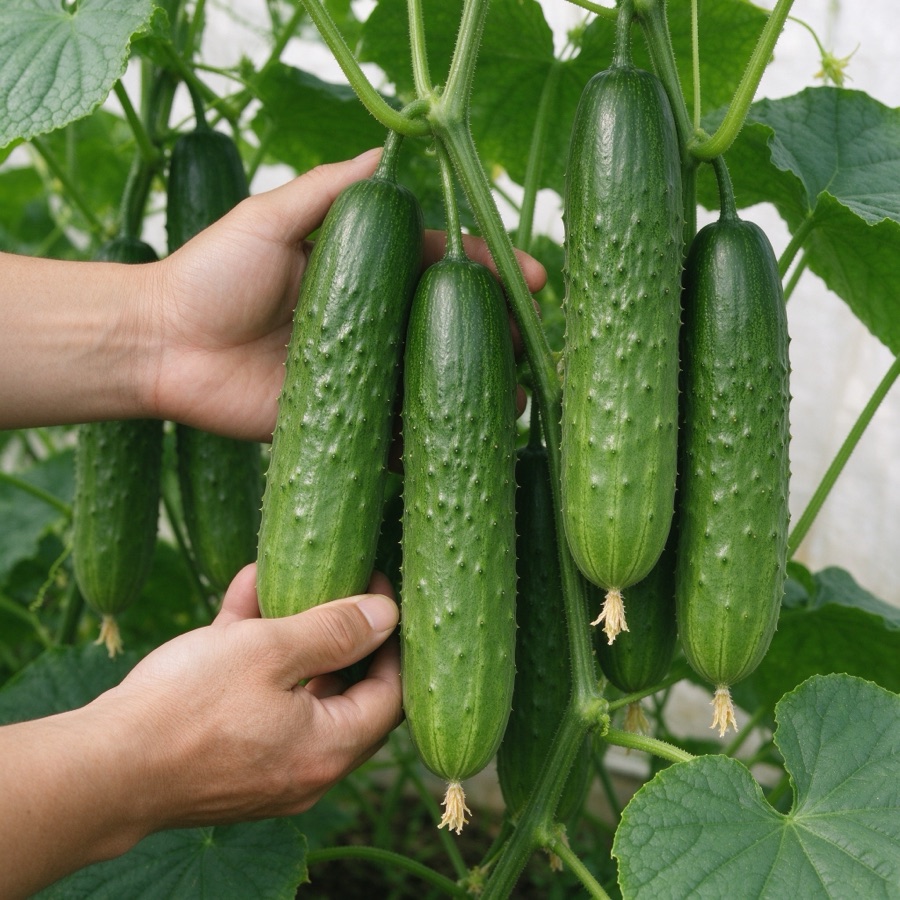
- •Cucumbers (Cucumis sativus) are fast-growing warm-season vines in the gourd family (Cucurbitaceae), grown for their crisp, watery fruits eaten fresh or pickled.
- •Native from the Himalaya to northern Thailand, they set long cylindrical green fruits on climbing vines that reach 6 to 10 feet on a trellis, or stay compact as bush types for pots.
- •Cucumbers need full sun, rich moisture-retentive soil, and warm conditions; the key to a bitter-free crop is consistent water, quick harvesting, and plenty of pollinators.
📋 Quick Facts
Scientific Name: Cucumis sativus
Family: Cucurbitaceae
Category: Vegetable
USDA Zones: 4-11 (annual)
Light:
- •Plant in full sun with at least 6 to 8 hours of direct light daily.
- •Cucumbers will not thrive in shade, and vines kept moist and sunny resist powdery mildew better than crowded, shaded plants.
Water:
- •Cucumbers are thirsty: provide about 1 inch of water per week, more in heat or when container-grown.
- •Water at the soil line and keep leaves dry; uneven water causes bitter fruit and blossom-end rot. Mulch helps retain moisture once soil warms.
Temperature:
- •Cucumbers are heat-loving and killed by any frost. They germinate best when soil is 70°F and grow well between 70 and 90°F.
- •Night temperatures below 50°F stunt vines; row covers warm cold early-season soil.
Soil:
- •Fertile, moisture-retentive but well-drained soil, pH 6.5 to 7.0.
- •Dig in 2 inches of aged manure or compost before planting; cucumbers are heavy feeders that respond to rich loam.
Harvest:
- •Slicing cucumbers are ready about 50 to 70 days after sowing, picked at 6 to 8 inches long; pickling types at 2 to 3 inches; burpless types up to 10 inches; gherkins at 1 to 3 inches.
- •Pick every couple of days—fruits turn yellow, seedy, and bitter fast if left on the vine.
Common Problems: Poor fruiting, Cucumber beetles, Powdery mildew.
📅 When to Plant
- •Direct-sow seeds outdoors no earlier than 2 weeks after your last spring frost, once soil is around 70°F.
- •For an earlier crop, start seeds indoors in biodegradable pots about 3 weeks before transplanting.
- •Make successive plantings every 2 weeks through mid-summer for a steady harvest.
🌱 Growing Stages
 1
Germination and emergence
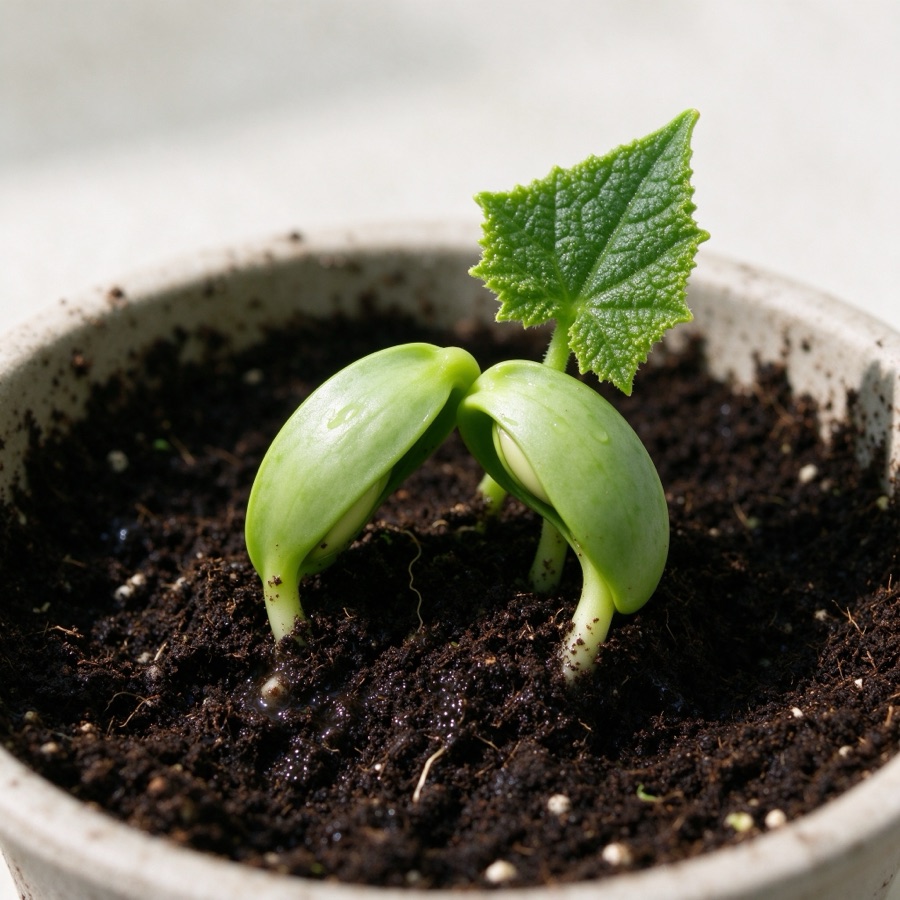
(3–10 days)- •Cucumber seeds germinate fast—3 to 5 days at 70°F soil, slower in cold ground. Two smooth cotyledons push up, followed by the first rough true leaf.
- •This stage is vulnerable to pests and cold; row covers warm the bed and block cucumber beetles.
 2
Vegetative vine growth
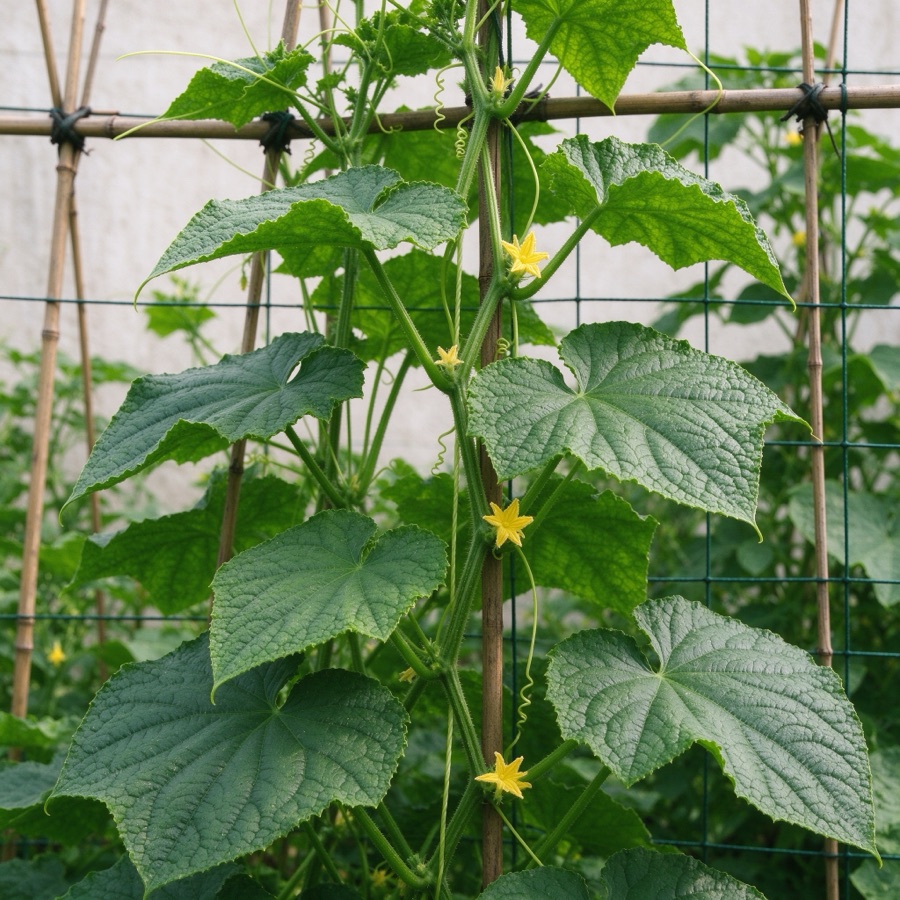
(3–4 weeks)- •Plants develop large rough heart-shaped leaves and long climbing stems with tendrils. Male flowers start appearing in leaf axils.
- •This is the time to guide vines onto the trellis, mulch once soil warms, and start side-dressing before female flowers arrive.
 3
Flowering and pollination
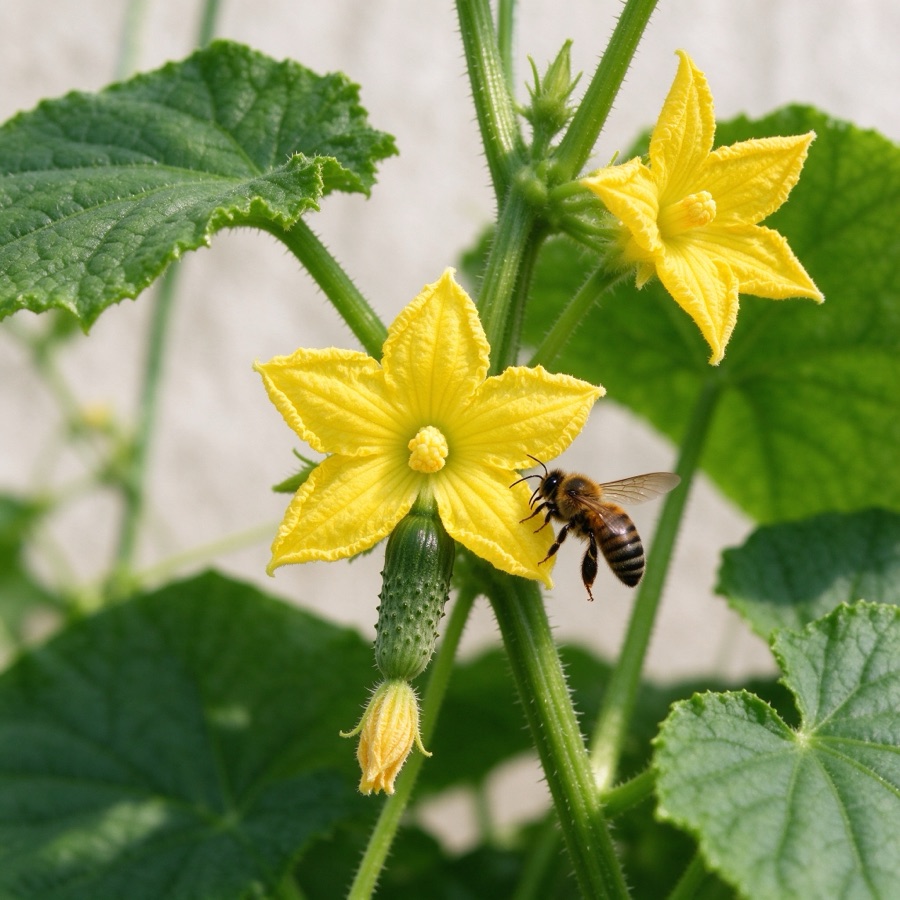
(2–3 weeks)- •Female flowers with their tiny fruit behind the petals begin opening about a week after males.
- •Bees must carry pollen from male to female flowers while both are open in the morning.
- •Poor pollination leads to misshapen fruit; keep beds bee-friendly and avoid insecticides during bloom.
 4
Fruit development and harvest
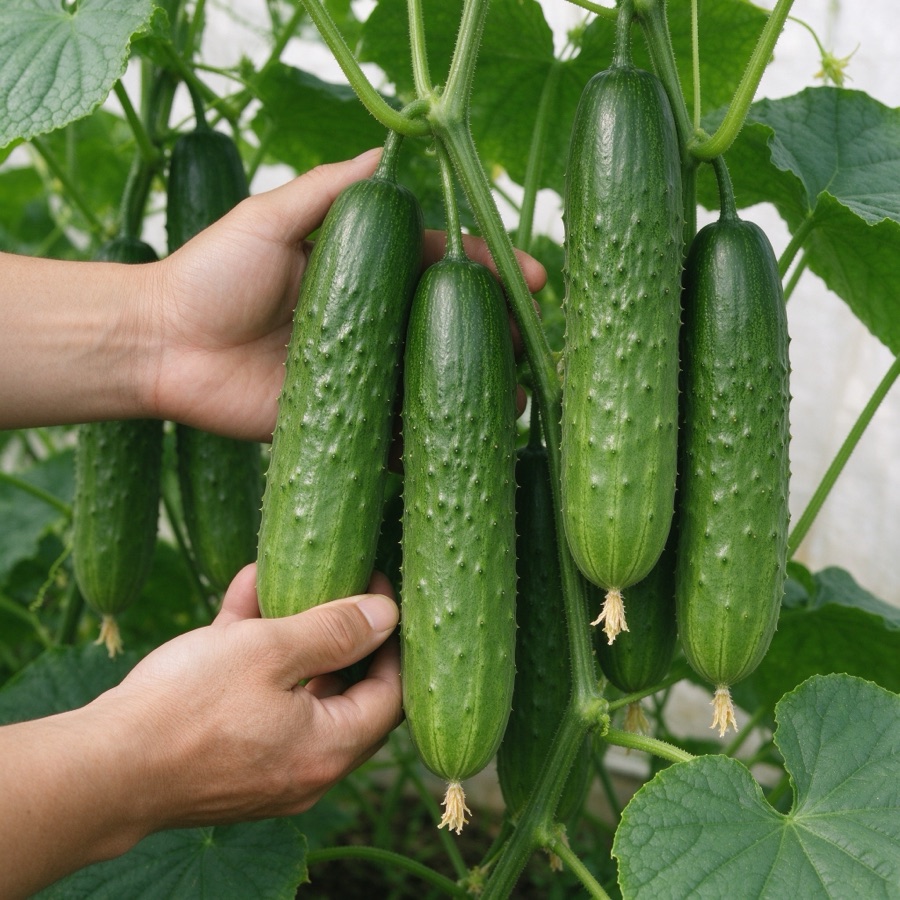
(4–6 weeks)- •Pollinated fruits swell rapidly, reaching slicing size in about a week.
- •Pick every 2 days; any yellow fruit left on the vine signals the plant to stop producing.
- •Successive sowings every 2 weeks keep harvests going until fall.
💧 Detailed Care Guide
☀️ Light Requirements
- •Plant in full sun with at least 6 to 8 hours of direct light daily.
- •Cucumbers will not thrive in shade, and vines kept moist and sunny resist powdery mildew better than crowded, shaded plants.
💧 Watering
- •Cucumbers are thirsty: provide about 1 inch of water per week, more in heat or when container-grown.
- •Water at the soil line and keep leaves dry; uneven water causes bitter fruit and blossom-end rot. Mulch helps retain moisture once soil warms.
🌡️ Temperature
- •Cucumbers are heat-loving and killed by any frost. They germinate best when soil is 70°F and grow well between 70 and 90°F.
- •Night temperatures below 50°F stunt vines; row covers warm cold early-season soil.
🌱 Soil & Fertilizer
Soil:
- •Fertile, moisture-retentive but well-drained soil, pH 6.5 to 7.0.
- •Dig in 2 inches of aged manure or compost before planting; cucumbers are heavy feeders that respond to rich loam.
Fertilizer:
- •Mix compost or aged manure into the bed at planting, then side-dress with a balanced or high-potassium fertilizer such as tomato feed once vines begin to flower.
- •Avoid overdoing nitrogen, which gives leaves but few fruits.
📝 Step-by-Step Planting Guide
- 1
Prepare hills or rows in warm, rich soil
- •Wait until all frost danger is past and the soil has warmed to about 70°F, then dig in 2 inches of aged manure or compost and a balanced organic fertilizer.
- •Form flat-topped hills 18 to 36 inches apart, or sow in rows 4 feet apart.
- •Cucumbers need very fertile soil, so this prep step matters more than for most vegetables.
- •If your spring is cold, cover the bed with black plastic mulch for 1 to 2 weeks before sowing to speed soil warming and to get a jump on the season.
- 2
Direct-sow seeds or transplant biodegradable pots
- •Sow two seeds 1 inch deep per station, spaced 12 to 18 inches apart in rows, or plant three seeds on each hill and thin to the strongest plant when seedlings are 4 inches tall.
- •If you want an earlier crop, sow seeds indoors in 4-inch biodegradable peat pots 3 weeks before planting out, since cucumbers dislike root disturbance.
- •Harden plants carefully, then set the whole pot in the soil so roots can grow through; water well after planting and protect young vines with floating row covers until they start to flower.
- 3
Install a trellis at planting time
- •Set up a cattle panel, bamboo, wire, or string trellis at the same moment you plant, because young vines start climbing immediately.
- •Growing cucumbers vertically saves space, keeps fruit straight and clean, improves air circulation around leaves, and sharply reduces powdery mildew and fruit rot.
- •Bush types can sprawl on mulch, but even they benefit from a low cage.
- •As tendrils form, gently guide vines onto the trellis; tie loosely with soft twine if needed.
- •Plan to harvest from below to avoid breaking heavy vines.
- 4
Water, mulch, and feed through flowering
- •Keep soil consistently moist—about 1 inch per week, more in heat—watering at the base in the morning so leaves dry by evening.
- •Once soil is warm (around 75°F), apply a 2-inch organic mulch of straw or chopped leaves to conserve moisture, suppress weeds, and keep fruits clean.
- •When vines begin to flower, side-dress with a balanced or high-potassium fertilizer such as tomato feed.
- •Remove row covers as soon as yellow flowers open so bees can pollinate; without pollination, fruits are small and misshapen.
- 5
Harvest every few days and clear vines
- •Pick slicers at 6 to 8 inches, picklers at 2 to 3 inches, and burpless types up to 10 inches, cutting the stem with a knife rather than pulling the fruit.
- •Harvesting every 2 days keeps plants producing; any yellow, over-ripe fruit left on the vine signals the plant to stop.
- •At season's end, pull up and compost healthy vines but bag and discard any heavily diseased foliage to reduce overwintering mildew and beetle eggs.
- •Rotate cucurbits to a new bed next year to break disease cycles.
🌱 Recommended Varieties
Early pickling and slicers
- •Choose early-maturing varieties to beat cucumber beetle pressure and start harvests fast.
- •'Boston Pickling' is a vining heirloom bred especially for crisp pickles, prolific and traditional.
- •'Carolina' and 'County Fair' are modern pickling hybrids with tolerance to bacterial wilt and cucumber beetles.
- •'Marketmore 76' is a popular slicing cultivar resistant to powdery mildew and angular leaf spot, ready in about 58 days.
Main-season slicers and burpless
- •Main-season slicers produce long, straight, bitter-free fruit for salads.
- •'Shintokiwa' (also called Japanese Long) is a Japanese heirloom yielding long, straight, crisp fruit.
- •'Burpless Bush Hybrid' is a compact variety for small gardens and pots that is slow to bitterness.
- •'Diva' is a thin-skinned, seedless parthenocarpic hybrid that needs no pollinator and resists powdery mildew.
Heirloom and novelty types
- •Heirloom and novelty cucumbers offer unusual shapes and colors. 'Lemon' is a round yellow baseball-sized heirloom that is sweet and easy to grow.
- •'Silver Slicer' is a white-skinned heirloom with crisp, mild flesh.
- •'Gele Tros' is a Dutch heirloom with yellow clustered fruit, and 'Suho Long' (Suyo Long) is a ridged Asian type known for burpless, mild flavor.
🪴 Growing in Containers
- Use a 5-gallon or larger pot:
- •Cucumbers are heavy feeders and thirsty; a 12-inch-wide, 12-inch-deep pot (5 gallons) holds one bush vine.
- •Vining types can be planted in the same size pot with a small trellis inserted.
- Pick bush or compact varieties: 'Burpless Bush Hybrid' and compact parthenocarpic 'Diva' are ideal for containers; long vining slicers need too much root room and frequent water in pots.
- Fill with rich, moisture-retentive mix:
- •Use quality potting soil with 20 percent compost; cucumbers wilt fast in tired mix.
- •Add a small handful of slow-release organic vegetable fertilizer at planting.
- Water daily, feed every 2 weeks: Pots dry fast in full sun—check daily and water until it drains. Flowers trigger feeding: dilute liquid tomato fertilizer every 10–14 days through the harvest.
- Add a small trellis and full sun: Insert a tomato cage, string netting, or bamboo teepee at planting. Place the pot in full sun (6+ hours) on a deck or patio; cucumbers will not fruit in shade.
✂️ Pruning & Maintenance
- ✓
Guide vines onto the trellis
- •As tendrils form, gently wrap young runners around the support.
- •This is the most important 'pruning' for cucumbers—it keeps fruit straight, exposes leaves to sun, and prevents sprawling tangles.
- ✓
Remove lower leaves to 6 inches
- •Once vines are established, snip off leaves on the lowest 6 inches of stem to improve air flow at soil level and reduce disease splash.
- •Do not remove large upper leaves that power fruit production.
- ✓
Pinch back overlong runners
If a vine races beyond the trellis, pinch the growing tip to encourage branching and more fruit sites. This is optional but keeps plants tidy in small spaces. - ✓
Harvest cleanly and remove yellow fruit
- •Use a knife to cut fruit stems cleanly—pulling can damage vines.
- •Remove any yellow or over-ripe fruit immediately; it signals the plant to stop production and diverts energy from new fruits.
🐛 Pest & Disease Control
Common Pests
Cucumber beetles
Symptoms: Small yellow-green beetles with black stripes or spots that chew holes in leaves, stems, and flowers, and rasp young fruit skin; they spread bacterial wilt and cucumber mosaic virus, often killing young vines.Control:- •Cover newly planted seeds with floating row covers until flowering to exclude beetles, remove them at bloom for pollinators.
- •Delay planting a week or two in beetle-heavy areas, handpick into soapy water in early morning, and surround plants with diatomaceous earth.
- •Plant resistant cultivars such as 'County Fair' and destroy crop residue in fall.
Squash bugs
Symptoms: Flat brown-gray bugs that suck sap from leaves, causing wilting, yellow speckling, and dead patches; shiny bronze egg clusters are laid on leaf undersides in rows.Control:- •Check leaf undersides daily and crush egg clusters by hand.
- •Handpick adults in early morning into soapy water, or lay boards on the soil overnight and scrape the bugs that shelter underneath each morning.
- •Clean up plant residue in fall, use trellises to improve air flow, and rotate crops.
Aphids
Symptoms: Tiny green or black insects clustered on leaf undersides and new growth, curling leaves and excreting sticky honeydew that grows black sooty mold and spreads mosaic virus.Control:- •Spray leaf undersides with a strong jet of water early; follow with insecticidal soap or neem oil every few days.
- •Release or attract ladybugs and lacewings with nectar flowers, and avoid high-nitrogen fertilizers that produce the soft growth aphids love.
Spider mites
Symptoms: Tiny spider-like mites feeding on leaf undersides cause pale stippling and fine webbing, usually in hot dry weather; leaves turn bronze and dry out, reducing yield.Control:- •Increase humidity by misting and mulching, spray leaf undersides with water jets, and apply insecticidal soap or horticultural oil when mites first appear.
- •Avoid broad-spectrum insecticides that kill predatory mites; keep vines well watered because stressed plants attract mites.
Common Diseases
Powdery mildew
Symptoms:- •A white talcum-like coating starts on upper leaf surfaces, spreads to cover leaves, and causes them to yellow and die.
- •Favored by warm days, cool nights, and poor air circulation rather than wet leaves.
Control:- •Space vines well, trellis vertically, and water at the soil line.
- •Spray preventively with a 40% milk / 60% water solution or baking soda (1 teaspoon per quart) every 10 to 14 days.
- •Grow resistant varieties such as 'Marketmore 76' and 'Diva', and remove badly infected leaves.
Downy mildew
Symptoms: Yellow angular lesions on upper leaf surfaces with gray-purple fuzz on leaf undersides; lesions turn brown and leaves die rapidly in cool wet spring weather.Control:- •Plant resistant varieties, trellis for air flow, water early in the day, and avoid overhead irrigation.
- •Remove infected leaves promptly; copper sprays may slow spread. The spores blow long distances, so clean up crop residue and rotate crops.
Bacterial wilt
Symptoms:- •Vines suddenly wilt during the day even in moist soil, leaves look dull gray-green, and eventually whole runners die.
- •Spread by cucumber beetles; the bacteria plug the water-conducting vessels.
Control:- •There is no cure.
- •Control cucumber beetles with row covers and resistant varieties ('County Fair' tolerates wilt).
- •Once a vine wilts, pull it and bag it; keep beds clean. Scout often and remove beetles before they feed.
Anthracnose
Symptoms: Round brown sunken spots on leaves and fruit, pinkish spore masses in centers in wet weather; lesions can rot fruit and girdle stems.Control:- •Plant resistant varieties, rotate cucurbits out of the bed for at least 2 years, avoid overhead watering, and remove infected debris.
- •Copper sprays applied at first sign can slow spread; do not save seed from infected fruit.
Fusarium and verticillium wilts
Symptoms:- •Older leaves yellow and wilt first, then the whole vine collapses; a cut stem shows brown discoloration of the vascular tissue.
- •Soil-borne fungi that persist for years.
Control:- •Choose resistant cultivars (look for F or V codes), plant in fresh well-drained soil or raised beds, and rotate away from all cucurbits for 4 years.
- •There is no cure for infected vines—remove and bag them. Avoid overwatering and remove crop residue in fall.
🍅 When to Harvest
- •Slicing cucumbers are ready about 50 to 70 days after sowing, picked at 6 to 8 inches long; pickling types at 2 to 3 inches; burpless types up to 10 inches; gherkins at 1 to 3 inches.
- •Pick every couple of days—fruits turn yellow, seedy, and bitter fast if left on the vine.
❓ Frequently Asked Questions
- 1
Why are my cucumbers bitter?
- •Bitterness comes from cucurbitacin, a compound the plant produces under stress.
- •Hot weather, drought, uneven watering, cold soil, or sudden temperature swings all trigger it.
- •Keep soil consistently moist under mulch, avoid over-fertilizing with nitrogen, and pick fruits young rather than letting them yellow.
- •If one fruit tastes bitter, the plant is stressed—check for water, root damage, or extreme heat.
- •Peeling the skin and cutting off the stem end removes most of the bitter compound.
- 2
Why do I have lots of flowers but no cucumbers?
- •Cucumbers produce separate male and female flowers on the same plant; male flowers appear first and do not bear fruit.
- •Female flowers have a tiny swollen cucumber behind the petals, while male flowers have a plain thin stem.
- •If you have only males early, wait—females come a week or two later.
- •Poor pollination from few bees or cold weather can also leave tiny fruits that turn yellow and drop; attract bees with flowers, avoid pesticides, and hand-pollinate with a small brush if needed.
- 3
Should I grow cucumbers on a trellis or on the ground?
- •Trekking vining cucumbers is almost always worth the effort.
- •Vertical plants use less garden space, stay straighter and cleaner, get better air flow, and suffer far less powdery mildew and fruit rot because fruit is not lying on wet soil.
- •Bush varieties are fine for pots or small beds and can be left on mulch.
- •Any sturdy support—cattle panel, A-frame trellis, string netting, even a wire fence—works; guide young tendrils up as they form and tie loosely with soft twine.
- 4
How often should I water cucumber plants?
- •Cucumbers are about 95% water and need roughly 1 inch per week, more during heat waves or when grown in pots.
- •Water deeply at the base in the morning so leaves dry quickly; avoid shallow daily sprinkling that wets foliage.
- •Mulch 2 inches with straw once soil warms to lock moisture in and keep roots cool.
- •If leaves wilt in the afternoon, water immediately—letting vines wilt stresses them and makes fruit bitter.
- 5
Can I grow cucumbers in containers?
- •Yes—bush varieties such as 'Burpless Bush Hybrid' or compact parthenocarpic types grow well in 5-gallon or larger pots with a small trellis.
- •Use quality potting mix blended with compost, keep soil constantly moist (pots dry fast in sun), and feed with diluted liquid tomato fertilizer every 2 weeks once flowers appear.
- •Place in full sun and water daily in hot weather; vining types will need a small cage or stake to climb.
- 6
Why are my cucumbers curved or deformed?
- •Curved or lumpy cucumbers are almost always the result of incomplete pollination.
- •Each ovary on the fruit needs enough pollen grains to develop evenly; if bees visit only part of the flower, the unevenly pollinated sections fail to size up.
- •Encourage more pollinators by planting flowers nearby, stop spraying insecticides during bloom, and ensure male and female flowers overlap.
- •Keep water even and pick regularly; well-pollinated cucumbers are straight and uniform.
Source:
NC State Extension Gardener Plant Toolbox — https://plants.ces.ncsu.edu/images/plants/cucumis-sativus/
The Old Farmer's Almanac — https://www.almanac.com/plant/cucumbers
Photo credit: NC State Extension
Images courtesy of NC State Extension under CC BY license. Thank you to the photographers who make these educational images available.
License: CC BY-NC 2.0 / CC BY 4.0